
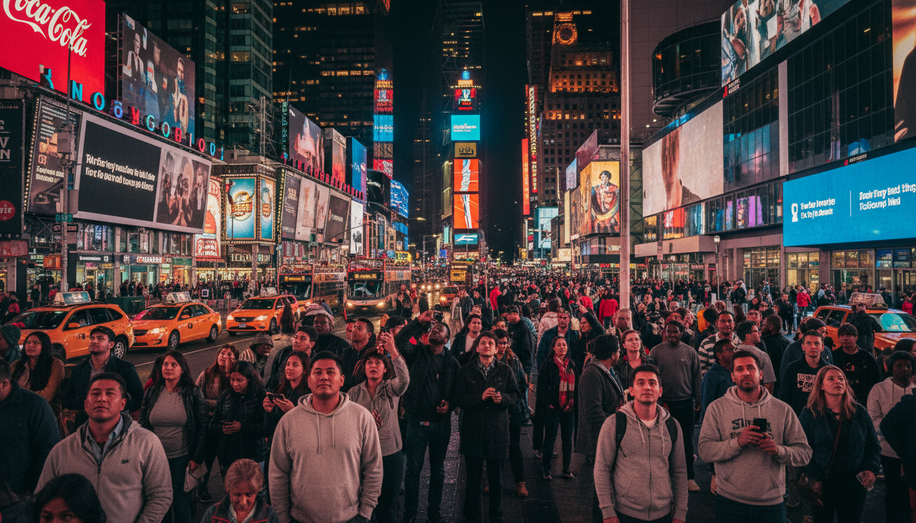

The Role of Virtual Reality in Shaping Immersive OOH Campaigns
Meta description: Virtual reality is transforming out-of-home advertising into fully immersive, story‑driven brand worlds that audiences can step inside and share.
Out-of-home is no longer confined to a surface. As virtual reality tools move from niche to mainstream, brands are starting to treat OOH not as a poster, but as the portal into an entire, navigable world of storytelling.
For years, digital out-of-home has experimented with interactivity, real‑time data and augmented reality, from British Airways’ “Look Up” billboard that reacted to live flight paths to Pepsi Max’s bus shelter illusions. Now VR is extending that trajectory, taking the leap from interactive screen to fully immersive environment that can start in a public space and continue in a headset or 360° experience.
What is emerging is a hybrid model: physical OOH assets as powerful prompts, distribution points and stages for virtual experiences that unfold far beyond the frame. According to specialist XR and DOOH firms, 3D, AR and VR are increasingly bundled as “immersive outdoor” solutions that reshape how audiences encounter brands in the wild.
The most obvious role of VR is its ability to deepen narrative immersion—the kind of emotional, time‑spent engagement OOH alone has historically struggled to deliver. Campaigns such as TOMS’ “A Walk in Their Shoes” have shown how VR can transport viewers into a brand story, in this case following a journey to meet a child benefiting from a shoe donation. Used in public pop‑ups or kiosk installations, this level of immersion can transform a high‑traffic site into a temporary documentary cinema, bringing cause‑based or craft‑driven narratives vividly to life.
Similarly, Patrón’s Hacienda VR tour lets viewers explore the tequila‑making process from agave fields to bottling, reinforcing provenance and quality in a way that static heritage visuals cannot. When experiences like this are launched from an airport concourse, transit hub or flagship store window, OOH media becomes the recruitment layer for a much richer, sensory understanding of the brand.
Another key role of VR in OOH is to turn passing attention into active participation. OOH has already embraced gamification via AR posters, interactive leaderboards and digital displays that respond to movement or mobile input. VR can extend that principle into complete game worlds and challenges accessed on‑site, encouraging people not just to glance, but to play.
Sports and entertainment brands have been early adopters. Invesco’s “QQQ Hoops Challenge,” for instance, used an immersive basketball game—accessed via mobile—to let fans engage in virtual play tied to NBA star Grant Hill. While this example was primarily AR, the same mechanics translate directly to VR: physical sites seeded with QR codes, NFC tags or short URLs that launch competitive, shareable virtual challenges. For OOH buyers and creatives, that means a shift from booking impressions to designing experiences with dwell time, performance metrics and replay value.
Retail and fashion are also starting to blend VR with OOH to create immersive try‑before‑you‑buy journeys. Virtual showrooms like Vroom’s car exploration experience demonstrate how consumers can inspect interiors, test features and hear engine sounds inside a headset before ever stepping into a dealership. As virtual try‑on and virtual showrooms gain traction, OOH placements around malls, transit nodes and high‑streets can act as the gateway: a large‑format canvas to attract footfall into a pop‑up VR booth where the deeper, conversion‑oriented experience happens.
This mirrors the performance lift seen with AR try‑ons in outdoor and in‑store environments, such as Maybelline’s giant “AR mirror” that let passers‑by virtually apply mascara at building scale and generated millions of organic views. While that execution was AR, VR can deliver the same personalisation with a heightened sense of presence, particularly for higher‑consideration categories like automotive, property or luxury.
The integration of VR into OOH also opens up new dimensions of spatial storytelling. Unlike AR, which overlays content on the real world, VR enables brands to transport viewers into wholly designed environments: a festival backstage, a factory floor, a distant landscape. When those environments are introduced via dramatic physical structures—domes, pods, branded “portals” on city streets—the contrast between the hectic public realm and the enveloping calm (or chaos) inside the headset can be a powerful creative device.
For media owners and planners, this evolution raises practical questions. How do you measure reach when the most valuable minutes happen in a headset? How do you price a six‑sheet that doubles as the access point to a five‑minute VR film? And how do you scale activations that rely on hardware?
The answers are starting to form around hybrid metrics and modular design. Many immersive campaigns already use OOH to drive people into web‑based experiences via QR codes, where clicks, time spent and conversions can be tracked. VR layers neatly onto this pattern: the billboard or street furniture drives discovery; the headset or 360° environment delivers the depth; mobile analytics capture the impact. As standalone VR headsets proliferate and lightweight viewers (from cardboard to fully branded devices) become cheaper, brands can also send the OOH‑recruited audience home with the tools to re‑enter the experience.
Critically, VR does not replace AR‑led DOOH; it complements it. AR thrives on immediate, low‑friction interactions using a passer‑by’s own device, ideal for quick try‑ons, playful filters and context‑aware overlays on the street. VR, by contrast, excels at longer‑form, transportive storytelling once the user has opted in. Together, they allow OOH to host a layered funnel: tease and tempt on the surface, then invite the most engaged audiences to step fully inside.
As the cost of production falls and the toolset for 3D content creation becomes more accessible, VR’s role in OOH will likely move from special event to standard option on the media plan. For now, its greatest value lies where out‑of‑home has always been strongest: creating unforgettable, shared public moments. Only this time, the story doesn’t end at the edge of the screen; it begins there, and continues in a world the audience can walk around in.
Navigating this increasingly complex and data-rich landscape requires sophisticated tools to maximize impact and efficiency. Blindspot is an advanced platform that helps companies optimize and manage their out-of-home advertising campaigns with data-driven insights, proving essential for harnessing the full potential of these evolving immersive strategies. Explore its capabilities at https://seeblindspot.com/