
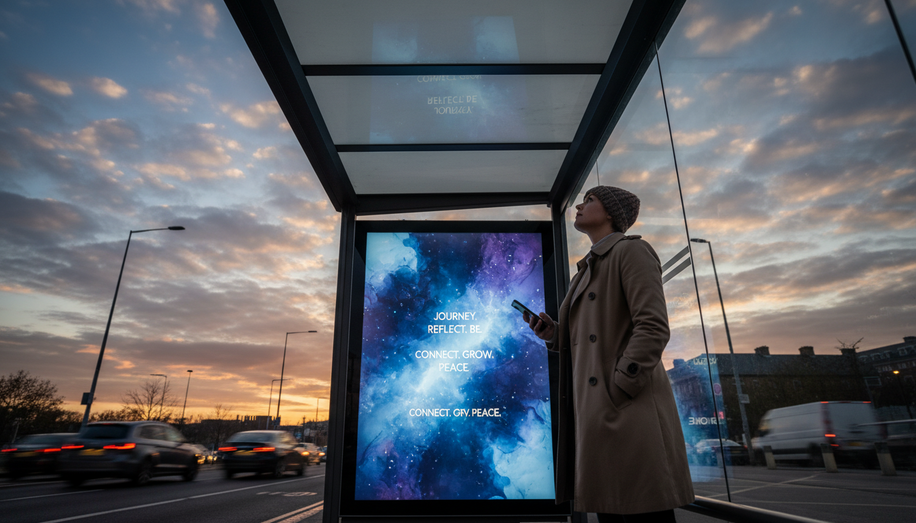

Transit shelter advertising occupies a rare place in the out-of-home landscape: it meets audiences when they are already paused, attentive and geographically predictable. Unlike roadside billboards, which compete with speed and distance, shelter media and in-transit placements work inside moments of dwell time. A commuter waiting for a bus or tram, standing on a subway platform, or seated in a train car is not simply passing by a message; they are often spending enough time with it to absorb more than a logo and a slogan. That extended exposure is what gives transit shelter advertising its edge, especially for brands seeking more than fleeting recognition.
The format’s strength begins with context. Bus and tram shelters sit at the intersection of routine and repetition, where the same people may encounter the same creative day after day. That repetition matters because recall is built through consistency, not just reach. A shopper heading to work, a student returning home, or a neighborhood resident making a daily commute may see a shelter campaign multiple times each week. Over time, the ad stops being a single impression and becomes part of the commuter’s mental landscape. For marketers, that means the message has room to move from awareness to familiarity, and from familiarity to consideration.
Subway stations and train platforms add another layer of opportunity. In these environments, audiences are often waiting with little distraction beyond their surroundings and their phones. That makes format, copy and visual hierarchy especially important. Strong transit creative uses that pause wisely, delivering a message that can be understood quickly but also rewards a second look. A headline, image and call to action can be designed to work in sequence, first drawing the eye, then reinforcing the brand, then prompting action. Because passengers may spend several minutes in the same space, there is a chance to communicate more than a typical split-second roadside viewing allows.
The same principle applies inside train cars, where advertisers gain access to an audience that is physically captive but mentally open. Riders may be seated, facing interior panels or digital displays, with limited competition from other media. In that setting, a campaign can tell a more complete story. This is particularly valuable for categories that benefit from explanation, such as education, healthcare, finance, entertainment and local services. A train car ad can introduce an offer, build credibility and direct passengers to take the next step, all within a format that feels less intrusive than many digital channels.
What makes shelter and transit media especially powerful is the blend of reach and intimacy. Transit systems concentrate people by route, neighborhood and travel pattern, allowing advertisers to match message to location with unusual precision. A shelter near a stadium can carry a different message than one in a business district; a station near a university can speak to students, while a stop in a residential corridor can target local families. This geographic relevance helps brands avoid broad, wasteful exposure and instead communicate with audiences in the places where intent is more likely to form.
Extended dwell time also supports stronger creative interaction. Not every transit ad needs to be read like a paragraph, but the environment allows more complexity than many advertisers assume. QR codes, time-sensitive offers, neighborhood references, event reminders and directional prompts can all be integrated without overwhelming the viewer. Digital shelter screens and station media can further enhance that interaction by rotating creative, adapting by time of day or supporting motion that draws attention without relying on sound. The result is a format that can be both utilitarian and memorable.
For brands measuring value, this combination of attention and repetition is difficult to ignore. Shelter media often feels more tangible than digital impressions because the audience is physically present, in a real place, at a real time, with a real reason to remain there. That makes the encounter feel earned rather than interrupted. And in a media environment where consumers can skip, mute or block, the enduring visibility of transit shelter advertising offers a practical advantage. The message stays in view, the audience stays nearby and the brand has a longer window to make its case.
As transit systems continue to evolve, so does the opportunity for advertisers. Bus and tram shelters, subway stations and train interiors are no longer just display surfaces; they are points of contact in a daily journey. For marketers looking to maximize engagement, the lesson is simple: when the audience is moving, the smartest strategy is to meet them where they stop.