
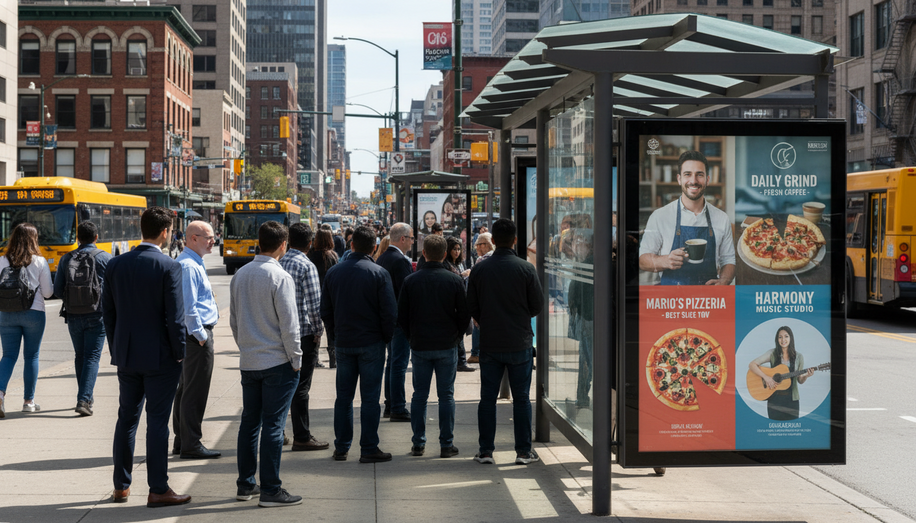

Transit Advertising: The Untapped Goldmine for Local Businesses
Meta description: Transit ads offer local businesses unmatched street-level reach, repetition and hyperlocal targeting. Here’s how to turn buses and trains into profit.
Transit advertising is having a quiet renaissance, but many local businesses still treat it as an afterthought. That hesitation is increasingly at odds with the data: transit media is expanding, highly visible, and built for the kind of hyperlocal targeting that neighborhood retailers, restaurants, clinics and service brands need most.
In an era of ad blockers and shrinking organic reach, buses, trains, shelters and benches are becoming one of the last places where people reliably notice commercial messages. Research cited by the Outdoor Advertising Association of America shows that about 90% of Americans notice some form of out‑of‑home (OOH) advertising in a given month. For transit specifically, Nielsen data indicates that 71% of riders say they look at transit ads “frequently” or “almost always.” In other words: if your message is there, people are likely to see it.
For local businesses, the advantage is not just reach, but geography. Transit advertising allows brands to follow the daily patterns of real people through real streets. Unlike a static billboard locked to one intersection, a wrapped bus can roll through multiple neighborhoods and business districts in a single day, building broad familiarity at a relatively low cost per impression. One media provider estimates that a single wrapped bus can generate more than 30,000 impressions daily in dense urban corridors.
At the same time, transit can be hyper‑specific. Local advertisers can select routes that pass their storefront, shelters in a particular ZIP code, or benches near schools, clinics or shopping centers. Agencies specializing in transit placements routinely plan schedules based on age, income and commuting patterns, using route maps and ridership data to align ads with the people most likely to buy. For a dental office targeting young families, that might mean school‑linked routes. For a neighborhood restaurant, it may be bus stops within a tight radius of lunchtime foot traffic.
The business case is strengthening as the category grows. U.S. transit advertising revenue reached around $1.4 billion in 2023 within a wider OOH market worth many billions more. Global forecasts project the transit segment climbing from roughly $25.3 billion in 2025 to over $35 billion by 2035. That growth is being driven heavily by advertisers seeking public‑space visibility as urban populations swell and commute patterns normalize.
Behind the numbers are real‑world results, including for very small, very local players. In Minnesota, funeral provider Fisher and Associates partnered with local transit authorities to run a modest, tightly targeted campaign on buses. The creative was straightforward, focusing on trust and pre‑planning services. Within weeks, the business saw an additional 25–30 website visitors per week directly correlated with the campaign. In the first month alone, one prospect contacted the firm specifically after seeing the ad to arrange their own cremation service—an unusually direct conversion for such a sensitive category. For a niche local service, a single contract of that kind can cover the cost of an entire campaign.
In another campaign described by Pearl Media, a series of branded trolleys carrying “eye‑catching graphics and compelling messages” across a growing urban market drove a clear lift in store traffic and online engagement for participating local brands. The moving vehicles effectively became roaming landmarks, repeatedly exposing residents to the same logos and offers as they moved between work, home and retail districts. That repetition—sometimes 10 or more encounters a week for regular riders—is a core strength of transit versus fleeting mobile impressions.
To unlock this “untapped goldmine,” local businesses need more than logo-on-a-bus thinking. The most effective campaigns start with a tight definition of audience and geography. Agencies advise mapping who you need to reach (by age, income, language, interests) and then overlaying that with how they move through the city: which lines they ride, what time of day, and where they board and exit. A yoga studio, for instance, might prioritize early-morning and after‑work routes feeding specific residential clusters, while a quick‑service restaurant would target lunchtime corridors and nearby shelters.
Creative also matters. Because dwell times vary—from seconds at a passing intersection to several minutes at a station—messages must be instantly legible yet memorable. The best local transit ads rely on bold visuals, minimal copy, a clear call‑to‑action and unmissable wayfinding: street name, nearest stop, website or QR code. A simple “3 minutes from this stop – Try our $9 lunch” with an arrow and appetizing image will usually outperform clever but vague branding for a neighborhood café.
Measurement, historically a weak spot for OOH, is catching up. Specialists now advise local advertisers to benchmark brand awareness before, during and after a transit campaign using short surveys or promos tied to specific routes. QR codes, vanity URLs and promo codes help attribute website visits, social follows or redemptions to transit exposure. On the back end, transit agencies provide data on vehicle counts, routes and average riders so advertisers can estimate impressions and calculate cost per thousand (CPM) against other channels. When compared with local TV, radio or paid social, transit frequently delivers a lower CPM and longer exposure windows for the same spend.
For small local businesses working with tight budgets, campaign duration may matter more than sheer volume. OOH specialists often recommend a minimum of three to six months for transit campaigns to fully exploit commuting repetition and build recall. A modest presence sustained over a quarter can outperform a short‑burst media blitz that disappears before it has time to embed in daily routines.
The broader advertising industry still treats transit as a niche line item—transit currently represents less than one‑half of one percent of total U.S. ad spending, according to a Transportation Research Board report. For local businesses, that underinvestment is the opportunity. Buses, trains and shelters remain comparatively uncluttered spaces where a single advertiser can stand out in a way that is now almost impossible on a phone screen.
For the bakery on the corner, the independent clinic, the new restaurant or the plumbing service that only serves three neighboring ZIP codes, transit advertising offers something rare in modern media: guaranteed presence in the real-world paths your customers actually travel. In a crowded digital landscape, that may be the most valuable goldmine left.