
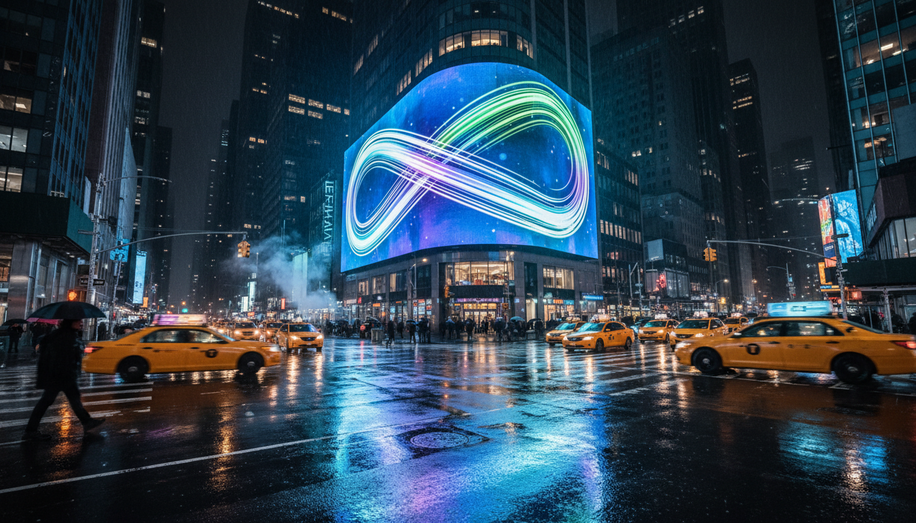

In an era where digital media fragments into endless echo chambers, out-of-home (OOH) advertising emerges as a potent force for piercing through the noise, delivering broad, unduplicated reach that digital platforms simply cannot match. Billboards, transit wraps, and street installations command attention from millions daily, unhindered by ad blockers or algorithmic silos, fostering widespread brand familiarity in ways that fragmented online feeds never could. As brands grapple with privacy regulations, declining trust in digital metrics, and saturated social channels, OOH’s resurgence—projected to hit $9.89 billion in 2026—signals a return to scalable, high-impact visibility that builds recognition across diverse audiences.
The digital landscape, once a promised land of precision targeting, has devolved into a fractured battlefield. Social feeds overflow with skipped ads, linear TV splinters under streaming competition, and nearly half of internet users deploy blockers that render billions in spend invisible. Privacy laws erode cookie-based tracking, while platform algorithms trap users in personalized bubbles, limiting exposure to like-minded echo chambers and starving brands of true mass awareness. OOH sidesteps these pitfalls entirely. Positioned in high-traffic arteries—highways, urban cores, retail hubs—it intercepts audiences in their physical world, where attention is undivided and exposure inevitable. A single billboard can register with thousands of commuters multiple times daily, imprinting the brand subconsciously through sheer repetition, a phenomenon rooted in the mere-exposure effect from cognitive psychology: familiarity breeds affinity.
This scale advantage manifests in unduplicated reach, a metric where OOH excels. Unlike digital, where overlapping audiences across apps and sites inflate duplicates, OOH blankets broad populations without redundancy, achieving efficiencies that digital fragmentation undermines. Industry data underscores this: OOH drives top-of-mind awareness by reinforcing messages in real-world contexts, from political campaigns gaining rapid geographic visibility to tourism boards sparking impulse visits. Marketers report consistent lifts in search traffic, site visits, and footfall post-exposure, with attribution models linking physical impressions to digital actions—proving OOH not only reaches but activates. In 2026, as programmatic DOOH spend surges into the billions, this integration sharpens further, enabling real-time, audience-first planning that measures dwell time, interactions, and downstream behaviors with retail first-party data.
Consider the science of perception at play. Human brains process visual cues from OOH at subconscious speeds—up to 13 milliseconds for initial recognition—bypassing the deliberate skips of digital scrolls. Repeated sightings amplify this, boosting brand stature: studies show OOH yields an 88% lift in premium perceptions, 41% in esteem, and 32% in fame, metrics that translate to long-term equity in competitive markets. Digital’s intimacy suits niche persuasion, but OOH’s mass imprinting builds the foundational familiarity essential for later conversion—a complementary dynamic where physical scale amplifies online performance. Campaigns blending OOH with CTV, mobile, and social extend narratives into tangible moments, bridging virtual exposure with real-world action like store traffic or event attendance.
Yet OOH’s power lies not just in reach but in its cultural authenticity amid digital fatigue. In a mistrustful environment scarred by data scandals and metric manipulation, OOH offers transparency: no hidden algorithms, no pay-for-play feeds—just unfiltered presence in public spaces. This reliability resonates with consumers weary of online intrusion, positioning OOH as a trusted medium for storytelling. Innovations like smart billboards with dynamic content and sustainable materials enhance this appeal, marrying environmental consciousness with measurable ROI, while urbanisation swells audiences in high-density zones. Retail media networks further entwine OOH, using in-store screens to tie impressions directly to purchases, outpacing digital’s vague proxies.
As 2026 unfolds, OOH redefines brand awareness not as a digital afterthought but as the anchor of omnichannel strategies. Its ability to cut through fragmentation—delivering unavoidable, broad-scale exposure—restores balance to media mixes dominated by elusive online metrics. Brands embracing this shift, from local players to global icons, harness OOH’s science-backed scale to forge enduring familiarity, proving that in a world of whispers, bold visibility still commands attention. Programmatic evolution and data sophistication ensure this growth endures, cementing OOH as the indispensable tool for recognition beyond the screen.