

The Role of Transit Advertising in Promoting Local Businesses
Meta description: Transit ads give small and mid-sized businesses cost-effective reach, hyperlocal targeting and daily visibility that drives awareness and community engagement.
Transit Advertising: The Local Marketer’s Best Kept Secret
For small and medium-sized businesses fighting for attention on crowded digital feeds, the side of a bus or the panel of a shelter may not sound like the obvious battleground. Yet transit advertising is fast becoming one of the most effective ways for local brands to stay visible, relevant and rooted in their communities.
Unlike static billboards, transit formats move with the audience. A single wrapped bus can generate tens of thousands of impressions per day as it passes through residential streets, business districts and retail corridors, placing local brands in front of people where they live, work and shop. For SMEs that cannot afford a patchwork of high-rent locations, that roaming footprint is a powerful equaliser.
Crucially, transit delivers what many media channels have lost: a captive, repeat audience. Commuters spend 45–60 minutes a day on public transport and often follow the same routes, seeing the same vehicles, shelters and station posters multiple times a week. That repetition underpins brand recall and makes modest budgets work harder for local players trying to build mental availability in specific neighbourhoods.
Cost is a defining advantage. Studies consistently place transit formats, particularly shelters, among the lowest-cost media options on a CPM basis, with some analyses putting transit shelter media around the US$2–3 per thousand impressions mark. For independent retailers, healthcare providers or local services, this means they can sustain month-long campaigns that generate millions of impressions at a fraction of the price of TV, print or broad digital display buys.
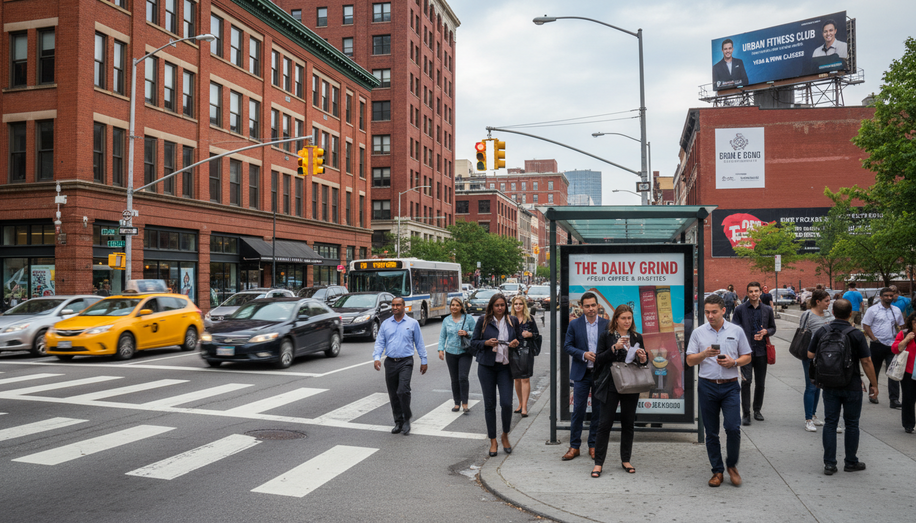
Just as important as scale is precision. Transit systems offer unusually granular geographic targeting. A business can focus spend on routes that pass its doorstep or on shelters in the exact zip codes it serves, effectively turning vehicles and street furniture into directional beacons for nearby residents. Local restaurants can dominate the stops around nightlife hubs; gyms can focus on morning commuter routes; clinics can select benches and shelters close to their catchment area, driving footfall from the people most likely to convert.
That hyperlocal capability extends beyond geography into culture and community. Creative can be tailored by neighbourhood, language and local priorities, with different messages running on different routes to reflect the character and needs of each area. Featuring community events, local landmarks or partnerships with nearby organisations helps brands feel embedded rather than intrusive, strengthening trust and loyalty.
For SMEs, the strategic question is not whether transit works, but how to deploy it for maximum visibility and engagement. The most effective campaigns typically combine three elements: clear targeting, disciplined creative and an integrated call to action.
Targeting starts with route and format selection. Retailers and hospitality brands often see the strongest results by “ring-fencing” the areas immediately surrounding their locations, running large-format vehicle exteriors for broad awareness and shelters or benches as reinforcement at key decision points. Service businesses with wider catchment areas – from legal practices to medical centres – may lean into longer routes that stitch together multiple suburbs, using interior cards and station posters to reach riders during dwell time.
On the creative side, simplicity wins. Transit ads must be legible at a glance and often from a distance. Bold branding, a short primary message and a clear location cue – street name, landmark or “2 minutes from this stop” – help tie the ad to the real-world environment. For community engagement, incorporating local imagery or references to neighbourhood initiatives can turn a generic promotion into a statement of belonging.
Digital integration is now non-negotiable. QR codes, short URLs and location-specific promo codes bridge the gap between the street and the smartphone, making it easier to attribute impact and retarget exposed audiences online. Case studies regularly show increases in web traffic, enquiries and in-store visits once transit campaigns go live, underlining their role as a top-of-funnel engine for local commerce.
Measurement has also become more sophisticated. Transit agencies provide data on vehicle ridership, route coverage and impressions, while digital displays and third-party tools can add real-time analytics on views and engagement. For small businesses, tracking simple metrics – store visits, voucher redemptions, incremental web sessions from geo-targeted areas – is often enough to prove value and refine placements over time.
Perhaps the most underappreciated role of transit advertising is its contribution to civic and commercial identity. Buses, trams, taxis and shelters are part of the shared streetscape; when they carry the names and stories of local businesses, they function as moving endorsements of the area’s economic life. For SMEs, appearing on those surfaces signals permanence and confidence, reinforcing the sense that they are part of the fabric of the neighbourhood, not just another interchangeable online listing.
In an era of ad-blockers, skipped prerolls and fragmented media consumption, transit advertising offers something refreshingly direct: unavoidable, real-world visibility in the exact places local businesses depend on. For small and medium-sized advertisers willing to think beyond the screen, the city itself is still the most powerful medium they have.