

Data Visualization: The New Language of Storytelling in Out-of-Home Advertising
Meta description: Data visualization transforms OOH campaigns from static displays into dynamic narratives, enabling brands to connect audience insights with compelling creative storytelling.
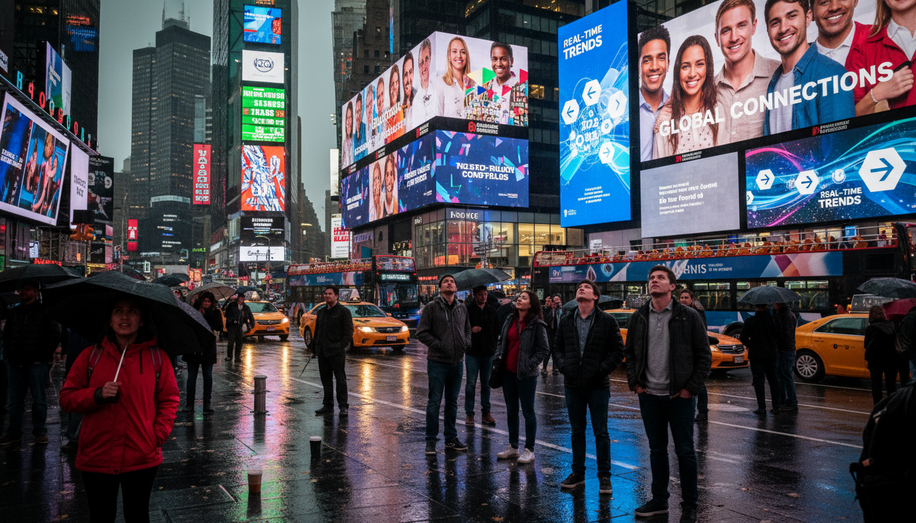
From billboards to digital panels, out-of-home advertising has entered a new era where data and creativity converge. Yet many brands still treat these two forces as separate entities—relegating data to the analytics dashboard while creative teams work in isolation. The most effective campaigns today bridge this divide by using data visualization as a design tool, transforming raw insights into visual stories that resonate with audiences in real time.
Data visualization in OOH advertising serves a dual purpose. First, it helps marketers understand their audiences with unprecedented clarity. Location intelligence and mobility analytics now reveal the tastes, preferences, and movement patterns of people who pass through specific points. By visualizing commuter flows, demographic overlays, and peak travel hours, brands can identify exactly where their target audience congregates and when they’re most receptive to messaging. This intelligence becomes the foundation for smarter creative decisions.
But visualization’s role extends far beyond the planning phase. The most innovative OOH campaigns now embed data storytelling directly into the creative itself. Rather than static headlines and images, brands are using heatmaps, real-time traffic graphics, and animated data patterns to capture attention and communicate meaning in seconds—the critical window before a commuter’s attention shifts. A fitness brand targeting health-conscious millennials, for example, might display live step-count data or proximity metrics showing distances to nearby gyms, turning the billboard into an interactive data experience.
The technology enabling this transformation is increasingly accessible. AI-powered cameras and geofencing technology now provide real-time impression counts and audience engagement metrics, allowing creative teams to see exactly how people interact with their designs. This feedback loop enables rapid iteration. A campaign that seemed effective in theory can be refined within days based on actual eye-tracking data and dwell-time metrics. Brands no longer guess; they optimize.
Consider the measurable outcomes. When data visualization informs both creative strategy and execution, results speak for themselves. Campaigns integrating geofencing with heatmap analytics have achieved 30 percent increases in store visits, while others have boosted brand recall by 40 percent. These aren’t marginal improvements—they represent the difference between a billboard that’s merely seen and one that drives action.
The creative implications are equally profound. Data visualization challenges designers to distill complex audience insights into memorable visual forms. Rather than relying solely on emotional appeals or traditional imagery, OOH creatives can now incorporate authentic audience data—visualized in ways that feel fresh and relevant. A real estate developer promoting suburban growth might showcase actual commute-flow visualizations on I-75, proving through data that thousands of drivers already match their target profile. The data becomes the story.
Integration amplifies impact further. By merging OOH data with digital campaigns, brands create sequential messaging that reinforces impact. A viewer who sees a data-rich billboard can later encounter retargeted ads on their phone—the same visual language continuing the conversation. This cross-channel synergy, powered by shared data visualization approaches, significantly increases both reach and ROI.
Looking forward, the convergence of data and creative design will only deepen. As attribution modeling and mobile geofencing become standard, brands will have even richer feedback on which visual storytelling approaches drive conversions. Machine learning will identify patterns in audience responses, suggesting optimal color palettes, typography choices, and data graphic styles for specific demographics and locations.
The brands winning in OOH advertising aren’t choosing between art and science—they’re choosing integration. They’re recognizing that data visualization isn’t a corporate overlay on creative work; it’s a creative language itself. By treating audience insights, real-time metrics, and visual design as interconnected elements, brands craft campaigns that are simultaneously intelligent, beautiful, and measurably effective. In an advertising landscape increasingly skeptical of hollow claims, data-driven visual storytelling offers something rare: proof and poetry combined.