
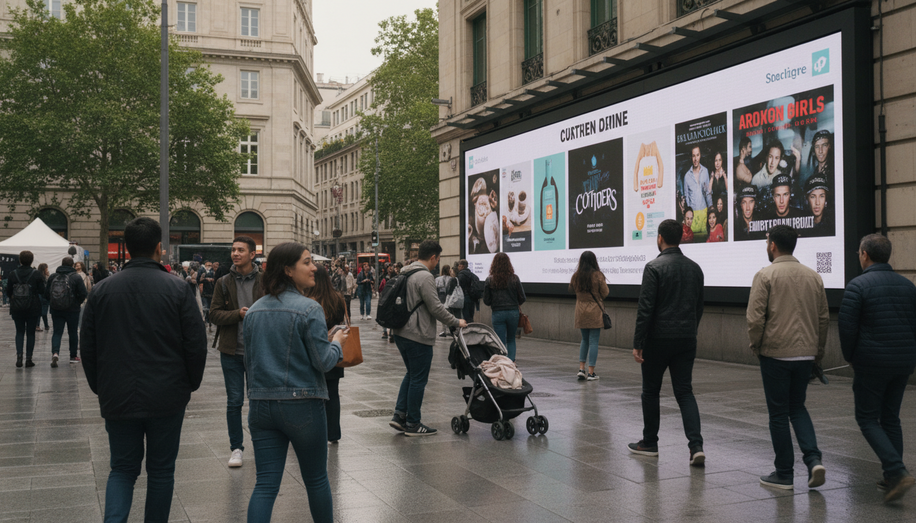

In the evolving landscape of advertising, out-of-home (OOH) campaigns have long relied on prime locations and eye-catching visuals to capture fleeting moments of consumer attention. Yet, as digital sophistication infiltrates traditional media, behavioral targeting emerges as a game-changer, infusing OOH with data-driven precision that makes messages not just visible, but profoundly relevant. By leveraging location data, weather patterns, mobility trends, and real-time consumer behaviors, advertisers can transform static billboards into dynamic conversations, boosting engagement, recall, and conversions in ways previously unimaginable.
At its core, behavioral targeting in OOH analyzes how people move through the world—tracking commute routes, shopping habits, app usage, and even proximity to competitors—to deliver tailored content at the optimal moment. This shift from broad-spectrum blasts to personalized encounters mirrors the success of online behavioral advertising, where studies show targeted ads command twice the price and effectiveness of generic ones. In OOH, the application is particularly potent because it marries physical presence with digital agility. Neuroscience backs this: consumers grant OOH 2.5 times more awareness than digital ads, with digital out-of-home (DOOH) variants generating 63% longer gaze times and 47% more visual fixations than static displays. When layered with behavioral insights, these metrics amplify, turning passive passersby into active responders.
Consider Burger King’s audacious 2019 “Whopper Detour” campaign, a masterclass in location-based behavioral targeting. Geofences encircled 14,000 McDonald’s outlets nationwide, triggering custom messages on digital billboards and the Burger King app only when users neared a rival site. A 1-cent Whopper deal unlocked via the app, complete with directions to the nearest Burger King, cleverly hijacked competitor foot traffic. The result? Significant surges in restaurant visits and sales, earning a Grand Prix at Cannes Lions. Fernando Machado, then Burger King’s global CMO, hailed it as proof that location technology could convert traditional OOH into a “powerful conversion tool.” This wasn’t luck; it was behavioral data spotting opportunity in real-time movement patterns.
Guinness took a subtler tack with its weather-responsive billboards, adjusting messages to local conditions—urging pints on rainy days or sunny outings—to drive pub traffic. Expedia embedded QR codes in airport billboards for traveler-specific vacation deals, sparking high engagement from jet-lagged audiences primed for escape. Betterment targeted urban professionals in financial districts, yielding spikes in brand recognition, app downloads, and account sign-ups; one billboard crushed campaign averages, prompting an extension. These cases illustrate a pattern: behavioral targeting elevates OOH from awareness-builder to action-driver, with proximity campaigns alone boosting store visits by over 1.3 million in some instances.
Programmatic DOOH supercharges this further, enabling real-time bidding and optimization based on traffic, weather, and consumer signals. Unlike online ads plagued by banner blindness, OOH thrives in distraction-free environments—traffic jams, transit waits—where dwell time fosters deeper engagement. Eye-tracking confirms it: elevator ads snag 100% attention in confined spaces. Brand recall hits 47%, outpacing digital’s 35%, as physical contexts cement memories. A five-year Clear Channel-Kantar study even equated OOH’s favorability and purchase intent to TV, at lower cost. Behavioral layers compound this: interactive elements like QR codes yield 45% higher recall and triple social shares versus static ads. Cross-channel synergy—pairing OOH with digital—delivers 2-3 times engagement.
Critics might question invasiveness, but evidence suggests receptivity when done right. Behavioral targeting shines when unobtrusive, aligning with consumer context rather than disrupting it. OOH’s unblockable nature—immune to ad blockers or bots—ensures 85% of viewers deem ads useful, extending reach into mobile and social spheres. Pearl Media notes contextual relevance fosters affinity, while advanced metrics like geolocation and brand lift surveys quantify ROI.
Looking ahead, as DOOH proliferates, behavioral targeting will redefine OOH as an integrated powerhouse. Australia’s Outdoor Media Association found digital signs pack 63% more punch than traditional ones in seconds-long glances. For brands, the imperative is clear: harness data to meet consumers where their behaviors lead, crafting campaigns that feel serendipitous yet surgically precise. In a fragmented media world, this fusion doesn’t just enhance OOH—it reasserts its dominance, proving relevance trumps reach every time.