
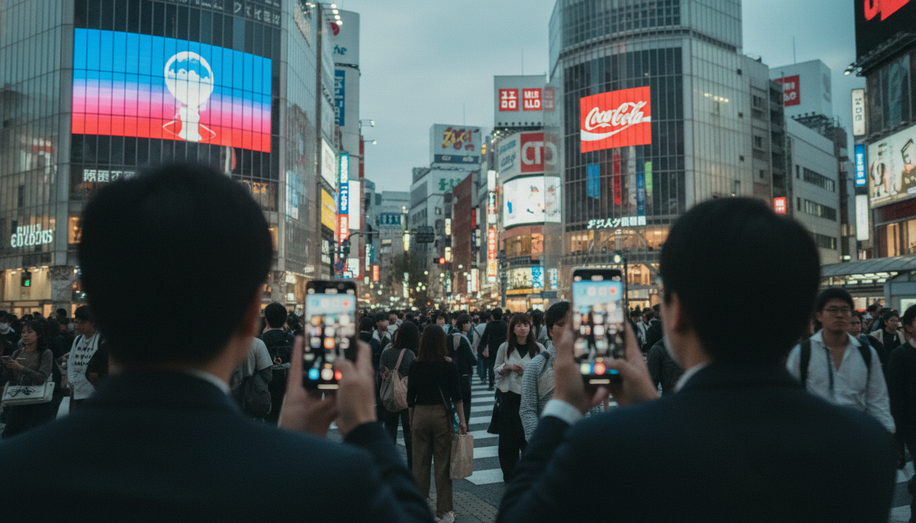

The Rise of Augmented Reality in Digital Out-of-Home: How AR Billboards Are Reshaping OOH Advertising
Meta description: Augmented reality in digital out-of-home is redefining billboards with interactive, data-rich experiences that lift engagement, recall and ROI.
Augmented reality in digital out-of-home advertising is moving from experiment to mainstream strategy. Brands are grafting AR layers onto digital billboards, murals and street furniture to turn fleeting glances into multi-minute interactions. For an industry built on reach and repetition, the promise is simple: fewer passive impressions, more active participation.
The shift is measurable. Research from BrandXR and others indicates AR ad experiences boost engagement by 35–40%, with interaction times climbing from seconds to more than a minute. That performance is drawing serious attention from global brands, media owners and city authorities looking to modernise public spaces.
From static impressions to interactive canvases
Digital OOH has already introduced motion, dynamic content and programmatic trading. AR is the next layer, using smartphones and, increasingly, wearables to overlay 3D content and utilities on top of large-format screens and murals. Consumers scan a site or tap a prompt and unlock games, product demos or location-specific stories that live in the same physical frame as the ad.
AR billboards are particularly effective in high-dwell environments such as transit hubs, shopping districts and festivals, where people have time to participate. Instead of a single creative loop, brands can offer branching experiences, from product customisation to mini-games and social filters, all anchored to one OOH placement.
Case studies that set the pace
Recent campaigns show how quickly AR has evolved from stunt to structured media tactic. BrandXR cites an AR mural for a major festival sponsor that generated more than 108,000 filter uses in four days, with average interaction time of 31 seconds and social sharing from 73% of users. The earned media value was estimated at $847,000, delivering a 4:1 return on the initial investment.
Another AR mural project for a financial services partner of Inter Miami CF delivered over 5.7 million social impressions, average engagement of 76 seconds and a 34% lift in local brand awareness. The physical artwork created a landmark, while the AR layer unlocked exclusive content and offers, tying brand discovery to real-world footfall.
Verizon’s Miami AR murals, triggered via Snapchat and built with local artists, underline the cultural potential of the format. According to campaign reports, the project delivered more than 650,000 plays while driving traffic to nearby stores and reinforcing Verizon’s local credentials. For media buyers, these examples position AR-enabled OOH not as a novelty, but as a repeatable playbook.
Why AR is rising on OOH media plans
Several forces are pushing AR to the top of OOH innovation agendas. First, consumers are primed. They already use AR lenses and filters on social platforms, so scanning a billboard or mural is a familiar behaviour rather than a technical leap. Second, smartphones and 5G networks can now handle real-time 3D rendering, making experiences smoother and less dependent on native apps.
Third, AR finally gives OOH the interaction data marketers have long wanted. AR billboards can log unique users, dwell time, feature usage, store locator taps and even downstream actions such as coupon redemptions. That feedback loop brings OOH closer to digital channels in terms of optimisation and attribution, without sacrificing the mass visibility that billboards still deliver.
Market-wise, AR-enabled formats are becoming part of standard OOH packages. Industry commentary suggests media owners are bundling AR extensions with premium digital sites, positioning them as engagement layers on top of traditional reach buys. As creative and production costs fall via templated tools, AR becomes viable beyond flagship brand campaigns.
Challenges and the path to scale
Despite momentum, AR in OOH still faces friction. Discovery remains an issue: many campaigns rely on QR codes or app-based triggers, which demand a clear value exchange to justify the extra step. Location-based triggers via social platforms help, but they also place experience design partly in the hands of walled gardens.
Creative quality is another constraint. Poorly executed 3D or thin experiences can feel gimmicky and undermine brand perception. Successful campaigns invest in narrative and utility, not just spectacle, often blending local culture, art and practical information such as wayfinding or product details. That demands closer collaboration between media agencies, experiential specialists and AR studios.
Measurement approaches are also uneven. While some campaigns report detailed interaction and ROI figures, many still default to soft metrics such as PR reach or anecdotal buzz. Standardised benchmarks for AR OOH performance will be essential if planners are to compare it fairly with other formats in the mix.
What it means for the future of OOH
Despite these hurdles, the direction of travel is clear. As AR toolsets mature and case studies accumulate, augmented reality in digital out-of-home is moving toward a regular line item on media plans rather than a one-off experiment. For brands, the format bridges the gap between broadcast-scale visibility and personalised digital interaction.
For the OOH industry, AR is less about replacing traditional billboards and more about revaluing them. A site that can host a persistent, data-rich AR layer becomes a hybrid asset: part media space, part interactive canvas, part social content engine. That shift could support premium pricing, deeper partnerships with brands and new commercial models with cities and venue owners.
The next phase will test how well AR can scale beyond hero activations into always-on, contextually driven experiences that sit quietly in the background until needed. If that happens, augmented reality may not just be an add-on to digital billboards, but a core expectation of what out-of-home advertising looks like in an interactive city.