
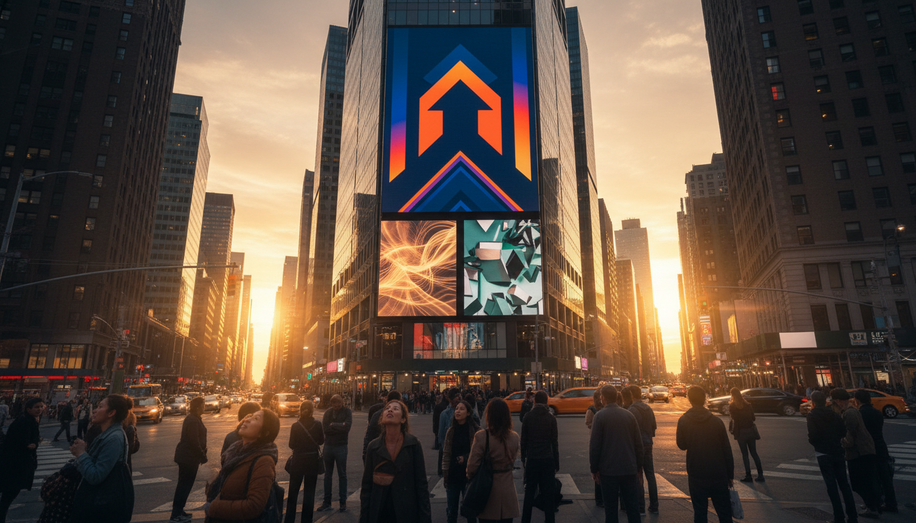

In the split-second glance afforded by a passing commuter or driver, out-of-home (OOH) advertising must seize attention and imprint a message before it vanishes. Visual hierarchy, the deliberate orchestration of design elements like size, placement, contrast, and spacing, exploits innate psychological cues to direct the eye precisely where advertisers intend, ensuring fleeting exposures yield lasting recall.
This principle operates on the brain’s rapid processing of visuals, which outpaces text comprehension by a factor of 60,000 to 1, relying on subconscious signals to prioritize information. Larger elements register as dominant first; a supersized logo or headline towers over finer details, mimicking how humans perceive scale in the physical world as an indicator of importance. In OOH contexts, where viewers scan billboards at speeds up to 60 mph, this size-based cue is paramount. A campaign for a new energy drink might amplify the product image to billboard-scale, dwarfing taglines and fine print, compelling the eye to anchor there amid urban clutter.
Strategic placement leverages entrenched viewing patterns, particularly the Z or F scan paths prevalent in Western cultures, where eyes sweep from top-left to top-right, then diagonally down to bottom-left before trailing rightward. OOH designers position core messages along this trajectory: headlines command the upper left, where fixation first lands, followed by imagery or calls-to-action (CTAs) in the mid-right zone. Eye-tracking studies confirm these paths hold even under motion; defying them scatters attention, but alignment creates an intuitive flow, guiding viewers from intrigue to action without cognitive friction.
Contrast, beyond mere color, sharpens focus through shape, texture, and value differences, creating focal points that pop against subdued backgrounds. A stark white CTA button amid muted grays demands notice, as the brain instinctively seeks high-contrast anomalies for survival-honed threat detection repurposed for commerce. In OOH, this manifests in bold sans-serif fonts slicing through hazy twilight or rainy glare, or irregular geometric shapes breaking the monotony of rectangular panels. Research underscores that such contrasts not only capture but sustain gaze, boosting message retention by organizing perception into a clear sequence: notice, process, remember.
Proximity and alignment further refine this hierarchy by forging visual relationships that reduce mental load. Elements clustered closely signal affiliation—a product shot nestled near its benefit claim implies connection, easing comprehension in under seven seconds, the average billboard dwell time. Alignment imparts order; left-aligned text mirrors reading habits, fostering trust and scannability, while misaligned chaos evokes confusion. Whitespace, often underutilized in dense OOH formats, acts as a magnifier, encircling key assets to amplify isolation and priority. Ample negative space around a luxury watch on a vast digital billboard conveys exclusivity, its void drawing the eye like a spotlight and lowering cognitive strain for better encoding into memory.
These tools converge to induce “mind motion,” a directed visual path that propels attention from hook to persuasion. Consider a transit ad: an oversized, high-contrast image in the top-left Z-prime pulls focus, proximate text below elaborates via aligned lines, whitespace funnels to a bottom-right QR code. This engineered journey aligns with Gestalt principles of perception, where the whole emerges greater than parts, compelling viewers to follow subconsciously.
Yet OOH’s unique constraints—distance, speed, environmental noise—amplify hierarchy’s stakes. Poor execution risks invisibility; a 2013 study on advertising design found that unprioritized posters fail to deliver messages, as viewers’ eyes default to irrelevancies. Successful campaigns, like those from global brands, master this by testing via heat maps, confirming size and contrast drive 80% of initial fixations. Emerging digital OOH adds dynamism, with sequential reveals enhancing flow, but static principles endure.
Ultimately, visual hierarchy transforms passive passersby into engaged prospects by mirroring neural wiring. In an era of information overload, OOH thrives not on volume but precision: direct the glance, deliver the message, and etch it into fleeting minds. Designers who wield size, placement, contrast, proximity, alignment, and whitespace as psychological levers don’t just advertise—they command attention, turning seconds into sales.