
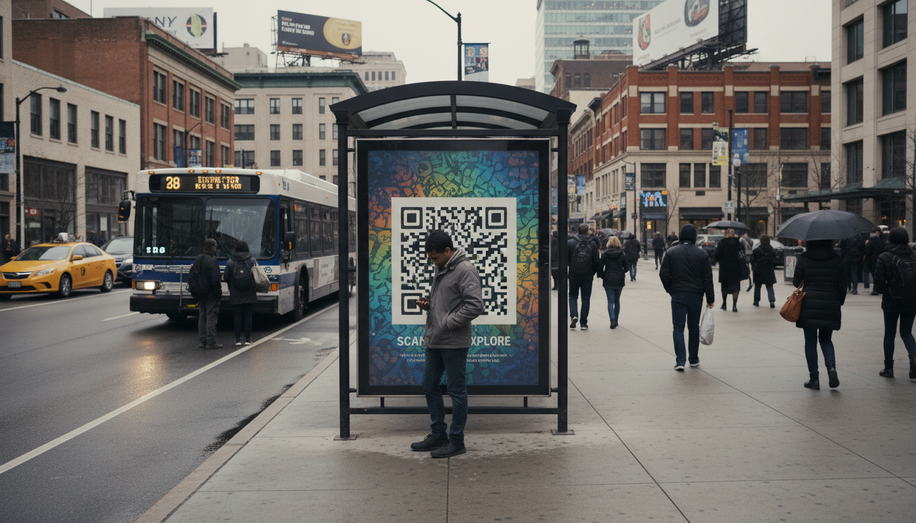

In the fast-paced world of out-of-home (OOH) advertising, where impressions flash by in seconds, QR codes have emerged as a powerful bridge between static billboards and dynamic digital interactions. Once dismissed as a fleeting novelty, these scannable squares now empower advertisers to transform passive viewers into active participants, driving measurable engagement that extends far beyond the physical ad space. By simply pointing a smartphone camera, consumers unlock exclusive content, discounts, or videos, seamlessly merging offline exposure with online action and reshaping campaign outcomes.
This integration addresses a longstanding challenge in OOH: the difficulty of quantifying impact in environments dominated by fleeting glances. Traditional billboards and posters deliver one-way messages, but QR codes introduce two-way communication, allowing brands to track scans in real time. Each interaction records user identifiers, timestamps, locations, and even device types, providing granular data on who engages, when, and how. For instance, dynamic QR codes—those that can be updated remotely without altering the ad itself—enable advertisers to refine landing pages or offers mid-campaign, optimizing performance based on live feedback. In programmatic digital out-of-home (DOOH), this data maps directly to audience segments, weather, or time of day, facilitating hyper-relevant adjustments that boost relevance and results.
Real-world campaigns illustrate this potential vividly. Boehringer Ingelheim’s Frontpro Antiparasitic launch in Spain paired static and digital OOH creatives with dynamic QR codes across key cities, yielding a 254% increase in positive brand perception through instant audience interactions. Retailers have similarly succeeded by embedding codes in window displays or bus shelter ads, directing passersby to virtual tours or flash sales that spike foot traffic and conversions. Over 70% of smartphone users have scanned a QR code in the past year, and 49% of OOH viewers research advertisers post-exposure—facts that underscore how these tools capitalize on mobile ubiquity to amplify awareness and loyalty.
Beyond metrics, QR codes foster deeper emotional connections. They turn mundane ads into gateways for personalized experiences: a bus stop poster offering an exclusive discount, a street-level panel linking to an immersive video, or an urban kiosk inviting event RSVPs. This interactivity counters the brevity of OOH—limited screen time on DOOH or quick drives past billboards—by demanding immediate action that aligns with campaign goals. Brands appear tech-savvy and customer-centric, rewarding scanners with value that builds recall and repeat engagement.
Placement proves critical for success. Pedestrian-heavy formats like bus shelters, urban panels, sidewalk kiosks, and storefronts excel, where viewers can pause, steady their phones, and scan comfortably. Airport trays or newsstands also offer captive audiences with optimal proximity. Conversely, high-speed contexts pose hurdles: scanning from 50 feet away at 60 mph on a highway billboard is impractical, as is rapid programmatic DOOH rotations that afford only 10-15 seconds. Lighting, angles, weather, and size further influence efficacy, demanding thoughtful design to ensure accessibility.
Critics argue QR codes falter in motion-heavy or distant scenarios, labeling them “mostly ineffective” for certain OOH inventory. Yet this overlooks their strength in targeted, static applications, where adoption has surged alongside smartphone cameras’ default QR readers. Studies affirm their role in lowering entry barriers for real-time, on-the-move marketing, shifting from one-way broadcasts to interactive dialogues. When paired with unique codes per placement, they pinpoint high-performing channels, reallocating budgets efficiently.
Looking ahead, QR codes herald a hybrid era for OOH, where physical presence fuels digital journeys. They not only measure exposure but also cultivate buyer intent, with scans often leading straight to purchases or sign-ups. For advertisers, the imperative is strategic deployment: prioritize dynamic variants for flexibility, educate consumers via clear calls-to-action, and analyze data iteratively. In doing so, OOH evolves from visual spectacle to engagement engine, proving that a simple scan can unlock exponential returns in an increasingly connected world.
This evolution towards interactive, data-driven OOH campaigns underscores the need for robust measurement and optimization tools. Platforms like Blindspot empower advertisers to precisely track real-time campaign performance and audience engagement from QR code interactions, providing invaluable location intelligence for strategic site selection and enabling dynamic adjustments within programmatic DOOH. By connecting offline exposure to online action, Blindspot facilitates comprehensive ROI measurement, ensuring every scan translates into actionable insights and optimized outcomes for a truly connected advertising experience. Learn more at https://seeblindspot.com/