
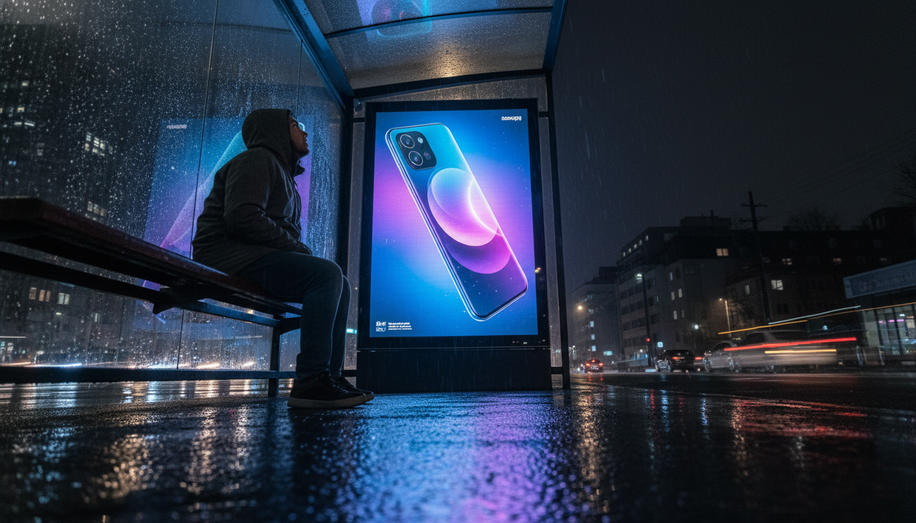

In an era where every screen is saturated and every feed is fighting for attention, the offline world has become one of the most powerful stages for a new product launch. Out-of-home (OOH) advertising, long seen as a broad awareness channel, is increasingly the backbone of launch strategies that need to cut through noise, build real anticipation, and convert curiosity into demand.
The strength of OOH begins with its physical presence. A looming billboard on a commuter route or a full-motion digital screen in a transit hub doesn’t ask consumers to click, scroll, or opt in. It simply exists in their daily path, unavoidable and ever-present. For brands introducing something new, that “always on” visibility is critical. In the early awareness phase, the goal is not complex persuasion; it’s to plant a simple, memorable idea: something new is coming, and it matters.
Teaser campaigns are where OOH often shines brightest. Sparse creative, a striking visual, perhaps just a product silhouette and a launch date can generate intrigue precisely because there is no immediate link to more information. The scarcity of detail feels intentional and cinematic. In contrast to digital, where audiences are trained to expect instant answers, OOH can slow the reveal, allowing anticipation to build over days or weeks as people repeatedly encounter the same message on their commute, in their neighborhood, or near their workplace. That repetition reinforces mental availability, ensuring the new product is top of mind before anyone has even seen the full proposition.
When the reveal moment arrives, OOH’s impact scales quickly. Large-format billboards, transit wraps, and spectaculars turn a launch into a public event, signaling that this is not just another SKU on the shelf but a major brand milestone. In key product categories—beverages, personal care, dining, technology—this sense of occasion is vital. A new drink flavor feels more exciting when it dominates a city block. A new restaurant concept feels more desirable when its bold visuals greet people right outside competing venues. OOH situates new products in the real contexts where decisions are made.
The channel’s ability to drive action is no longer just assumed; it is increasingly measurable. Studies conducted with the OAAA and others show that a significant majority of digital OOH viewers report taking follow-up actions, from visiting websites and nearby stores to making purchases or sharing information. For launches, that means OOH can do more than introduce a name—it can move people to the next step, whether that’s trying a sample, scanning a code, or seeking the product in-store.
Modern OOH formats deepen that connection by bridging offline and online experiences. Digital out-of-home (DOOH) and programmatic DOOH allow brands to adapt creative in real time, sync messages with other media, and integrate interactive elements. A launch campaign can invite passersby to scan a QR code for an early-access offer, use NFC for instant app downloads, or trigger augmented reality experiences that let people virtually “try” a product. The physical scale of OOH draws the eye; the interactive layer channels that attention directly into measurable engagement.
Location strategy is a decisive factor in making launches succeed. OOH’s strength is not just in reach, but in being visible at the right moments. A new beverage promoted on panels near grocery stores and convenience outlets is top of mind at the shelf. A personal care product advertised around gyms and high streets becomes part of the daily routine it aims to serve. Real estate launches use OOH near prospective neighborhoods to capture interest when people are literally exploring new areas. By aligning placements with likely purchase occasions, brands shorten the path from awareness to intent.
OOH is rarely working alone. In effective launch ecosystems, it often sets the stage while digital channels deliver precision. A consumer first encounters a striking billboard for a new product, then later sees retargeted display or social ads that echo the same visuals and tagline. This synergy is particularly powerful: the offline sighting gives substance and familiarity to online impressions, and the online elements provide the detail and direct response mechanisms that OOH intentionally keeps simple. The result is a coherent story that follows the consumer from street to screen to store.
Simplicity is another reason OOH is pivotal at launch. In a crowded market, complicated messages are forgotten. OOH’s creative constraints—limited copy, bold imagery—force clarity about what makes this product worth noticing. Is it a radical new feature, a provocative flavor, a price point, or a lifestyle promise? The discipline of condensing that into a few words and an image produces sharper positioning that can then cascade into other media.
For marketers under pressure to demonstrate performance, OOH’s role in launches is becoming easier to justify. DOOH impressions can be measured, footfall near panels can be analyzed, and campaign exposure can be linked to online behavior and sales lift. Brands are already using geofencing and mobile data to track how exposed audiences behave differently from control groups, turning what was once considered a “branding-only” tactic into a demonstrably effective driver of demand.
Ultimately, launching a product is about more than awareness metrics. It’s about creating a sense that something new has arrived and is part of the cultural conversation. OOH does this in a way no other channel can, by making the product visible in shared public spaces where people live, work, and gather. It turns launches into part of the urban and suburban landscape—a countdown on a digital screen, a wrap on a tram, a mural on a side street that becomes a backdrop for photos.
As the digital world grows more fragmented and ads become easier to skip, the physical impact of OOH is gaining, not losing, relevance. For new product releases fighting for attention, OOH is not just a supporting act. It is the stage, the spotlight, and often the first encounter that transforms an unknown product into something people recognize, talk about, and ultimately buy.