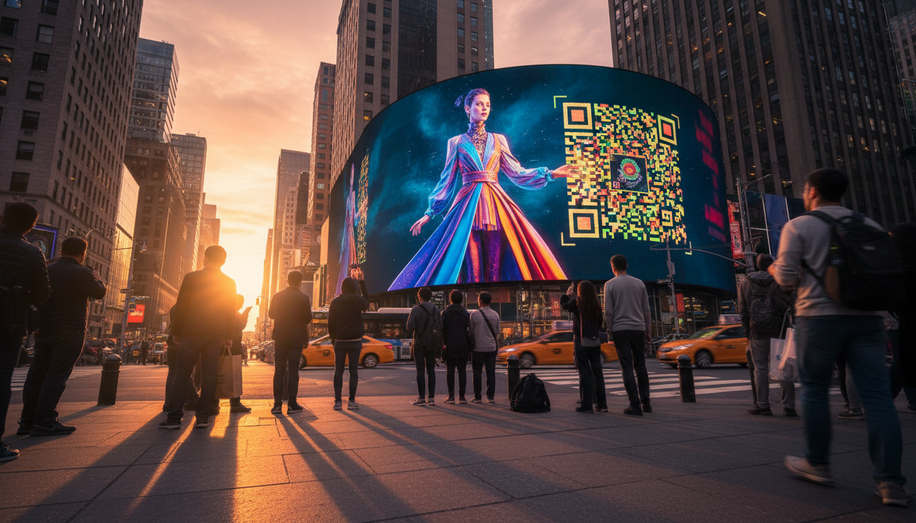
Out-of-home advertising has fundamentally transformed from a one-directional broadcast medium into a dynamic bridge between physical and digital worlds. At the heart of this evolution lies a critical technological convergence: QR codes, NFC technology, and augmented reality are dismantling the traditional barriers between what consumers see on the street and what they can do online, creating what industry leaders now call the “phygital frontier.” This shift represents far more than technological novelty—it addresses advertising’s most persistent challenge: measuring offline impact and converting fleeting glances into measurable business outcomes. For decades, outdoor advertising operated in isolation from digital marketing. A billboard could reach millions, but advertisers had no way to track whether those impressions translated into engagement or sales. Today, that disconnect is dissolving. A commuter passing a transit billboard can now scan a QR code and instantly access a promotional offer, watch product content, or enter a contest—each action tracked in real time with precise attribution to the specific billboard location and moment of interaction. This simple yet powerful mechanism transforms static surfaces into conversion points, extending the reach of outdoor campaigns into the digital sphere where measurable outcomes reside. QR codes have emerged as the practical workhorse of interactive outdoor advertising, requiring nothing more than a smartphone camera and a moment of curiosity. Their ubiquity stems from elegant simplicity: no apps, no downloads, no technological barriers. Brands like Pepsi Max have leveraged this accessibility to remarkable effect, converting London bus stops into augmented reality portals where QR prompts overlaid “unbelievable” scenarios onto real streetscapes, spiking social buzz and foot traffic. The mechanics are straightforward, yet the results are profound. High-traffic zones consistently achieve engagement rates exceeding 10 to 20 percent, with brands reporting conversion metrics that directly link billboard exposure to online behavior and sales lifts of up to 25 percent near retail points. NFC technology elevates this interactivity further by eliminating the friction inherent in QR scanning. Rather than requiring deliberate framing and visual focus, NFC-enabled billboards allow consumers to tap their smartphones against the advertisement surface to trigger actions seamlessly. This touchless proximity feels almost magical to audiences accustomed to contactless payments and mobile interactions, proving particularly effective in crowded environments like transit hubs where dwell times are elevated. A striking example from Women’s Aid demonstrated this power: an interactive billboard featuring a bruised face that faded upon approach, paired with NFC prompts urging viewers to engage with domestic violence awareness content, generated thousands of engagements in days. Conversion rates for NFC interactions can hit 30 percent higher than QR codes in proximity scenarios, as the technology leverages always-on smartphone capabilities without requiring visual targeting. The convergence of these technologies enables something unprecedented in outdoor advertising: hyper-local, real-time personalization that mirrors the sophistication of digital advertising while maintaining the emotional resonance and scale unique to physical spaces. Programmatic DOOH platforms now trigger context-specific messages based on weather, traffic flow, nearby events, and audience demographics. A coffee brand’s billboard can promote iced beverages on hot days and warm drinks during cold weather, simultaneously inviting consumers to scan a code for location-specific ordering and pickup. Rain-X synchronized rain-triggered displays with NFC product locators beside retailers, converting weather conditions into foot traffic and measurable store visits. Augmented reality represents the next frontier, building on QR and NFC foundations to create immersive experiences that blur the line between physical and digital entirely. Rather than directing consumers to a separate digital experience, AR overlays interactive digital content directly onto the real world, transforming the billboard itself into a portal. This evolution democratizes interactivity for budget-conscious campaigns—traditional billboards gain NFC stickers for minimal cost, while digital screens rotate prompts dynamically based on real-time data. The phygital frontier fundamentally redefines outdoor advertising’s value proposition. By combining the immediate reach and creative impact of physical billboards with the precision, interactivity, and measurability of digital channels, brands can now forge genuine, quantifiable connections with audiences at moments that genuinely matter. In an era where every marketing dollar demands accountability, interactive outdoor advertising has transcended its traditional role as a brand awareness medium to become a sophisticated, data-driven conversion channel that bridges the gap between seeing and doing.
The Phygital Frontier: Bridging Online and Offline with QR Codes and AR in OOH