
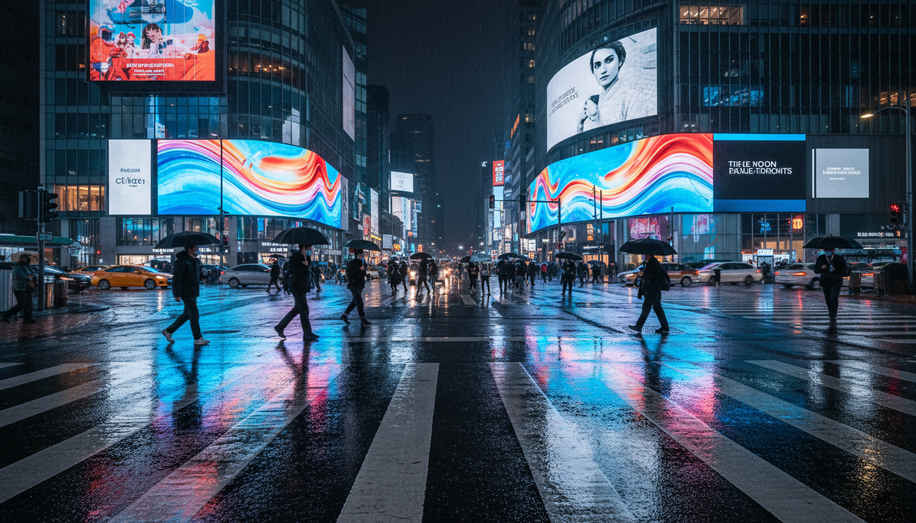

The urban advertising landscape has undergone a fundamental transformation since the pandemic reshaped how cities function and how people move through them. Out-of-home advertising, once dismissed as a relic of an earlier media era, has emerged as a critical pillar of modern marketing strategy, precisely because it addresses the fractures that have widened in the digital advertising ecosystem.
The pandemic accelerated a crisis of trust in digital channels. Social feeds became oversaturated, linear television fragmented further, and the metrics advertisers relied upon to measure performance grew increasingly unreliable. Simultaneously, privacy regulations tightened, and third-party cookies began their final exit from the advertising infrastructure. In this environment, brands discovered something unexpected: billboards work. They are unskippable, unblockable, and they do not depend on the consent of platforms or the integrity of data brokers. For cities rebuilding foot traffic and consumer confidence, outdoor advertising provided a channel that reached people without friction or mistrust.
The strategic shift toward OOH reflects deeper changes in urban behavior and consumer psychology. The pandemic forced a reckoning with how people inhabit public space. Transit patterns changed. Workplace configurations evolved. Consumer priorities shifted toward experiences and authenticity. Outdoor advertising adapted accordingly. Brands recognized that the physical environments where people congregate—airports, transit hubs, street-level retail zones—offered something digital channels could not: the ability to reach audiences in moments of genuine attention and openness.
What distinguishes 2026’s OOH renaissance from previous iterations is the sophistication of execution. The industry has moved decisively toward data-driven strategies that integrate creative boldness with measurable outcomes. Programmatic digital out-of-home (DOOH) now dominates large-format networks, enabling brands to deploy location-aware campaigns that respond to real-world variables like weather, time of day, or passenger flow patterns. This represents a fundamental shift from static to smart media. Outdoor displays are no longer passive billboards; they are responsive platforms that adapt messaging based on audience demographics, dwell time, and contextual relevance.
Interactive and immersive formats have become the frontier of creative expression in outdoor spaces. Holographic displays and 3D anamorphic installations at high-traffic locations like airports create what industry professionals call a “stop-and-stare” effect—moments that generate organic engagement and social media amplification. These formats serve a crucial function in post-pandemic cities: they create shared cultural moments in public space at a time when fragmentation dominates other media channels. When consumers encounter a striking outdoor installation, they experience it collectively with strangers, reinforcing the sense of shared urban life that the pandemic had interrupted.
The sustainability imperative has also reshaped OOH strategy. Brands and municipalities increasingly prioritize energy-efficient LED and OLED screens, solar-powered signage, and recyclable display structures. This shift reflects genuine changes in consumer values and regulatory requirements, particularly in cities implementing green mandates. Sustainability has transitioned from marketing language to a concrete buying criterion that influences both creative development and media planning decisions.
Perhaps most significantly, OOH has proven its value as an amplification engine within omnichannel strategies. When combined with digital touchpoints, outdoor campaigns consistently demonstrate higher engagement rates and measurable downstream effects on foot traffic and website visits. The channel no longer competes with digital; it complements and strengthens it. A consumer who encounters a brand on a transit billboard is more likely to search for that brand online, visit a retail location, or engage with social media content. This multiplier effect has driven meaningful budget reallocation toward outdoor media.
As cities continue to recover and evolve, outdoor advertising stands at an inflection point. The question is no longer whether OOH belongs in the media mix. Instead, brands must determine how aggressively they will leverage the channel’s unique capabilities. For cities themselves, OOH represents an opportunity to activate public spaces as platforms for cultural expression and commercial communication simultaneously. In the post-pandemic urban landscape, outdoor advertising has become not a nostalgic holdover, but an essential tool for reaching audiences with clarity, presence, and reliability.
To aggressively leverage these unique capabilities and ensure clarity, presence, and reliability, platforms like Blindspot provide essential tools. Through programmatic DOOH campaign management, coupled with advanced audience measurement and precise ROI attribution, Blindspot empowers brands to deploy data-driven OOH strategies that drive measurable impact in the revitalized urban landscape. Explore how at https://seeblindspot.com/.