

The Intersection of Fashion and OOH Advertising: From Catwalks to Billboards
How fashion brands are using spectacular, tech-led OOH during fashion weeks and beyond to turn catwalk buzz into always‑on, city‑scale visibility.
From Front Row to Street-Level Spectacle
Fashion has always been about visibility, but the arena for that attention has shifted far beyond the runway. Out-of-home (OOH) advertising is now a primary stage where brands debut collections, make cultural statements and extend the life of fashion moments long after the models have left the catwalk. According to specialist media analysts, 2025 has seen an unprecedented convergence of luxury fashion, high-street labels and OOH innovation, with brands using billboards, building wraps and large‑scale stunts to create city‑wide “fashion shows” that double as social‑first content engines.
Times Square as the new front row
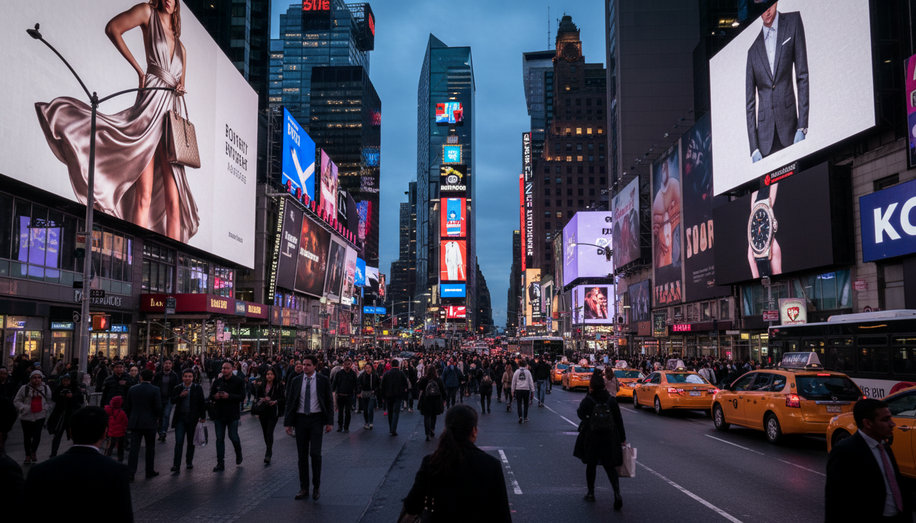
High‑impact fashion activations in places like Times Square illustrate how OOH has become an extension of the catwalk. Shapewear and swimwear label Skims, for instance, dominated the Midtown skyline with a 60‑foot Kim Kardashian sculpture to launch a new swimwear range, turning an already crowded media environment into a single‑brand takeover. The oversized figure became a magnet for selfies, news stories and social commentary, proving that OOH can deliver both reach and controversy—two currencies the fashion industry understands well.
Media strategists point out that these fashion OOH “drops” increasingly mirror the choreography of runway shows: tight embargoes, surprise reveals, celebrity presence and timed social amplification. In practice, a billboard unveiling now functions like a digital runway finale, designed as much for TikTok and Instagram as for pedestrians on the ground.
Fashion weeks go phygital
During the big four fashion weeks, brands increasingly use OOH to knit together *physical* events and *digital* audiences. Digital spectaculars and 3D or anamorphic billboards allow labels to project looks and brand worlds across entire districts, giving them visibility that rivals the official show schedule. For emerging designers priced out of marquee venues, a single striking building wrap or digital screen near a key venue can deliver the kind of presence that once required a tent at the Tuileries.
Media buyers say this shift is changing how OOH is briefed and bought. Rather than treating it as a late‑stage awareness layer, leading fashion brands are building OOH into their core fashion‑week planning, alongside runway production and influencer seeding. The question is no longer “Do we have a billboard?” but “What’s our city‑scale moment?”
From billboards to immersive runway universes
The most forward‑thinking campaigns treat OOH as an experiential space rather than a flat media buy. H&M’s use of Times Square’s digital billboards as both backdrop and broadcast platform for a surprise Charli XCX performance is frequently cited as a template: OOH became a live event platform, blurring the line between concert, fashion drop and urban spectacle. The stunt generated heavy social sharing and measurable footfall to a nearby flagship, proving that billboard spend can be tied directly to retail impact.
Other brands are experimenting with mixed‑reality and FOOH (fake OOH) executions that mimic the scale of real outdoor but are designed natively for social feeds. BOSS’s London activation, where a red double‑decker bus appeared to unveil a giant Fernando Alonso helmet outside Selfridges, fused motorsport energy with luxury fashion codes and delivered the sort of jaw‑dropping visual that thrives on TikTok. Mango’s campaign that turned a store window into a virtual, water‑filled pool around Victoria Beckham–styled mannequins similarly used an OOH canvas to create a surreal, premium fashion moment.
These stunts may be digitally composited, but they borrow heavily from traditional OOH logic: bold forms, immediate legibility and strong interaction with their urban setting. For media owners, they are also a proof‑of‑concept for future physical builds, where AR layers and digital takeovers can turn standard sites into fashion playgrounds.
OOH as brand world, not just product shot
Fashion’s adoption of OOH is also changing the creative vocabulary of the medium. Instead of simple product‑plus‑logo layouts, brands are using large‑format sites to tell more cinematic stories that align with broader positioning work. Columbia Sportswear’s “Engineered for Whatever” platform, while rooted in performance apparel rather than runway fashion, shows how apparel brands can use OOH to dramatise personality and attitude, not just features. The campaign’s roll‑out strategy explicitly puts out‑of-home at the centre, alongside social and retail activations, to convey a playful, irreverent brand voice in oversized outdoor scenarios.
Luxury houses are adopting a similar approach, using billboards and digital spectaculars to extend the worlds they build in campaign films and runway sets—often with the same talent and creative teams. The OOH creative becomes another chapter in an ongoing narrative, rather than a cut‑down of print or film assets.
From moments to always‑on visibility
Historically, fashion’s relationship with OOH was cyclical, peaking around seasonal drops and major shows. That rhythm is giving way to a more always‑on presence, particularly for brands targeting younger, urban audiences. Media planners note that fashion advertisers are now booking digital OOH in bursts that align with capsule drops, collaborations and influencer‑led moments, using programmatic tools to flex creative by neighbourhood, time of day or even live social trends.
This model suits an industry defined by perpetual novelty. Anamorphic 3D displays, AR‑enabled posters and data‑triggered content allow brands to keep re‑styling the same sites throughout a season, turning a standard location into an evolving “lookbook in public”. For fashion marketers under pressure to justify spend, the ability to connect OOH plays with footfall, search spikes and online sell‑outs is accelerating investment, especially in key fashion capitals.
The next season for fashion x OOH
As OOH technology matures, the line between runway, retail and public space will continue to blur. Expect more fashion brands to treat city centres as extended show venues, with synchronized screens, live‑streamed presentations, AR try‑ons and data‑driven storytelling all playing out on the street. For the OOH sector, fashion’s appetite for drama, speed and cultural relevance is a tailwind—pushing the medium toward bigger ideas, smarter targeting and ever more photogenic executions that live as powerfully online as they do in the real world.