

The Impact of Urbanization on Out-of-Home Advertising Strategies
How rapid urban growth, smart-city tech and shifting commuter habits are reshaping OOH planning, formats and creative.
Out-of-home is being rewritten by the city itself. As global urbanization accelerates and megacities densify, OOH is shifting from static backdrop to responsive media layer woven into the urban fabric, powered by data, connectivity and new patterns of movement.
Cities are growing taller, denser and more digital, concentrating audiences but fragmenting attention. That is forcing advertisers and media owners to rethink everything from formats and locations to measurement and creative. Urban space has become both the canvas and the data engine for a new generation of OOH.
Densification is the first big driver. More people living and working in compact cores means higher impressions per site, but also heavier visual noise. In response, planners are trading pure size for *context*: sightlines at key junctions, adjacency to transit choke points and proximity to retail or entertainment clusters now matter as much as raw traffic counts. Street furniture, transit hubs and retail environments are being revalued as precision “micro-stages” where brands can intercept specific urban tribes.
At the same time, urban mobility patterns are diversifying. Traditional car commutes are giving way to multimodal journeys built around metro, buses, ride-hailing, cycling and walking. That shift is redistributing attention from highway spectaculars to networks of smaller, highly targeted assets across transit systems, sidewalks and mixed-use districts. For brands, it is less about owning one skyline-defining site and more about orchestrating a journey—sequential messages that follow commuters from platform to escalator to street corner.
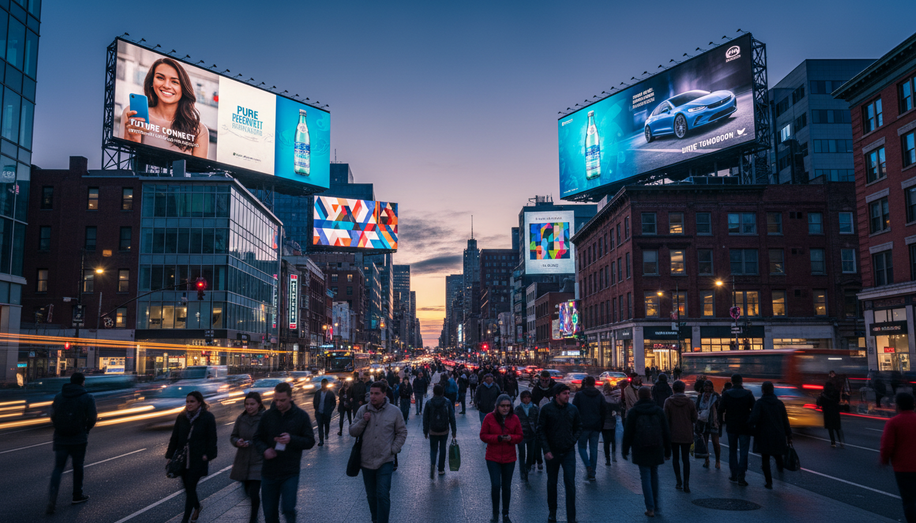
This new urban OOH is increasingly digital. Digital out-of-home (DOOH) is one of the fastest‑growing segments of the sector, driven by dynamic content capabilities and programmatic buying. In dense downtowns, digital screens allow advertisers to rotate multiple brands, respond to real-time conditions and tailor messages by time of day, audience profile or even weather. Smart scheduling means a coffee brand can dominate morning rush hour, while a streaming platform takes over evenings, optimising both yield for media owners and relevance for passersby.
The rise of smart-city infrastructure is accelerating this evolution. Connected sensors, traffic systems and public Wi‑Fi are generating granular data on flows, dwell times and behaviors. OOH specialists are tapping into these feeds—often via anonymized mobile data—to refine planning and attribution. Programmatic OOH platforms now use AI and real-time data to automate buying based on triggers such as congestion levels, temperature or event calendars, turning the city into a dynamic decision engine for campaigns. According to industry analyses, this kind of data‑driven targeting is significantly improving campaign effectiveness in urban environments.
For creative, urbanization is raising the bar. Shrinking attention spans and hyper-stimulating streets mean messages must be instantly legible, emotionally resonant and visually bold. In crowded downtown corridors, short-form video, high‑contrast design and tight copy are no longer nice-to-haves but survival tactics. Digital networks are enabling dayparted storytelling—snackable sequences that unfold over multiple exposures rather than a single static image.
The smartphone is the critical bridge between physical city and digital life. Urban audiences navigate by phone, fill dead time in transit with social feeds and are comfortable scanning codes in public spaces. OOH campaigns are exploiting that behavior by integrating QR codes, NFC tags and app prompts into street-level and transit formats. A metro platform screen can hand off to an AR try‑on experience; a bus shelter ad can trigger a mobile discount; a large-format banner can invite social participation, extending reach far beyond the immediate streetscape.
Experiential and interactive installations are also flourishing in high-footfall urban areas. Brands are using augmented reality, live data visualizations and immersive street activations to cut through the urban “smog” of competing messages. From AR-enabled murals to responsive façades that react to movement or weather, these experiences turn city dwellers from passive viewers into participants, generating earned media and social amplification.
Urbanization is also forcing the industry to confront sustainability. As cities push stricter environmental standards, OOH owners are adopting LED and solar-powered structures, eco-friendly inks and recyclable materials. Smart cities with aggressive climate agendas are favoring installations that contribute to urban goals—such as shelters with green roofs, solar‑powered charging kiosks or air‑purifying billboards—aligning brand visibility with civic benefit. For advertisers courting eco-conscious urban consumers, sustainable OOH is becoming both a reputational asset and, increasingly, a license to operate.
Crucially, the metrics are catching up with the medium. In big cities, where accountability is under intense scrutiny, OOH’s integration with mobile location data is enabling more robust measurement of reach, frequency and store visits. Studies of billboard and transit campaigns in metropolitan areas point to measurable lifts in awareness, footfall and sales when OOH is planned as part of an omnichannel system rather than a standalone tactic. That proof of performance is helping OOH defend and grow its share of urban media budgets even as digital competition intensifies.
The net result is a structural shift in how out-of-home is conceived and sold in cities. Instead of static real estate, it is being treated as a flexible, data-rich layer of the smart city—responsive, measurable and deeply entwined with mobile and social behaviors. For advertisers and agencies, succeeding in this environment means planning OOH not just *in* cities, but *with* cities: reading their flows, tapping their data, respecting their sustainability goals and designing creative built for the ceaseless pulse of urban life.