
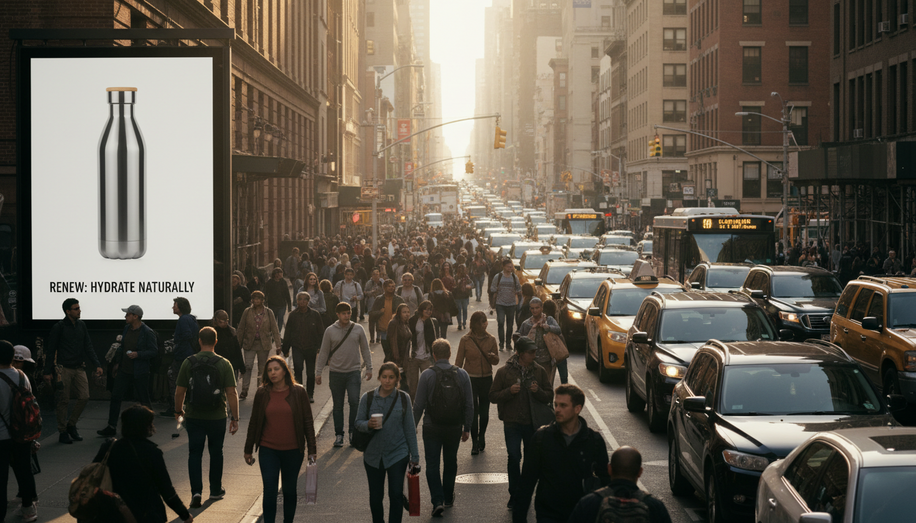

On a crowded city street, where digital screens flicker and storefronts compete with traffic signage, the quietest message can sometimes be the one that speaks loudest. Minimalist design in out-of-home (OOH) advertising has shifted from niche aesthetic to mainstream strategy, as brands discover that stripping away can be the fastest way to stand out.
The logic is rooted in the reality of how people move through public space. Commuters hurtle past billboards at highway speeds or glance up from their phones on platforms for only a few fleeting seconds. In that window, a complex visual story simply cannot be decoded. Minimalist OOH responds by prioritizing instant legibility: one idea, a handful of words at most, and a clear focal point. Agencies increasingly work to refine messaging so even the simplest execution can be grasped at a glance while still carrying emotional or functional weight.
Psychology is doing a lot of the heavy lifting here. In an environment saturated with information, audiences are gravitating toward cleaner, visually decluttered spaces. The mental fatigue of constant digital stimulation makes overdesigned ads feel not just ignorable but intrusive. Minimalist executions, by contrast, can function almost as a visual palate cleanser. Neutral palettes, abundant negative space and a single bold element naturally draw the eye because they *break* the pattern of visual noise rather than adding to it.
This simplicity does more than capture attention; it supports comprehension and recall. Research and industry practice both suggest that viewers have roughly 5-8 seconds to absorb a roadside billboard. Designs that focus on one key message—often seven words or fewer—are easier to process and remember. Agencies report that drivers may actually spend more of those seconds engaging with a simple, well-crafted billboard than a busier one, precisely because there is so little to decode. That quick, complete read-through translates into stronger brand recall and a clearer association between visual, message and advertiser.
Some of the strongest case studies in recent years have leaned into this stripped-back approach. Apple’s “Shot on iPhone” work—essentially a single striking image and a spare line of copy—has become a global shorthand for minimalist OOH effectiveness, using scale and craft instead of dense messaging to convey product quality. McDonald’s “Follow the Arches” campaign, which reduced its golden arches to cropped directional shapes, proved that a brand can guide drivers without a single line of copy. These executions use what minimalism does best: trust that a strong, singular idea will carry the communication.
Minimalist design also performs well in specific OOH environments such as metro systems. In transit hubs, passengers are in motion, often distracted and time-poor. Simple, uncluttered creative not only respects that context but can align with the architecture and flow of the space. Rather than dominating platforms with loud visuals and dense text, minimalist posters and station takeovers integrate with their surroundings, conveying a sense of sophistication and calm. That subtlety can foster a perception that the brand “belongs” in the environment, rather than feeling like an interruption.
Beyond brand image, minimalism offers practical advantages. Clean layouts with fewer elements retain clarity at multiple sizes and aspect ratios, making them easier to adapt across static billboards, digital OOH, street furniture and social assets without losing impact. Production costs can be lower when the creative relies on a small set of high-quality visuals and typography rather than complex compositions. The aesthetic is also in step with broader digital design trends, allowing campaigns to feel consistent from the roadside to the mobile screen.
The key, however, is that minimalist does not mean generic. The most effective OOH work in this space is not simply “less,” but precisely less: each word, color and shape is doing visible work. High-contrast visuals help messages pop at distance. One persuasive call to action—often as simple as a QR code or a sharp tagline—can be more powerful than a list of benefits, because it directs attention instead of dividing it. Bold colors and typography can coexist with minimal layouts, using contrast and scale to ensure the message is visible even in poor conditions or at oblique angles.
For media owners and brands, the implication is clear. As OOH inventory becomes ever more visually congested—particularly in dense urban corridors—minimalist design is emerging not just as an aesthetic preference but as a strategic advantage. In a landscape where everyone is shouting, the ad that dares to whisper can be the one people actually hear.