
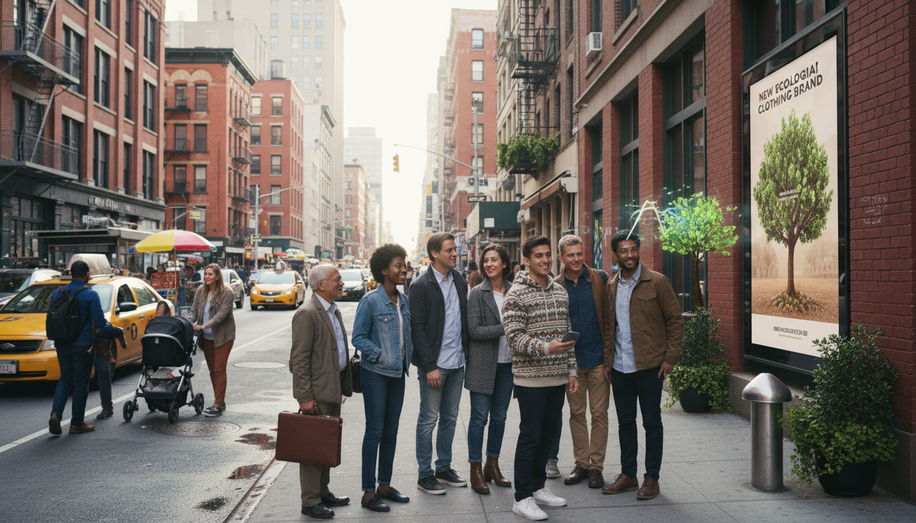

On a busy street corner, a crowd gathers around what looks like an ordinary bus shelter. Through their phones, though, a portal opens: fantastical creatures spill from the poster, products come to life, or a cause unfolds as an emotional, personalized story. This is the new frontier of out-of-home advertising, where augmented reality turns static media into interactive stages.
For an industry built on reach and repetition, AR is changing the very definition of attention. OOH has long been a one‑way medium: brands talk, audiences pass by. By layering digital content over physical structures, AR invites people to *participate* rather than simply notice. Using nothing more than a smartphone camera and a QR code or visual marker, a billboard becomes a game, a mural becomes a narrative, and a poster becomes a shoppable screen.
The business rationale is clear: interaction drives dwell time, recall and data. Rock Paper Reality, an AR studio specializing in OOH, reports that brands are increasingly fusing traditional billboards and posters with AR content specifically to increase dwell times, strengthen brand retention and extract richer behavioral analytics. AR platforms can now track how many users engaged, how long they stayed, what they tapped and whether they converted—metrics that have historically been a challenge for classic OOH.
Some of the most compelling examples show how AR can create emotional impact as well as novelty. A UK National Health Service campaign, for instance, used AR to let people “virtually” donate blood to a patient on a digital billboard. After downloading an app, users saw a virtual needle appear on their arm and watched as the empty blood bag on the screen filled up and the patient visibly recovered. The message—your donation changes lives—was no longer a line of copy; it was something the passerby could enact. The technology served the story, not the other way around.
Retail and CPG brands are also experimenting with AR-enhanced OOH that blends spectacle with clear commercial outcomes. BON V!V Spiked Seltzer ran a WebAR campaign in Los Angeles and San Diego that turned printed murals into interactive retail experiences. Scanning a QR code allowed users to place a full 3D virtual vending machine in front of them, browse flavors and watch their chosen can dispense in an animated sequence. From there, they could tap through to a map of the nearest store or purchase online, directly connecting an eye‑catching OOH placement to measurable sales.
Burger King took a more mischievous route, using competitors’ billboards as fuel for its “Burn That Ad” campaign. App users could point their phones at rival burger chains’ posters and watch them erupt in virtual flames, revealing a Burger King ad and a free Whopper coupon. It was a masterclass in using AR to hijack attention in the real world while driving app downloads and in‑store traffic—1 million downloads in a month and a 56.4% increase in in‑app sales, according to campaign reports.
Telecoms, unsurprisingly, see AR OOH as a showcase for their networks. Verizon’s recent series of AR murals in Miami, launched during Art Basel, turned entire building facades into living brand canvases. Using their phones, viewers could unlock 3D animations: futuristic cityscapes lighting up in Midtown, digital vines wrapping neon circuitry in Coconut Grove, and portraits in Hialeah morphing into futuristic visuals that symbolized connectivity. The campaign sat at the intersection of public art, technology demo and social content engine, with visitors posting videos of the murals’ transformations and amplifying the media buy far beyond the physical walls.
These campaigns point to a broader shift: OOH spaces are becoming programmable, updateable and context-aware. With WebAR, many experiences now run in the browser, eliminating app‑download friction and lowering the barrier to entry. Spatial computing advances mean almost any surface—shop windows, transit shelters, park installations—can serve as a trigger for AR content. As 5G and edge computing roll out, more complex, real-time experiences will be possible without long load times or clunky UX.
For media owners and agencies, AR layers new value on familiar inventory. A classic 48‑sheet can now be sold with an interactive extension; a mural can be renewed, not repainted. Campaigns can be refreshed remotely by swapping out digital assets tied to a marker or QR code, extending the life and relevance of the physical placement. Dynamic creative optimization—already common in online advertising—starts to become feasible on the street, with different AR content served by time of day, location or audience segment.
The data dimension is equally significant. AR OOH lets brands monitor engagement in ways that static posters never could: number of scans, length of sessions, completion rates for mini‑games or story sequences, click‑throughs to store locators or ecommerce. Those insights can flow back into both OOH planning and broader marketing strategies, informing which creative concepts, formats or locations justify further investment.
Of course, AR in the wild is not without challenges. Experiences have to justify the effort of scanning: gimmicky overlays quickly lose their charm. Creative needs to be intuitive enough for someone in motion, on a sidewalk or platform, to understand and use in seconds. Accessibility and inclusivity are considerations too; not everyone will have the latest handset or unlimited data. And measurement methodologies are still evolving, with no single industry standard yet for evaluating AR OOH alongside impressions and reach.
Still, the trajectory is hard to ignore. As audiences grow more adept at filtering out traditional ads, AR offers OOH a way to be not just seen, but sought out. The most successful executions are those that treat public space as a canvas for shared experiences—playful, useful or emotionally resonant—rather than as a surface to be filled with another logo.
In that sense, augmented reality is not replacing out-of-home so much as revealing what it can become: a medium where the physical and digital collaborate, where a poster is an entry point, not an endpoint, and where a fleeting glance can turn into a memorable interaction that lives far beyond the street.