
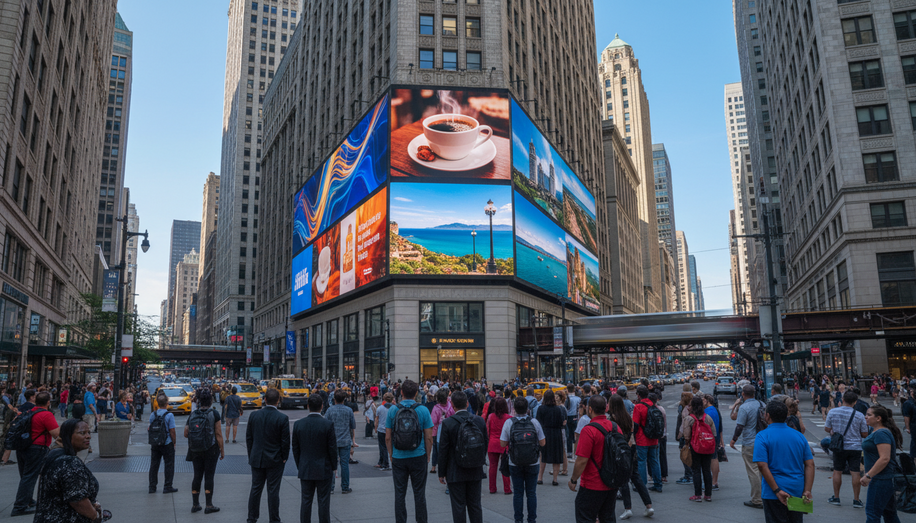

Digital out-of-home advertising is undergoing a profound transformation as 2026 unfolds, marked by the convergence of immersive display technologies, artificial intelligence, and real-time audience engagement strategies. Static billboards are rapidly becoming obsolete, replaced by sophisticated systems that blur the line between physical and digital experiences, fundamentally reshaping how brands capture attention in crowded urban environments.
The most striking visual innovation gaining traction is the rise of holographic and three-dimensional anamorphic displays that create optical illusions and motion graphics capable of stopping pedestrians in their tracks. These technologies transcend traditional flat visuals by crafting storytelling that extends beyond the screen itself, turning advertisements into shareable moments that amplify organically across social platforms like TikTok and Instagram. High-impact activations from major brands including McDonald’s, Maybelline, and Nike demonstrate the viral potential of these immersive formats, which leverage perspective and digital depth to generate unprecedented brand recall. As pixel costs continue to decline, mainstream adoption is surging in premium locations such as EV charging stations, airports, and sports venues, where high-intent consumers encounter these interactive portals during their daily journeys.
Complementing these visual advances is the explosive growth of programmatic digital out-of-home (DOOH) buying, which is positioning itself as the dominant purchasing model for 2026. This data-driven approach enables advertisers to deploy dynamic three-dimensional content in real-time across citywide digital networks, synchronized with granular audience data including dwell time, demographics, weather conditions, and live events. The result is hyper-relevant messaging that adapts instantaneously to the environment, allowing a single billboard to promote sunscreen on sunny days while highlighting delivery options during evening commute hours. This level of responsiveness transforms billboards from static fixtures into intelligent marketing instruments.
Artificial intelligence serves as the creative engine powering much of this transformation. AI tools analyze real-time conditions to automatically adjust billboard messaging for maximum relevance, swapping visuals, updating calls to action, and modifying promotions based on audience behavior. Rather than replacing human creativity, AI functions as a powerful partner, enabling faster content production, smarter scheduling, and data-driven optimization that ensures outdoor media remains strategically aligned with consumer intent. However, industry experts caution that technology alone cannot compensate for weak creative fundamentals—messages must still compete against light and motion while remaining legible from a distance, demanding disciplined copywriting and clear visual communication.
Interactivity has evolved beyond passive viewing into active participation. Immersive and interactive OOH environments increasingly incorporate gesture-controlled displays, motion-responsive walls, and sensor-based technologies that enable real-time engagement through gestures, proximity triggers, QR codes, NFC tap-to-engage features, and geofenced retargeting. These innovations transform billboards into participation hubs where audiences move from visibility to measurable action, particularly in high-dwell locations like airports and sports venues. Augmented reality features such as interactive games and captivating filters further immerse consumers in creative content, with the “wow factor” encouraging organic social media sharing that extends campaign reach exponentially.
Sustainability has transitioned from marketing buzzword to operational necessity. Energy-efficient LED and OLED screens, solar-powered signage, recyclable structures, and hybrid display formats now lead the market amid global green mandates and regulatory pressures. Digital formats inherently reduce environmental impact by eliminating physical printing, transport, and vinyl installations while enabling instant digital updates that lower resource consumption. This alignment between innovation and ecological responsibility appeals to environmentally conscious brands seeking to reduce their operational footprints.
Perhaps equally significant is a strategic repositioning of billboards themselves. Rather than serving as afterthoughts to integrated campaigns, forward-thinking brands increasingly design billboard executions as origin points—the physical spark that triggers downstream digital behavior, driving search activity, social conversation, and website visits. This shift reflects growing recognition of outdoor media’s unique capacity to command unskippable attention in privacy-conscious digital environments, positioning OOH as essential rather than supplementary to modern marketing strategies.