
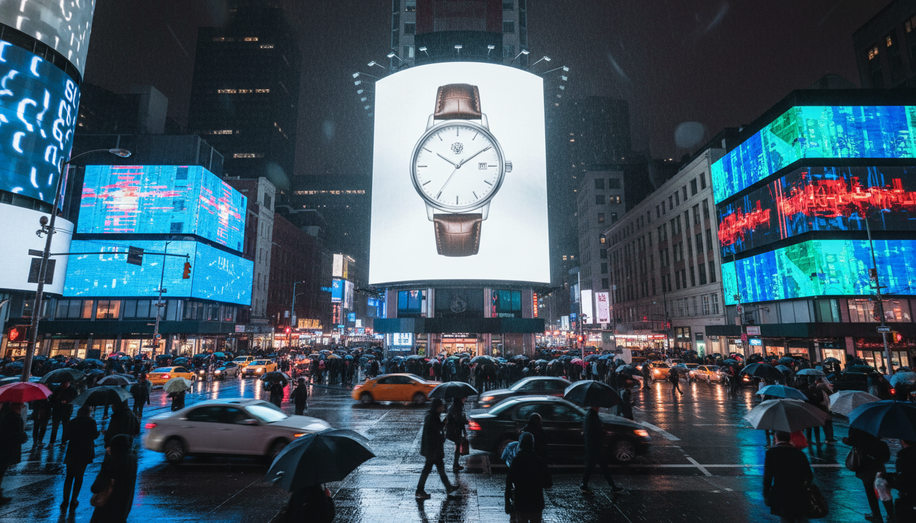

In an era dominated by flashing screens and algorithmic precision, static billboards—those unyielding sentinels of vinyl and steel—refuse to fade into obscurity. Far from relics of a bygone age, they are evolving, harnessing timeless creative ingenuity and razor-sharp placement strategies to hold their ground in the out-of-home (OOH) landscape. Their endurance stems not from nostalgia, but from proven advantages that digital counterparts struggle to match: unwavering visibility, singular brand dominance, and a capacity for bold, unfiltered expression.
Static billboards command 100% share of voice, a luxury digital OOH often denies advertisers who must rotate with competitors on shared screens. This exclusivity translates to relentless exposure—your message doesn’t flicker off every eight seconds; it looms large for weeks or months, etching itself into commuters’ minds through sheer repetition. Research underscores this potency: studies show consistent messaging drives high recall rates, particularly for local campaigns spanning eight to twelve weeks, where drivers encounter the same bold visual day after day. In a world of ephemeral online ads that vanish with a scroll, this “always-on” presence offers a stark contrast, capturing eyes in transit when digital fatigue sets in.
Global data reinforces their vitality. Traditional OOH spending, led by static formats, reached nearly $21 billion by late 2023, with no slowdown in sight amid rising digital alternatives. Even as U.S. OOH revenues climbed 4.5% in Q3 2025—the 18th straight quarter of growth—static billboards retained dominance, proving their role in diversified strategies. Marketers recognize that while digital out-of-home (DOOH) excels in flexibility, static thrives on simplicity and scale, delivering lower cost-per-thousand impressions (CPM) and production expenses than LED behemoths.
Strategic placement amplifies this edge, turning location into a superpower. Static billboards excel at hyper-local targeting, positioning brands squarely in front of specific communities—think a regional retailer blanketing high-traffic arterials or a diner teasing specials to nearby workers. Unlike DOOH’s data-driven dynamism, which can feel intrusive, static’s fixed gaze fosters familiarity, building trust through contextual relevance: a billboard near a stadium hypes game-day deals, its message unchanging yet omnipresent. This precision extends to small businesses, where affordability allows sustained presence without the premium of digital slots.
Yet adaptation is key to their survival. Classic creative principles—brevity, high contrast, emotional punch—remain sacrosanct, demanding designs that arrest at 60 miles per hour. Billboard companies now greenlight extensions beyond standard frames: 3D embellishments, sculptural add-ons, or wild installations tailored to a site’s quirks, like a towering soda can bursting from a rooftop. These tactile innovations sidestep digital’s glitch-prone nature—no power outages, no tech failures disrupt the show.
The real evolution lies in hybrid vigor, where static billboards bridge to the digital realm without surrendering their soul. Augmented reality (AR) overlays, QR codes, and NFC tags transform passive panels into portals: scan a code for an interactive promo, or point your phone to unlock AR animations that leap from the poster. A static ad for a sneaker drop might link to virtual try-ons, driving traffic while the billboard itself stays analog. Social media integration furthers this, prompting selfies with branded hashtags that amplify reach organically. These tools boost engagement metrics, proving static isn’t stagnant—it’s a launchpad for deeper interactions.
Critics argue DOOH’s real-time adaptability—weather-triggered ads, time-of-day swaps—renders static blunt. Programmatic buying and audience data collection give digital an analytical sheen, enabling hyper-personalization. But static counters with reliability and creativity unbound by pixel constraints. Where DOOH shares space and demands brevity, static affords epic storytelling, unhurried and immersive. Campaigns blending both formats—static for broad awareness, digital for bursts of relevance—maximize impact, as seen in surging OOH investments.
Consider real-world triumphs: local chains dominating neighborhoods with custom 3D builds, or national brands layering AR on iconic placements for viral moments. In 2026, as programmatic OOH matures, static’s low-barrier entry keeps it indispensable for budget-conscious innovators. Its evolution isn’t about mimicking digital; it’s about amplifying what static does best—seizing unscripted attention in the physical world.
Ultimately, static billboards endure because they tap primal advertising truths: size commands respect, repetition breeds recognition, and place breeds connection. In a digital deluge, they offer respite—a fixed point of impact amid the flux. By leaning into smart siting, audacious design, and tech-infused interactivity, static OOH not only sustains relevance but reasserts its throne, proving that some evolutions honor the past to conquer the future.