
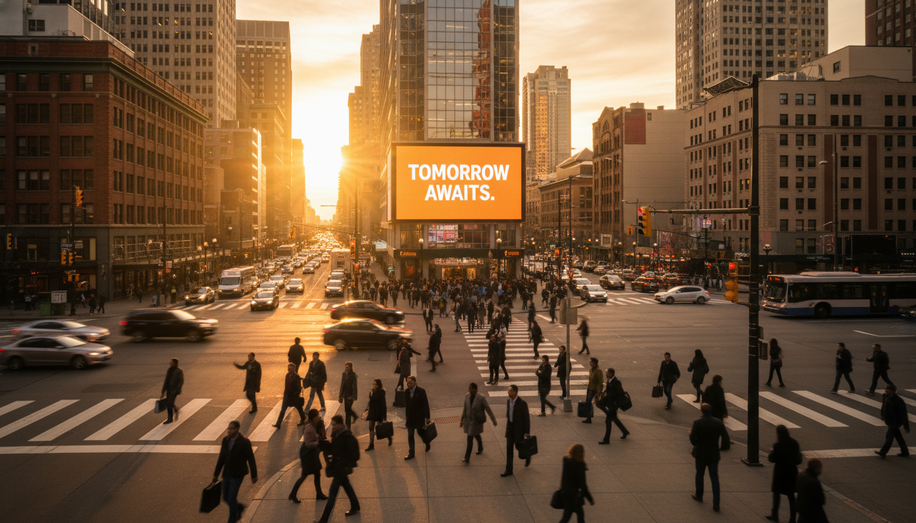

In the split-second rush of urban life, where drivers glance at billboards from 60 miles per hour and pedestrians spare a fleeting look amid the sidewalk scrum, copywriting for out-of-home (OOH) advertising demands a ruthless precision that digital formats rarely require. Unlike the scrollable luxury of online ads, OOH copy must seize attention, imprint a message, and compel action before the moment evaporates—often in seven words or fewer. This high-stakes arena elevates copywriting from mere wordsmithing to a visceral art form, where every syllable battles distraction and distance.
The unique challenges of OOH begin with brevity’s tyranny. Attention spans here are measured in heartbeats: a commuter zipping past a highway spectacular has perhaps three seconds to absorb the message. Experts emphasize that effective billboard copy rarely exceeds seven words, forcing writers to distill brand essence into telegraphic punches. Readability compounds the difficulty; text must be legible from afar, demanding large, bold fonts with thick strokes to cut through glare, motion blur, and visual noise. Vikki Ross, a copy consultant celebrated for her OOH work, underscores this by advocating for simplicity as the ultimate sophistication—one tip she shares is to strip copy to its emotional core, ensuring it resonates universally without demanding deep cognition.
Contrast this with digital copywriting, where hyperlinks, animations, and retargeting allow elaboration. In OOH, there’s no hover for details or click for more; the medium’s static power lies in its inescapability, bombarding audiences in real-world contexts like bus stops or transit hubs. Yet this ubiquity breeds skepticism—viewers are ad-weary, their defenses honed by constant exposure. Persuasive copy must pierce this armor, using influential language to drive specific actions, whether it’s visiting a store or shifting perceptions. Grand Visual’s strategies highlight how OOH thrives on environmental integration, where copy plays off surroundings for amplified impact, turning a mundane billboard into a conversational spark.
Creative strategies emerge from these constraints, transforming limitations into superpowers. Start with the big idea: borrow from legends like David Ogilvy, whose advertising gospel stressed facts over fluff, headlines that promise benefits, and copy that sells through specificity. For OOH, this translates to benefit-driven hooks—”Lose 10 Pounds in 10 Days”—that promise transformation instantly. Rhyme, rhythm, and repetition forge memorability; think “Got Milk?” whose cadence lingers long after the drive-by. Questions pull viewers in—”Hungry?”—prompting mental engagement without overtaxing the brain.
Humor disarms, but sparingly: a wry twist like “Left turn only? Not anymore” for a navigation app sticks because it mirrors daily frustrations. Commands cut through: “Drive Thru Now” leverages urgency, propelling impulse. Alliteration adds sonic punch—”Brighten Your Smile”—aiding recall in noisy environments. Avoid jargon, negatives, or punctuation pitfalls; “Don’t Miss Out” confuses at speed, while positives like “Grab Yours Today” propel forward momentum.
Testing refines the craft. Experts recommend the “drive-by read” simulation: print copy at scale, view from 500 feet at speed, tweaking until it lands flawlessly. A/B trials in real locations reveal what pops—bold sans-serifs outperform scripts, primary colors dominate. Data from successful campaigns, like those boosting sales through high-converting brevity, prove the payoff: concise OOH can lift engagement by double digits.
Yet pitfalls abound for the unwary. Overloading with details—”Now with 20% more vitamins and free shipping”—dilutes impact, leaving audiences bewildered. Ignoring audience context dooms efforts; a luxury watch ad quipping “Time Flies” near an airport soars, but flops in farmland. Failing to align copy with visuals is fatal—words must amplify imagery, not compete.
Mastering OOH copywriting rewards boldness. Agencies like Effortless Outdoor Media champion “do’s” such as evoking emotion and curiosity while shunning “don’ts” like tiny fonts or complex ideas. Leadpages echoes this for broader ads, urging copy that converts through clarity and call-to-action strength. Seek Marketing Partners draws from proven campaigns, where inspirational phrasing sparks sales surges.
Ultimately, beyond the pixel’s forgiving glow, OOH copywriters sculpt public consciousness with linguistic scalpels. In a world of fleeting glances, the best lines don’t just advertise—they hijack the collective psyche, turning passive passersby into active advocates. As Ross notes, the secret lies in one transcendent tip: make it human, make it hit home, make it unforgettable. When executed masterfully, these words don’t whisper from the sidelines; they roar across the horizon, reshaping behaviors one glance at a time.