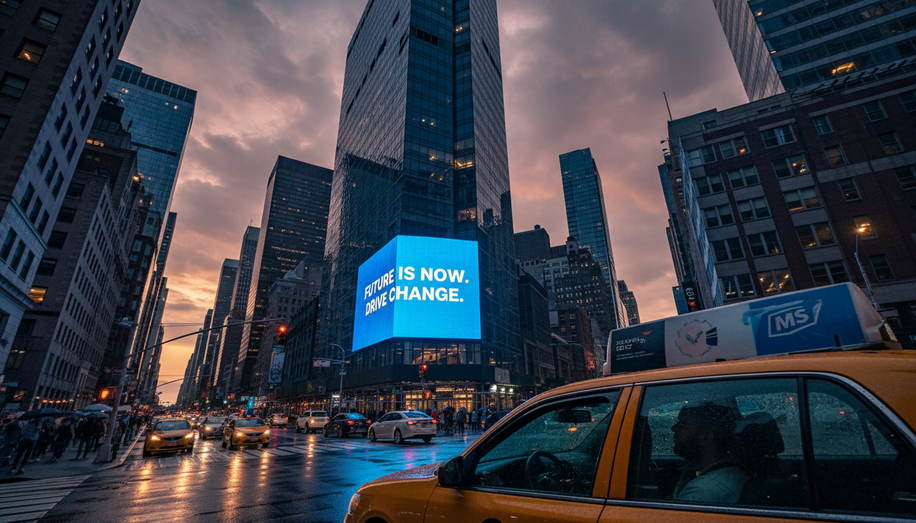
In the split-second world of out-of-home advertising, where commuters glance at billboards from highway speeds or pedestrians spare a fleeting look at transit wraps, copywriters wield words like scalpels—precise, unyielding, and designed for maximum incision. Effective OOH copy distills complex messages into phrases that lodge in the brain before the viewer vanishes, adhering to a creed of brevity that demands under seven words for billboards to ensure readability at distance. This isn’t mere minimalism; it’s a calculated art form rooted in psychology, where every syllable battles for attention amid urban chaos.\n\nThe principle of conciseness reigns supreme. Drivers have mere seconds—often three to five—to absorb an ad before their eyes flick away, so verbosity is the enemy. Industry experts advocate slashing copy to its essence: bold, memorable statements that punch through visual noise. Coca-Cola’s iconic “Taste the Feeling” exemplifies this, clocking in at three words yet evoking sensory delight and brand loyalty in an instant. Similarly, KitKat’s “Have a Break, Have a KitKat” leverages rhythm and familiarity, turning a simple imperative into cultural shorthand. The rule of thumb? Less than 10 words, ideally seven or fewer, to sidestep cognitive overload and boost recall. Overloading with details risks dilution; as one guide notes, billboards aren’t novels—they’re headlines screaming from afar.\n\nClarity follows as the unbreakable backbone. OOH copy must transcend ambiguity, employing large, thick fonts in contrasting colors against bright backgrounds to pierce fog, rain, or dusk. Power words like “exclusive,” “instant,” or “proven” inject urgency and persuasion without excess verbiage. Consider specificity over vagueness: “Lose 10lbs in 30 Days—No Gym Required!” trumps “Lose Weight Fast” by painting a vivid, believable promise. This precision addresses viewer skepticism upfront, preempting objections in the reader’s mind. Conversational tones amplify clarity, mimicking speech to feel natural amid motion—”Save More, Stress Less” feels like a friend’s advice, not corporate jargon. Spellcheck is non-negotiable; a single typo at 60 miles per hour erodes trust irreparably.\n\nImmediate impact hinges on emotional resonance and visual synergy. Words alone falter without bold imagery and color contrasts that grab the eye from hundreds of feet. Bright hues outperform muted palettes, enhancing retention by making ads pop against urban backdrops. Emotional appeals—tapping fear, joy, or aspiration—drive action: “Feel Confident Every Day” stirs desire more than feature lists. Social proof sneaks in succinctly, like “4.9/5 by 50,000 Users,” building credibility without bloating the line count. Context matters profoundly; ads in high-speed zones demand bigger fonts and fewer words, while longer-dwell spots like malls allow subtle storytelling. Creativity blooms from freewheeling brainstorming—jot every wild idea, then refine ruthlessly for minimalism that surprises.\n\nBranding anchors it all, not through obtrusive logos but seamless integration that reinforces identity without dictating it. Savvy consumers, armed with smartphones, seek brands online post-exposure—66% act after OOH encounters—so copy prioritizes the hook, trusting visibility handles the rest. This omnichannel cohesion extends impact, aligning OOH with digital touchpoints for unified narratives.\n\nYet pitfalls abound for the unwary. Focusing on features over benefits bores; “advanced fiscal strategies” flops where “Save More, Stress Less” soars. Ignoring mobile realities or overcomplicating muddies the waters—simplicity sells. Responsible creativity tempers edge: innuendos or insensitive imagery invite backlash in public view, where all ages encounter ads unfiltered.\n\nMastering brevity transforms OOH from backdrop noise to cultural force. Test variations relentlessly—A/B trials reveal winners—while adapting to environment: highways crave stark commands, sidewalks invite wit. In this arena, the sharpest copy doesn’t just inform; it imprints, urging impulse and action long after the glance fades. Brands that hone this art don’t advertise—they imprint.
The Art of Brevity: Crafting Impactful OOH Copy in Limited Space