
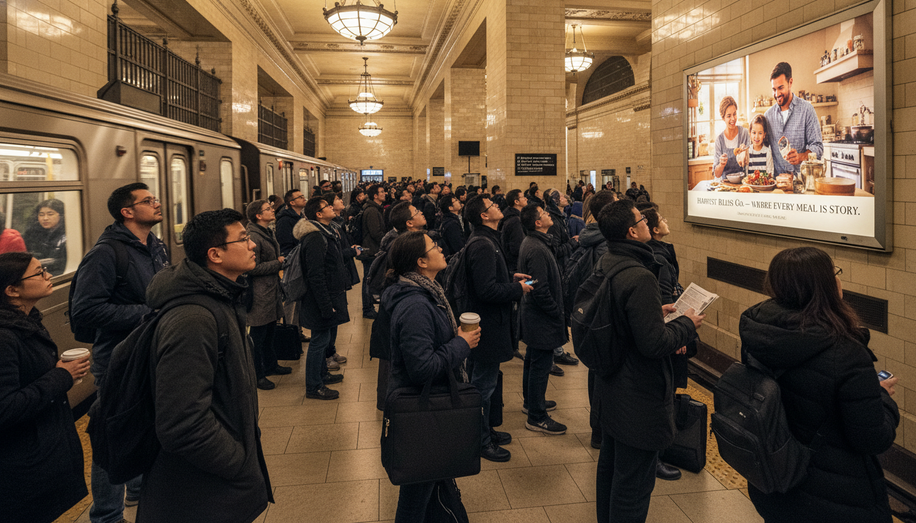

At 8:15 on a Monday morning, the metro platform is a study in split attention. Commuters scroll through phones, sip coffee, scan the tracks. Between the digital screens and the steel is the battleground where transit advertising has shifted from static posters to serialized stories designed to hook an audience that never asked to be entertained.
Storytelling has become the differentiator in this environment. Brands that move beyond product shots and slogans to craft narratives tailored to the rhythms of a commute are discovering that buses, trains, and stations can behave more like episodic media than background media. The commute, with its forced dwell time and repeated exposure, is uniquely suited to narrative formats that unfold over days, routes, and touchpoints.
Many of the most effective campaigns start by treating the vehicle itself as a “chapter one.” Full wraps—on buses, trams, or ferries—create the opening scene, using bold imagery to establish characters, mood, and setting before a single line of copy is read.A beverage brand’s “Wrap Your Ride” execution, for example, used vibrant vehicle wraps as a mobile prologue: the story of a new product launched visually on the street, then expanded through social media where riders shared photos of the moving canvas.The wrap sparked conversations that extended far beyond the route map, turning an everyday bus into a recurring character in the city’s visual landscape.
Other brands use transit to build anticipation the way a TV network teases a new series. When Sky Now promoted a slate of new shows, it treated a full bus wrap as a narrative billboard—hero characters, tension-filled imagery, and a visual promise of stories waiting to be discovered.On the street, the message was simple: there are worlds you could be watching instead of just waiting at a light. Online and on CTV, those worlds were delivered. The transit layer didn’t need to tell the whole story; it just had to make the shows feel present in the daily lives of potential viewers.
Public service and cause-driven advertisers have gone further, using storytelling on transit to change behavior in real time. In Wichita, the Sexual Assault Center’s bus campaign paired stark, empathetic language with a hotline number to create a series of micro-stories commuters could see themselves in.The narrative was as minimal as it was powerful: you are not alone, help is local, and this might be your moment to act. Staff later reported multiple calls from people who said they were stopped at a red light behind a bus when they decided to reach out.In that context, the bus isn’t just media; it becomes the setting where a personal turning point occurs.
Safety campaigns have applied similar thinking in metro systems. One award-winning initiative used eye-catching visuals and clear, human-centered scenarios to narrate the consequences of small choices—standing behind the line, avoiding distractions, respecting signals.Instead of lecturing, the creative staged brief, relatable vignettes that commuters could grasp in a glance, then revisit day after day. The result was not only high engagement and pledged commitments to safer behavior, but a measurable reduction in safety incidents across the system.The storytelling worked because it felt anchored in the lived experience of the riders moving through the space.
Museums, hospitals, and civic institutions have adopted a hybrid approach: brand-building narratives that double as public invitations. In the Netherlands, a leading medical center used bus wraps to share its work with the public.The creative didn’t attempt to compress complex healthcare messages into a single exposure. Instead, it used reassuring imagery and simple, human copy to build a story of expertise and accessibility over repeated encounters—on the road, at stops, in traffic. Similarly, a museum campaign used transit backs to pose questions and hints about exhibits, turning each following driver into an audience member experiencing a teaser trailer in slow motion.
What unites these campaigns is an understanding of transit as a serialized medium. The narrative often unfolds in layers: a bold, easily decoded visual for moving viewers; a more detailed line or call to action for people on the platform; and a deeper digital chapter for those who search, scan a code, or follow a hashtag later.Commuters might see chapter one on the side of a bus in the morning, chapter two on a platform display at night, and chapter three in their social feed when a friend posts a photo of the same creative.
For OOH strategists, the craft lies in designing stories that work at every speed of attention. The message must be legible at 30 miles an hour yet rich enough to reward someone stuck behind a wrapped bus through three sets of lights. It must stand alone in a single exposure but also feel like part of a larger, coherent narrative arc across a city.
As transit systems digitize and formats become more dynamic, the opportunities for storytelling will only expand. But the most successful case studies already show that the fundamentals are not technological; they are narrative. Define a clear protagonist—whether a product, a rider, or a community. Establish tension—loneliness, risk, boredom, curiosity. Offer a resolution that feels achievable in the context of a commute—calling a hotline, watching a show, visiting a venue, changing a habit.
When those elements align, a bus is no longer just a surface and a station is no longer just a waypoint. They become recurring scenes in a story commuters encounter every day—one that, at its best, they start to look for as part of the journey.