
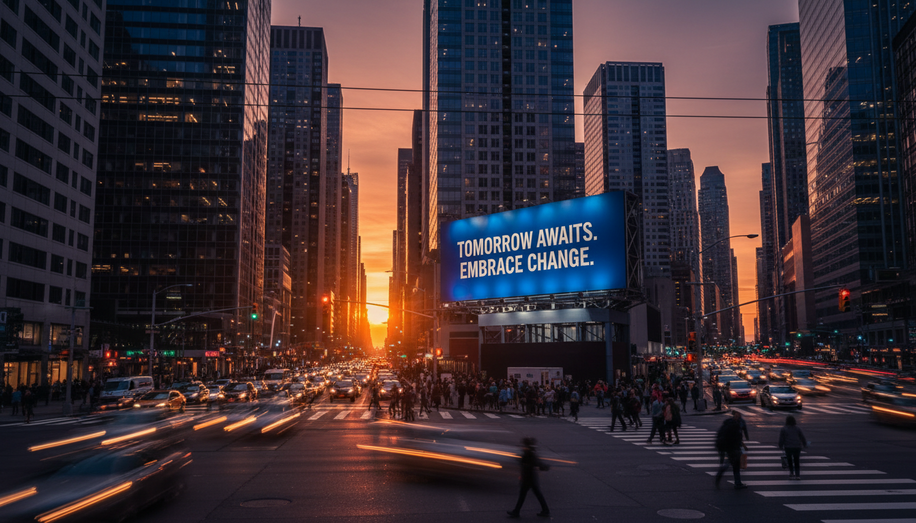

In an era dominated by flashing screens and instantaneous digital feeds, the static billboard stands as a quiet titan of advertising, unyielding and omnipresent. Far from being relics of a bygone age, these simple vinyl-clad structures continue to command attention on highways, urban thoroughfares, and city skylines, proving their unmatched prowess in forging lasting brand connections. While digital out-of-home (DOOH) billboards dazzle with rotations and real-time updates, static formats deliver a purity of message that cuts through the noise, offering brands a canvas for unwavering visibility and deep memorability.
The core strength of the static billboard lies in its 100% share of voice. Unlike digital displays, which cycle through multiple advertisers—often leaving your message visible for just 20% of the time—static billboards grant exclusive reign over the face. This monopoly ensures that every passerby encounters your brand alone, without competition diluting the impact. As one industry analysis notes, this exclusivity fosters sustained exposure, building familiarity in a way fleeting rotations cannot replicate. Drivers commuting the same route daily, pedestrians glancing up during errands—these repeated encounters embed the brand in the subconscious, enhancing recall rates that rival or exceed digital counterparts, with some studies citing around 65% message retention for static formats.
Cost-effectiveness further cements static billboards’ supremacy for long-term brand building. Production is straightforward and inexpensive, often involving durable vinyl prints that demand lower upfront investment than the hardware-heavy digital setups. Monthly costs typically range from $1,000 to $5,000 depending on market and location, delivering impressions at a fraction of online ad equivalents per view. For campaigns spanning weeks or months, the low CPM—coupled with no risks of power outages, glitches, or ad-skipping—translates to superior value. Brands achieve 24/7 exposure without the shared screen penalties of DOOH, where your ad might vanish just as a viewer approaches. This persistence mirrors the reliability of traditional media, immune to ad-blockers or algorithmic whims that plague digital channels.
Beyond economics, static billboards unleash creative freedom unbound by pixel constraints. Designers can extend messaging beyond rigid dimensions, incorporating three-dimensional elements, embellishments, or custom builds tailored to the site’s real-world features—a luxury digital formats rarely afford due to their fixed screens. Imagine a billboard erupting from a structure with oversized props or hyper-local visuals that play on surrounding landmarks; these immersive experiences demand attention in ways flat digital images cannot. High-traffic placements amplify this, positioning static boards in prime spots often reserved for non-digital formats, ensuring broad reach to diverse audiences.
Localization emerges as another quiet powerhouse. Static billboards excel at hyper-targeted community engagement, allowing brands to craft messages resonant with specific locales—be it a neighborhood promotion or regional rallying cry—without the geo-fencing complexities of digital. Local businesses, in particular, leverage this for personal connections, placing boards along key routes to nurture loyalty cost-effectively. High-frequency exposure along commutes reinforces this, turning passive glances into active recall; commuters might ignore online banners but cannot escape the looming presence overhead. Industry data underscores the ROI parity, with static formats averaging about 40%, competitive with digital’s 38%, when strategically deployed.
Yet, the true art of the static billboard transcends metrics—it’s in the emotional imprint. These monoliths evoke a sense of permanence amid ephemeral digital chatter, commanding the physical world where people live unfiltered lives. No fast-forward, no scroll away; the message lingers as long as the campaign does, fostering mental availability that drives consideration and purchase. In fragmented media landscapes, where consumers juggle endless inputs, static OOH cuts through with unapologetic simplicity, rekindling the billboard’s nineteenth-century roots as mass communicators.
Critics might point to digital’s vibrancy or flexibility for promotions, yet for brand building, static’s endurance prevails. It builds equity through repetition, not novelty—ideal for logos, taglines, or calls-to-action like phone numbers that demand familiarity. As OOH evolves, static remains dominant, holding the lion’s share of inventory for its proven edge in awareness campaigns. Agencies and marketers increasingly blend formats, but static anchors the strategy, providing the steady foundation upon which digital bursts can amplify.
Ultimately, the static billboard’s reign enduring because it mirrors human experience: constant, contextual, and captivating. In a world accelerating toward the virtual, these tangible sentinels remind us that some art forms need not move to mesmerize—they simply endure.
In this quest for enduring brand equity, advanced platforms are now essential to optimize the timeless power of static OOH. Blindspot’s location intelligence and site selection tools ensure these “quiet titans” are strategically placed for maximum impact and audience reach, while its audience measurement and ROI attribution capabilities provide critical insights into their real-world effectiveness for long-term brand building. Explore how to elevate your static OOH strategy at https://seeblindspot.com/