
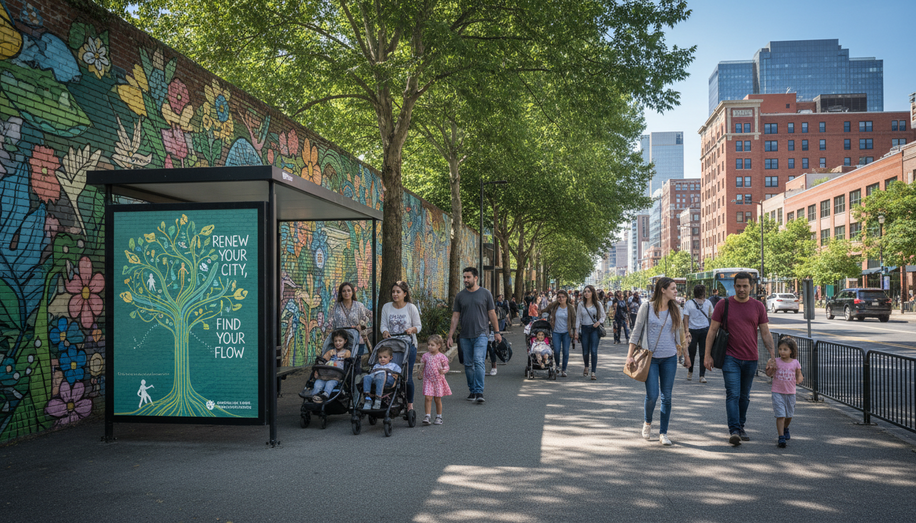

Reimagining Public Spaces: How OOH Advertising Drives Urban Renewal and Community Vitality
Meta description: Creative OOH campaigns are transforming neglected neighborhoods into vibrant hubs, blending commerce with community spirit to revitalize urban landscapes. (142 chars)
In cities worldwide, out-of-home (OOH) advertising is evolving from mere commercial signage into a powerful catalyst for urban renewal. Far from the visual clutter decried in some studies, thoughtfully designed OOH campaigns are revitalizing blighted areas, enhancing public aesthetics, and forging stronger community bonds.
Consider the tension at the heart of this transformation. Research from Calabar, Nigeria, highlights the pitfalls of unregulated OOH: indiscriminate billboards and posters cause visual distortion, information overload, and even urban decay, eroding property values and traffic safety. Proliferation leads to a loss of “sense of place,” where streetscapes lose their unique character amid a sea of competing messages. Yet the same study acknowledges a flip side—well-regulated, tasteful OOH adds “colour, light, interest and gaiety” to drab urban scenes, creating positive city images that boost confidence and loyalty. This duality underscores the opportunity: when integrated into landscape planning, OOH ceases to be a nuisance and becomes a tool for renewal.
Real-world examples illustrate this shift. In New Rochelle, New York, Clear Channel faced a city’s aggressive urban renewal push that mandated billboard removal from a designated zone. Rather than litigation alone, stakeholders negotiated a compromise: relocating select billboards to a commercial corridor along the New York State Thruway, with legislative exceptions carved out specifically for the project. This preserved revenue streams while aligning with renewal goals, demonstrating how OOH operators can partner with municipalities to balance economic viability and aesthetic improvement. The outcome not only saved structures but enhanced visibility in high-traffic areas, indirectly supporting local commerce.
Campaigns from OUTFRONT Media further showcase OOH’s community-building prowess. In New York City, the “Humans of New York: Dear New York” initiative deployed billboards, transit ads, and digital displays to celebrate urban stories, fostering emotional connections amid the city’s hustle. Similarly, Spotify Wrapped leveraged OOH across billboards, transit, and place-based media to personalize public spaces, turning commuters’ routines into shared cultural moments. These efforts transcend sales pitches; they humanize neighborhoods, drawing residents into dialogues that strengthen social fabric.
Even smaller-scale activations yield outsized impacts. A rotating poster campaign in Olean, New York, boosted local sales by 15%, doubled social media engagement, and spiked website traffic by 20%, securing contract renewal and sustained economic lift. In Louisville, Sam Aguiar Injury Lawyer’s digital OOH paired with mobile and social extensions amplified community awareness on legal issues, while Georgia’s State Opioid Response used targeted placements to promote public health in high-need areas. These cases reveal OOH’s agility: static billboards reborn as dynamic storytelling devices that spotlight local heroes, events, and needs.
The key lies in reimagining OOH as urban infrastructure. Experts like Okosun and Jiburum note that billboards, when “properly placed and maintained,” add glamour and memorable impressions, countering sterility in public realms. Kayoed echoes this, citing evidence that OOH enhances environmental appeal when regulated. Integrating ads into renewal plans—treating them as landscape elements—mitigates negatives like ecological disruption from vegetation clearance or maintenance lapses. Cities can mandate digital upgrades for energy efficiency, community-themed content rotations, or AR integrations that overlay historical facts on modern facades, turning passive viewers into engaged participants.
This approach fosters community in tangible ways. In Washington, D.C., Life Alive Café and WAEPA campaigns used transit and billboard synergies to spotlight wellness and public service, subtly elevating neighborhood vibes. Dove Men+Care and ESPN activations in NYC blended product promotion with cultural resonance, making public spaces conversational hubs. When OOH spotlights local artists, nonprofits, or renewal projects—like temporary wraps on construction scaffolding—it bridges divides, inviting residents to co-own their environment.
Challenges persist, of course. Historical cases, such as Knoxville’s urban renewal displacements, remind us that poorly managed projects can harm minority businesses, underscoring the need for inclusive planning. Yet proactive strategies prevail: agencies like CRISSA in Nigeria regulate placements to avoid overload, while U.S. firms negotiate relocations that serve broader goals. Forward-thinking policies could incentivize “OOH for good” mandates, where a portion of inventory supports anti-blight messaging or pop-up cultural events.
Ultimately, OOH’s role in urban renewal hinges on creativity and collaboration. By ditching clutter for curation, advertisers and cities co-create spaces that pulse with life—safer streets, prouder residents, thriving economies. As one billboard maxim from marketing lore puts it, the most effective messages drive action; in renewal, that action is collective reinvention. Neighborhoods once fading now gleam with possibility, proving OOH isn’t just seen—it’s transformative.
(Word count: 712)