
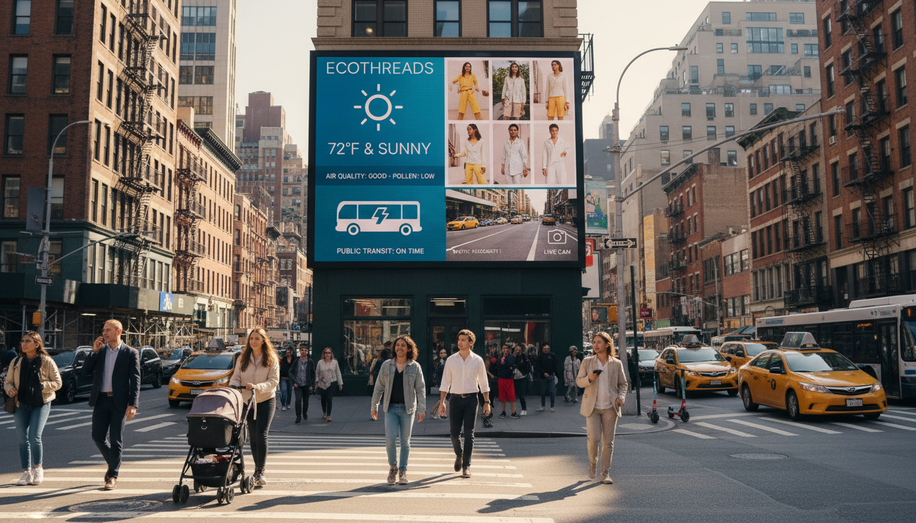

In the bustling streets of major cities, where digital billboards flicker to life with messages tailored to the passing crowd, programmatic digital out-of-home (DOOH) advertising is rewriting the rules of engagement. No longer confined to static schedules, brands can now swap creatives in real time, responding to weather shifts, traffic patterns, or breaking news with unprecedented agility. This evolution from rigid placements to dynamic, data-driven delivery is positioning programmatic DOOH as a cornerstone of modern marketing, with U.S. spending projected to surpass $1.2 billion by the end of 2026.
At its core, programmatic DOOH leverages automated bidding and real-time data to optimize inventory across thousands of screens. Marketers access vast networks via platforms that integrate audience movement, location signals, and contextual triggers, ensuring the right ad appears at the optimal moment. For instance, a coffee chain might trigger promotions for hot lattes during sudden rainstorms or pivot to iced drinks under clear skies, all without manual intervention. This flexibility addresses a long-standing critique of out-of-home: its perceived lack of responsiveness. Traditional OOH relied on weeks of planning; today, programmatic systems enable near-instantaneous adjustments, turning screens into living canvases that mirror consumer realities.
The technology’s responsiveness extends to current events, allowing brands to seize cultural moments that digital channels alone might miss. During major sporting triumphs or global happenings, programmatic DOOH can flood high-traffic zones with celebratory messaging, amplifying reach in physical spaces where attention is undivided. Experts note that this real-time adaptability boosts recall and relevance, as ads feel timely rather than contrived. Smaller brands, once sidelined by high costs, now compete on equal footing through precise targeting and surgical budget allocation, democratizing access to premium inventory.
Artificial intelligence is the engine propelling this revolution forward. By 2026, AI will transition from assistive tools to agentic systems that anticipate campaign needs, interpreting briefs, maintaining strategic coherence amid changing conditions, and suggesting optimizations like creative tweaks or channel shifts. Dynamic creative optimization (DCO) already automates personalization at scale, swapping elements based on time, audience demographics, or even emotional sentiment inferred from nearby data streams. Imagine a retailer’s ad morphing from family-oriented promotions on weekends to professional networking pitches during rush hour, all driven by predictive modeling of viewer intent.
This intelligence fosters omnichannel synergy, where DOOH integrates seamlessly with mobile, social, CTV, and display ads. Cross-border campaigns, now routine with multi-market revenue streams comprising significant portions of platforms like VIOOH, deliver consistent messaging across fragmented audiences. Unified measurement tracks lift across touchpoints, proving DOOH’s role in driving both brand awareness and performance metrics. As privacy regulations tighten, programmatic DOOH thrives on first-party data, contextual intelligence, and cohort-based targeting, sidestepping cookie dependencies while delivering transparency and accurate exposure modeling.
Yet, the true power lies in strategic evolution. Dynamic optimization is expanding beyond messaging to encompass budget reallocation and channel mix, with AI autonomously favoring high performers. Brands pursuing omnichannel dominance report amplified results, as DOOH acts as a “powerhouse” in trusted, real-world environments that command genuine attention. Standardization efforts are accelerating this shift, with programmatic buying moving from experimental to essential, fueled by demands for flexible budgets and quality controls.
Challenges persist, including inventory fragmentation and the need for robust data governance, but 2026 promises maturation. Sustainability may emerge as a differentiator, though AI’s maturation into a campaign-wide orchestrator remains the headline. As digital feeds overflow with AI-generated noise, DOOH’s authenticity—rooted in physical presence—restores trust, positioning it as the “grown-up” medium leading media mixes.
For advertisers, embracing programmatic DOOH means unlocking flexibility that static formats can’t match. Whether hijacking a viral trend or fine-tuning for local weather, the medium empowers responsive storytelling that resonates in the moment. As spending surges and technologies converge, programmatic DOOH isn’t just enhancing out-of-home—it’s redefining advertising’s future as intelligent, integrated, and inescapably real.
As programmatic DOOH redefines advertising’s future with its dynamic, data-driven capabilities, platforms like Blindspot provide the essential infrastructure for brands to truly thrive. Their integrated platform offers real-time campaign management, advanced audience measurement, and precise location intelligence, enabling agile creative swaps and optimal ad delivery responsive to shifting consumer realities. This ensures measurable ROI and seamless omnichannel integration, turning every screen into a strategic asset for modern marketers. Learn more at https://seeblindspot.com/