
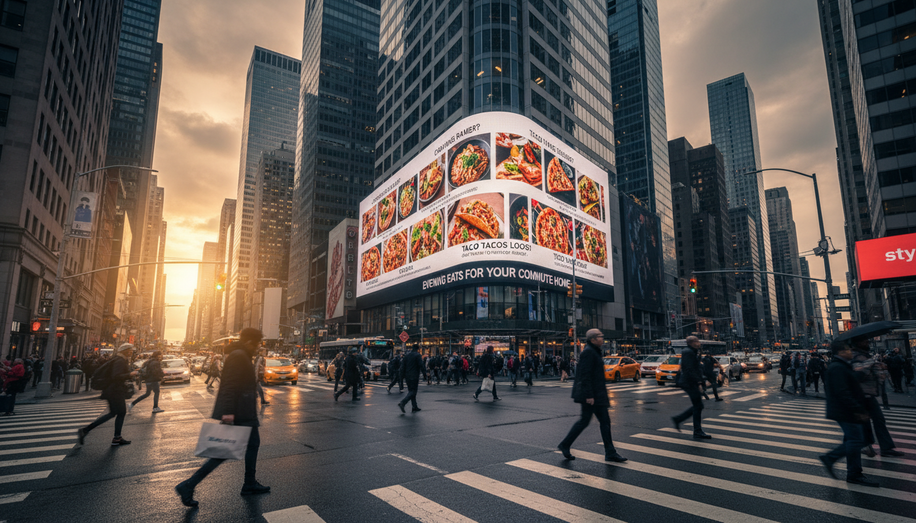

In the bustling heart of a city commute, a digital screen atop a transit hub flickers to life, displaying a tailored ad for a premium coffee brand just as rush-hour crowds pour in—workers with mid-level incomes, urban dwellers drawn to lifestyle perks like artisanal brews. This isn’t chance; it’s programmatic digital out-of-home (DOOH), or pDOOH, harnessing real-time data and audience segmentation to deliver ads with surgical precision, right audience, right time, right place. By automating the buying, selling, and delivery of OOH ads through real-time bidding on digital screens, pDOOH shifts from static placements to dynamic, context-aware campaigns that rival the efficiency of online programmatic media.
At its core, pDOOH operates via demand-side platforms (DSPs) where advertisers define targeting parameters, and algorithms execute bids in milliseconds. Unlike traditional OOH, which locks in fixed screen buys months ahead, programmatic DOOH uses aggregated data signals—movement patterns, first-party audience data, demographics, and environmental triggers—to determine ad eligibility across shared physical spaces. This audience-centric approach avoids individual tracking, focusing instead on probabilistic who, when, and where: time of day, day of week, venue types like office lobbies or retail hubs, and proximity to points of interest (POIs) such as grocery stores or new restaurant openings. For instance, brands targeting working professionals can layer household income, purchase habits, and brand affinities to activate screens in high-traffic office networks, reaching urban commuters during their daily journeys.
Real-time environmental data elevates this further, enabling hyper-relevant messaging without personal identifiers. Weather shifts prompt sunblock promotions on sunny days; local events trigger festival tie-ins; traffic conditions cue ride-share offers. Screenverse, managing over 16,000 screens in U.S. office buildings, exemplifies this by profiling audiences via lifestyle interests and frequent visits, then geotargeting within POI radii to embed campaigns in meaningful moments. Lamar Advertising’s programmatic networks similarly allow instant creative swaps and precise location targeting, optimizing for commuter touchpoints from transit stops to retail clusters. The result? Ads that feel serendipitous yet engineered, breaking through public-space noise with relevance that boosts engagement.
Efficiency gains are profound. Automation streamlines workflows, slashing manual negotiations and enabling budget optimization across thousands of screens in real time. Clear Channel Outdoor emphasizes how pDOOH blends online speed with OOH’s massive reach, where data-empowered teams fine-tune for measurable impact like store visits via geo-fencing or device ID passback. Measurement has evolved too: in-screen sensors, centralized reporting, and attribution tools link exposures to downstream actions, such as website traffic or sales lifts, closing the loop traditional OOH struggled with. StackAdapt notes programmatic DOOH now claims over 30% of DOOH spend, projecting 18.8% year-over-year growth into 2026, underscoring its scalability.
Case studies illuminate the payoff. Visit Arizona’s nationwide campaign targeted high-intent travelers on high-traffic screens, pairing impressions with mobile retargeting for sustained connection. Results included a 12% sales lift and 42% jump in purchase consideration. HP’s regional push aligned screens with core audiences, yielding twofold positive brand perception gains. These outcomes stem from pDOOH’s agility: advertisers set conditions—like affluent commuters near business districts—and ads serve only when met, maximizing ROI without waste.
Challenges persist, notably in measurement’s probabilistic nature versus online’s user-level granularity, but advancements in AI and machine learning are bridging gaps. Platforms like The Trade Desk leverage real-time data for unobtrusive, contextually rich ads on billboards and kiosks, while Perion’s automation handles planning to attribution end-to-end. For brands, this means unprecedented control: dynamic creative swaps mid-campaign, omnichannel extensions, and data-backed decisions that turn public screens into personal touchpoints.
As urban landscapes digitize—think smart city screens in malls, transit, and workplaces—pDOOH positions OOH as a powerhouse in the programmatic era. It doesn’t just reach audiences; it anticipates them, syncing messages to life’s rhythms for campaigns that resonate deeply and perform measurably. In an attention economy cluttered by digital fatigue, this fusion of physical scale and data precision redefines out-of-home, proving that the right ad, in the right moment, can still stop commuters in their tracks.