
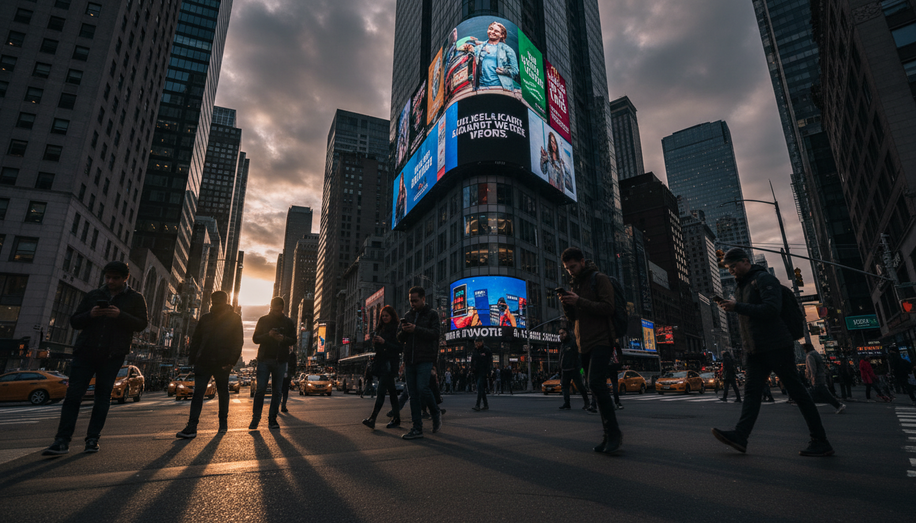

In the bustling corridors of urban life, where towering billboards command fleeting glances from commuters and pedestrians, a quiet revolution is reshaping how out-of-home (OOH) advertising captures consumer attention. Marketers are no longer content with one-and-done impressions from static displays; they’re extending the reach of those physical touchpoints into the digital realm through sophisticated OOH-to-mobile retargeting. By harnessing geofencing technology around billboard locations, brands can identify mobile devices that enter a campaign’s viewshed—the precise area where an ad is visible—and serve tailored follow-up ads on users’ smartphones, all without touching personally identifiable information. This seamless bridge from billboard to browser is proving to be a game-changer, amplifying brand recall and driving measurable conversions.
The mechanics are elegantly simple yet powered by advanced location intelligence. Companies like Outfront Media and Reveal Mobile deploy geofencing to create virtual boundaries around OOH placements, such as a high-traffic billboard in Times Square or a digital screen along a highway. When a mobile device crosses into this zone, it’s anonymously tagged as having been “exposed” to the ad. Moments or days later, that same device can receive a retargeted mobile ad—perhaps a promotional coupon or video teaser—precisely when the consumer is most receptive, like scrolling through social media during lunch. “OOH acts as the primer, planting the seed, while mobile retargeting nurtures it into action,” explains a Reveal Mobile strategist, echoing research from Ocean Neuroscience that shows consumers are 48% more likely to click a mobile ad after DOOH exposure compared to TV priming.
This strategy shines in its precision, turning OOH’s mass-reach strength into hyper-targeted digital follow-through. Take a streaming service launching a billboard campaign in urban centers to hype a new series. Geofencing captures devices in the viewshed, then retargets them with CTV trailers or mobile links to the sign-up page. The result? A multi-channel funnel from awareness to conversion. Broadsign’s data underscores the potency: campaigns blending digital OOH and mobile boast up to 30% higher engagement rates, with one case delivering a 1.75x lift in in-store visitation. Similarly, Programmads’ work with a food service giant yielded a 0.12% click-through rate alongside surges in “restaurant finder” searches (222 hits) and menu views (1,038 hits), proving the synergy between physical exposure and digital nudges.
For marketers, implementation demands careful orchestration. Start with robust viewshed mapping—using GPS data, elevation models, and traffic patterns to define not just who passes by, but who likely sees the ad. Pair this with audience segmentation on the mobile side: dynamic creative optimization adjusts ads based on time of day, user behavior, or even weather. A morning billboard touting coffee might trigger afternoon mobile offers for the same chain, while proximity targeting around points-of-interest (POIs) like stores or competitors lets brands steal share in real-time. Vistar Media advocates geofencing key locations to re-engage nearby users, creating omnichannel experiences that feel intuitive rather than intrusive.
Privacy remains a cornerstone, with anonymized signals ensuring compliance amid evolving regulations like GDPR and CCPA. Aggregated location data, clean rooms, and device graphing allow scale without individual tracking, building trust while delivering ROI. Outfront’s platform, for instance, extends OOH audiences to connected devices, reporting that combined OOH-mobile efforts drive store traffic 2.5 times more effectively than either channel alone, per S4M research. Outsmart’s studies add that top OOH campaigns spark a 38% uplift in mobile brand actions, with 66% of responses happening short-term.
Challenges persist—accurately modeling viewsheds in complex environments or attributing conversions across channels requires sophisticated measurement. Yet tools like Broadsign’s geo-targeting and Reveal’s ad-tracking are closing the loop, with lift studies quantifying everything from brand recall to purchase intent. As digital out-of-home (DOOH) evolves with programmatic buying, the marriage of OOH and mobile will only deepen, potentially incorporating AR overlays or beacon tech for even tighter integration.
Ultimately, from billboard to browser, this retargeting playbook empowers marketers to transform passive exposures into active engagements. In an era of fragmented media, it’s a reminder that the most effective advertising doesn’t shout once—it whispers persistently, guiding consumers from the street to the screen with surgical precision. Brands ignoring this fusion risk leaving impressions on the table; those embracing it are rewriting the rules of audience connection.