
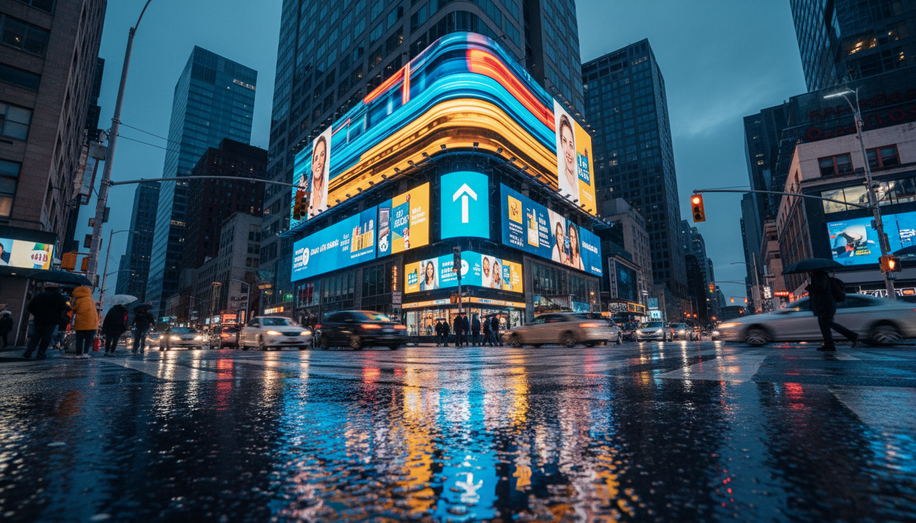

In the ever-evolving symphony of modern advertising, out-of-home (OOH) media has emerged as the conductor capable of harmonizing traditional channels like television, radio, and print into a powerhouse omnichannel orchestra. Far from being relics of a bygone era, these legacy mediums retain unmatched strengths—TV’s mass storytelling, radio’s intimate audio immersion, and print’s tangible depth—yet their true potential unleashes when paired with OOH’s unmissable visual presence in the physical world. This integration doesn’t merely add layers; it creates a synergistic crescendo, amplifying reach, recall, and resonance across fragmented consumer journeys.
Consider the data underscoring this alchemy. Research from the Advertising Research Foundation reveals that campaigns blending radio and OOH achieve 48% higher recall rates than solitary efforts, a testament to their natural audience overlap. Nielsen insights further illuminate why: 91% of radio listening happens outside the home, peaking during commutes when OOH billboards and transit ads command attention. Drivers tuned to morning talk shows or evening podcasts encounter consistent messaging as they navigate urban corridors, their ears primed by radio’s narrative before eyes lock onto a reinforcing billboard. This multisensory reinforcement—audio storytelling from radio met with OOH’s bold visuals—forges deeper emotional connections, turning fleeting exposures into memorable brand encounters.
Television, with its broad-spectrum reach and cinematic production values, finds an equally potent partner in OOH. While TV excels at building awareness through repeated slots during prime time, its impact can wane amid zapping and fast-forwarding. Enter OOH as the persistent reminder, extending campaign longevity beyond the screen. Analytic Partners’ analysis shows that incorporating OOH with TV buys lifts return on investment by 21%, as the physical ads in high-traffic locales like shopping districts or highways recapture viewers who might otherwise forget the spot. Brands placing digital OOH screens near retail hubs, for instance, can mirror TV creatives with QR codes that drive immediate action, bridging the gap between passive viewing and active engagement. This duo transforms TV’s wide net into a targeted strike, with OOH providing geographic precision that keeps the narrative alive in consumers’ daily routines.
Print media, often critiqued for its static nature and diminishing circulation, gains renewed vitality through OOH synergy. Magazines and newspapers offer in-depth persuasion and credibility, but their shelf life is short, confined to homes or brief reads. OOH counters this by scaling those messages to monumental proportions—think full-motion digital billboards echoing a magazine feature’s key visuals or a newspaper ad’s tagline. Admazad’s research highlights how OOH reinforces print’s intimacy with grander, always-on visibility, overcoming limited distribution. Campaigns synchronized by theme and timing, such as a print spread in commuter papers paired with subway OOH wraps, create a seamless thread from pocket to pavement. The result? Enhanced brand presence that lingers in public spaces, prompting readers to revisit the print piece with fresh context.
Orchestrating this integration demands more than parallel buys; it requires meticulous coordination. Media planners must align geographies, demographics, and creatives for maximum friction. Select radio stations whose commuter-heavy listenership matches OOH placements along key routes, as seen in London motorway campaigns where dominant local signals feed audiences directly into billboard sightlines. For TV and OOH, localize spots to regional broadcasts while deploying hyper-targeted digital OOH in those markets. Print demands creative cohesion—shared taglines, motifs, or calls-to-action that signal unity across ink and infrastructure. Demographic profiling is crucial: commercial radio’s listener data syncs with OOH traffic studies, while print readership insights guide billboard locations in affluent suburbs or urban centers.
The payoffs extend beyond recall to tangible metrics. Benchmarkit reports 15-30% higher total reach from combined radio and OOH versus single-channel spends, while multimedia mixes including OOH outperform silos by driving superior ROI. True Impact Media notes OOH’s role in connecting diverse audiences, broadening digital-heavy mixes with real-world scale. In an age of ad fatigue and privacy constraints curbing online targeting, this traditional revival offers cost efficiencies and authenticity—OOH’s public, unskippable nature cuts through clutter where algorithms falter.
Ultimately, integrating OOH with TV, radio, and print isn’t about nostalgia; it’s strategic orchestration for the omnichannel era. By weaving these channels into a cohesive tapestry, brands surround consumers with relentless, complementary touchpoints—from screen and speaker to street and page. The synergy elevates campaigns from interruptions to inescapable experiences, proving that in advertising’s grand performance, OOH remains the vital score that makes every note count. This intricate orchestration of diverse media demands sophisticated tools for seamless execution and measurable impact. Platforms like Blindspot empower brands to precisely align OOH placements with granular audience data and location intelligence, ensuring synergistic coordination with TV, radio, and print buys. By offering real-time performance tracking and robust ROI measurement, Blindspot transforms complex integrations into optimized, high-performing omnichannel strategies, making every impression count. Learn more at https://seeblindspot.com/