
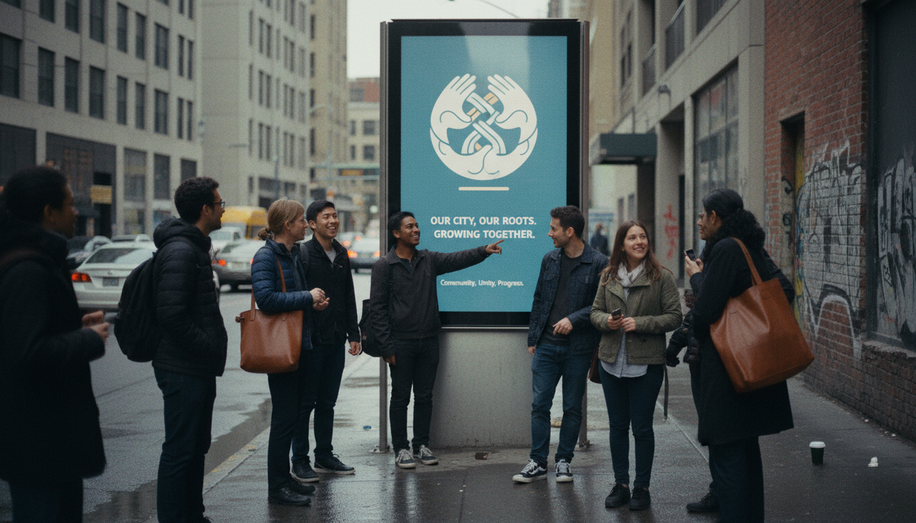

Out of home advertising has long been recognized as a powerful tool for driving commercial sales and building brand awareness. Yet an emerging body of evidence suggests that OOH campaigns can serve a more profound purpose: functioning as a mirror that reflects the values, concerns, and identity of the communities they inhabit, while simultaneously catalyzing meaningful public dialogue on social issues.
The transformation of OOH from purely transactional messaging to purpose-driven communication represents a significant shift in how brands leverage public space. When executed thoughtfully, outdoor advertising transcends its traditional role as a sales vehicle and becomes a platform for addressing social challenges, celebrating cultural diversity, and amplifying marginalized voices. This evolution reflects a broader recognition that consumers increasingly expect brands to demonstrate values alignment and social responsibility.
Bank of America’s recent campaign exemplifies this potential. By positioning out of home advertising at the core of a multi-channel effort supporting charitable causes, the campaign generated record-breaking results, raising $71.9 million for 168 charities with a 78.4% year-over-year increase. The campaign’s success demonstrates that when OOH carries messages of social impact rather than product promotion, audiences respond with genuine engagement and support.
Similarly, brands like Patagonia have leveraged outdoor and social channels to promote environmental causes and sustainable practices, focusing on raising awareness of critical environmental issues rather than direct product promotion. Their mission-driven approach highlights how OOH and complementary media can build community around shared values while simultaneously strengthening brand reputation as a leader in sustainability.
The geographic specificity of outdoor advertising provides unique advantages for reflecting local community values. The Istrouma at Sugar Farms relaunch campaign demonstrated how strategically placed OOH messaging could speak directly to nearby audiences, celebrating the venue’s blend of food, farm, and family-friendly experiences. This hyperlocal approach generated a 136% year-over-year increase in foot traffic and a 30% increase in sales, with 95% of visitors being new. By anchoring messaging to authentic local identity, the campaign fostered genuine community connection.
Museums and cultural institutions have similarly embraced OOH’s capacity to spark engagement with social and historical narratives. The Deep Time and Fossil Hall campaign targeted families in the DC metropolitan area by incorporating drawings created by children, directly engaging young audiences in conversations about natural history and scientific discovery. Such campaigns demonstrate how outdoor advertising can elevate public discourse beyond consumer transactions.
The power of OOH as a social mirror extends to its capacity for real-time responsiveness. Weather-based marketing campaigns have shown that contextually relevant messaging—where content adapts to actual conditions and audience circumstances—generates meaningful engagement while eliminating wasted impressions. This principle applies equally to social context: campaigns that reflect current community conversations and concerns resonate more authentically than generic messaging.
Yet the potential for OOH to drive public dialogue remains underutilized. Most outdoor campaigns continue to prioritize awareness metrics and sales conversion over substantive community engagement. The challenge for the OOH industry is developing measurement frameworks that capture impact beyond impressions and clicks—metrics that assess how campaigns influence community conversations, shape public perception of social issues, and strengthen civic participation.
As communities navigate complex social challenges ranging from environmental sustainability to public health to social equity, the physical infrastructure of outdoor advertising offers untapped potential. Public spaces are precisely where communities gather, commute, and develop shared identity. When OOH campaigns authentically reflect local values and address genuine community concerns, they transform passive exposure into active participation in public dialogue.
The future of OOH lies not in competition with digital media for consumer attention, but in leveraging its unique position in physical community space. By embracing its role as a social mirror—reflecting community identity while elevating public conversation—outdoor advertising can deliver value far beyond commercial metrics, positioning itself as essential infrastructure for civic engagement and cultural expression.