
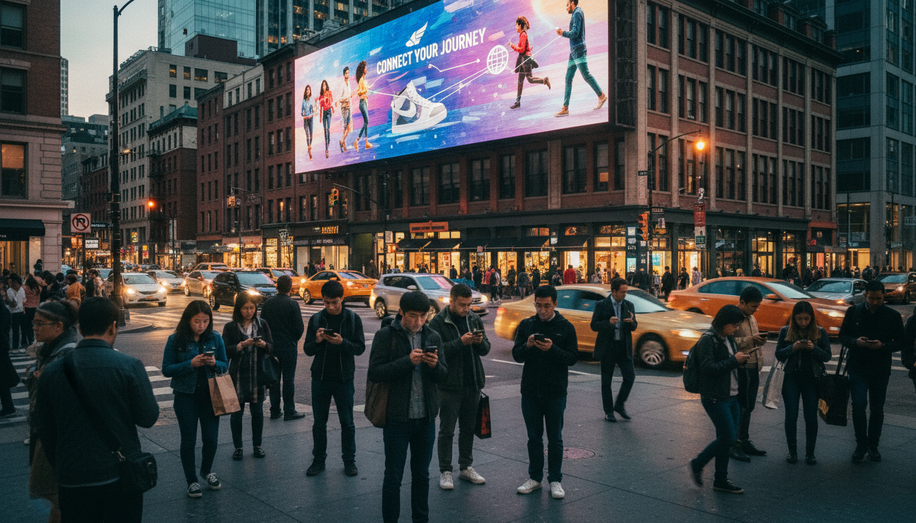

For more than a century, out-of-home advertising has been defined by physicality: steel structures, printed vinyl, LED screens anchored to real-world coordinates. Now, as brands experiment with virtual billboards and branded experiences inside persistent 3D worlds, OOH is pushing beyond the pavement. The metaverse is emerging as an extension of public space – and with it, a new canvas where outdoor media owners and advertisers are learning to bridge physical and digital touchpoints.
The basic proposition is deceptively simple. In virtual environments, billboards function much like their roadside counterparts: large-format displays placed along high-traffic routes, near landmarks or inside entertainment venues. But instead of steel and LEDs, they are rendered in real time inside game engines and virtual platforms. That shift unlocks a radically different media model. Creative can be swapped instantly, targeting can be based on behavioral and contextual data, and every impression can, at least in theory, be measured with precision.
Tech and media players are already building connective tissue between these realms. Lemma, a supply-side platform for large-format ads, has partnered with Maxamtech Digital Ventures to offer “metaverse billboards” as an extension buy for real-world digital OOH clients. Brands booking physical screens can mirror or adapt their messaging in virtual spaces, effectively doubling their footprint and frequency while telling a unified story. According to Lemma, these virtual placements allow for per-user personalization based on demographics, interests and in-world actions, reducing waste and boosting campaign efficiency. For OOH specialists accustomed to broad-reach targeting, that level of granularity marks a profound shift.
The value proposition is not just theoretical. In one campaign, Coca‑Cola deployed interactive billboards within Roblox, inviting users to engage with the virtual ads and earn digital rewards. The initiative generated more than 1.7 million unique interactions, demonstrating how metaverse placements can blur the line between awareness, engagement and participation. Where a traditional billboard delivers a fleeting glance, its virtual cousin can function as the gateway to a mini‑game, a collectible asset or a social challenge – all within the same “outdoor” frame.
For brands, the strategic question is no longer whether virtual out-of-home will exist, but how to orchestrate it alongside physical inventory. One emerging pattern is the “digital twin” approach: replicating iconic real-world locations or campaigns inside virtual worlds. An urban plaza hosting a 3D anamorphic OOH spectacular might be mirrored in a metaverse venue, with synchronized creative that updates across both environments in real time. Platforms such as Ocean Outdoor and LandVault are experimenting with Web3-enabled DOOH packages that natively integrate ads into virtual venues, allowing users to “teleport” from a virtual screen into branded spaces or experiences. The result is a continuous narrative: a commuter glimpses a striking execution offline, then encounters a richer, interactive counterpart while gaming or socializing online.
A second strategy centers on true cross-channel journeys. Traditional OOH has already been tying into mobile through QR codes, NFC tags, geofencing and beacons, nudging passersby from the sidewalk to their screens. In a metaverse context, that bridge runs in both directions. A user who encounters a brand’s virtual billboard or product placement might be redirected to a website, a social channel or even a map pin for the nearest physical store. Meanwhile, exposure to roadside DOOH can trigger retargeted messaging in virtual environments, creating a frequency curve that spans city streets, smartphones and headsets.
Cost and flexibility are also drawing attention. Virtual billboards are relatively affordable to produce and maintain compared with large-scale physical sites, with no printing, installation or weather-related wear. Creative can be dynamic, animated and context-aware, updating in response to time of day, in-world events or user behavior. As AI-driven systems mature, campaigns are expected to deliver hyper-personalized experiences, serving different versions of the same placement depending on who is “walking” past. For OOH buyers used to negotiating fixed cycles and static faces, the prospect of programmatic, real-time optimization inside a three-dimensional world is both enticing and disruptive.
Yet the metaverse is not merely a new distribution channel; it is a different kind of public space. Successful campaigns tend to “think beyond billboards,” using virtual placements as anchors for immersive spaces, branded goods and interactive storylines rather than as digital replicas of print. Agencies advise brands to build experiences people want to inhabit – from virtual stores and concerts to AR mirrors that connect in-store environments with digital overlays – so that OOH, in both realms, becomes a doorway rather than a destination.
That shift raises familiar questions in unfamiliar settings. Issues of brand safety, user privacy and regulatory oversight, long debated in online advertising, now follow OOH into virtual streets. Platform operators and advertisers are starting to discuss standards for intrusive formats, data use and transparency in metaverse spaces, seeking a balance between innovation and user protection. At the same time, the sustainability credentials of virtual media – with no physical materials or energy-hungry lighting infrastructure – are becoming part of the pitch to environmentally conscious brands.
For the outdoor industry, the metaverse is less an existential threat than a chance to reassert its core value: occupying shared spaces where culture happens. As cities grow “smarter,” with IoT-connected screens and AI-driven optimization in the real world, and as virtual worlds attract their own commuter flows of avatars, the most effective brands will be those that treat these environments as two halves of a single canvas. The billboard of the future may stand on a highway embankment or beside a virtual plaza – or, increasingly, in both – telling one story that follows consumers wherever they choose to spend their time.