
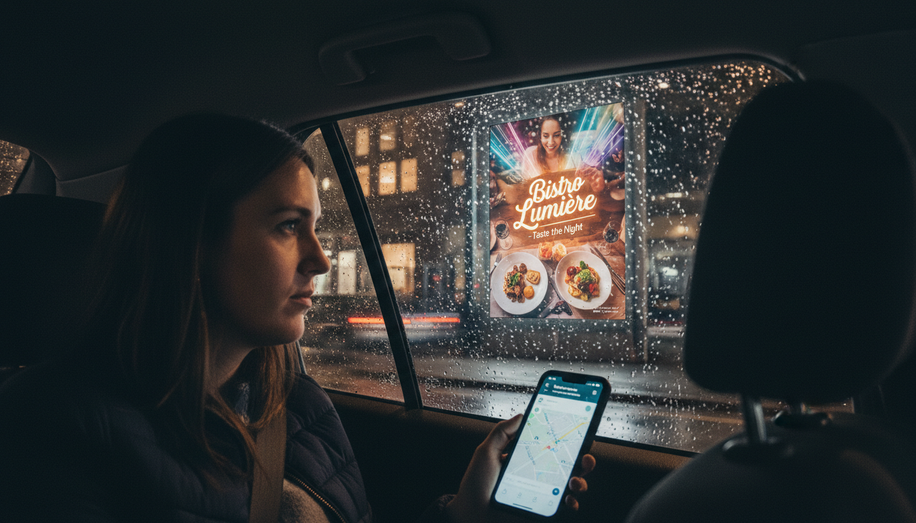

In an era where 82% of purchases occur in-store and 62% stem from impulse decisions, out-of-home (OOH) advertising has emerged as a potent force for converting fleeting impressions into tangible foot traffic. Retailers, restaurants, and service providers are increasingly harnessing OOH—particularly its digital variant—to intercept consumers during their daily routines, bridging the divide between awareness and action at critical junctures like commutes, errands, and urban explorations.
The mechanics of this influence are rooted in timing and proximity. Research from Talon Outdoor indicates that 59% of shoppers are likely to make a purchase within 30 minutes of encountering an OOH ad, underscoring its role as a last-mile catalyst. Proximity-based targeting amplifies this effect by delivering hyper-local messages when consumers are primed to act. For instance, placing digital screens in high-traffic pedestrian zones or near retail clusters ensures ads reach audiences already in motion toward potential buying spots. A campaign by Holt Renfrew exemplifies this precision: leveraging geofencing around closing Nordstrom locations, it activated 200 ads across billboards, bus shelters, and office buildings in seven markets. The result? Over 400,000 store visits in ten weeks, driven by consumer mapping and timely promotions.
This approach thrives on contextual relevance. Advertisers appeal to price-sensitive shoppers—41% of whom will switch stores for savings—by spotlighting limited-time deals, exclusive in-store offers, or real-time stock availability. In long-dwell environments like transit hubs, where commuters linger 5-15 minutes, interactive messaging builds urgency through QR codes or time-sensitive prompts. Jack in the Box’s programmatic digital OOH campaign targeted hungry consumers within a two-mile radius of its restaurants, generating 1.3 million store visits and a 12:1 return on ad spend. Such tactics transform passive exposure into immediate movement, with 56% of shoppers in a global study buying featured items after seeing DOOH displays, 65% of those unplanned.
OOH’s efficacy extends beyond retail to diverse sectors. Automotive brands have seen 36% of exposed audiences visit dealerships within a week, capturing urgency in high-stakes decisions. Consumer packaged goods (CPG) campaigns report 72% of sales from new customers among those reached, with 50% purchasing the advertised product within two weeks. Food delivery apps, meanwhile, achieved a 31% lift in new orders and double the repeat business through market-wide digital bulletins in key direct marketing areas. Near-store placements prove especially persuasive: 71% of shoppers notice ads just outside retail entrances, and main household shoppers are 12 times more likely to act on retail DOOH than average adults.
Integrating OOH with digital channels supercharges these outcomes. With 76% of consumers taking mobile actions post-DOOH exposure—such as scans, app downloads, or shares—brands create closed-loop journeys. First-party data from loyalty programs enables personalized creative, while geolocation tracking and brand lift surveys quantify ROI. Captivate’s network, positioned at points of interest en route to stores, primes recall and directs traffic, complementing retail media networks for omnichannel amplification. Cross-channel synergy yields 2-3x higher engagement than OOH alone, as interactive elements like touchscreens foster viral sharing and repeat visits.
Seasonal and demographic tailoring further refines impact. During holidays or back-to-school rushes, messaging on gift guides and extended hours resonates in transit hubs and social venues. Gen Z and millennials respond to bold visuals, QR-driven exclusives, and values like sustainability, placed amid their frequent mall trips (33% weekly) or daily drives (39%). Advanced tools layer in behavioral signals—shopping patterns, commute routes, even weather—to heighten relevance.
Challenges persist, including measurement standardization and digital noise, yet OOH’s unskippable nature endures: 42% of consumers say it sways in-person shopping, and 75% recall it inside stores. Nearly 80% have engaged with OOH in the past 60 days, per OAAA and Morning Consult. As consumers spend more time out-of-home—visiting high streets or malls regularly—OOH primes upper-funnel awareness while persuading at the point of decision.
Ultimately, OOH redefines drive-to-store by embedding brands in real-world paths, turning unavoidable moments into measurable conversions. For retailers and services chasing foot traffic, it’s not just visibility—it’s velocity, propelling impressions straight to the storefront. To truly master this velocity, advanced platforms like Blindspot offer crucial tools, providing location intelligence and programmatic DOOH campaign management for hyper-targeted placements. With real-time performance tracking and ROI attribution, brands can precisely measure the impact of their OOH efforts, ensuring every impression drives directly to the storefront. Explore how at https://seeblindspot.com/