
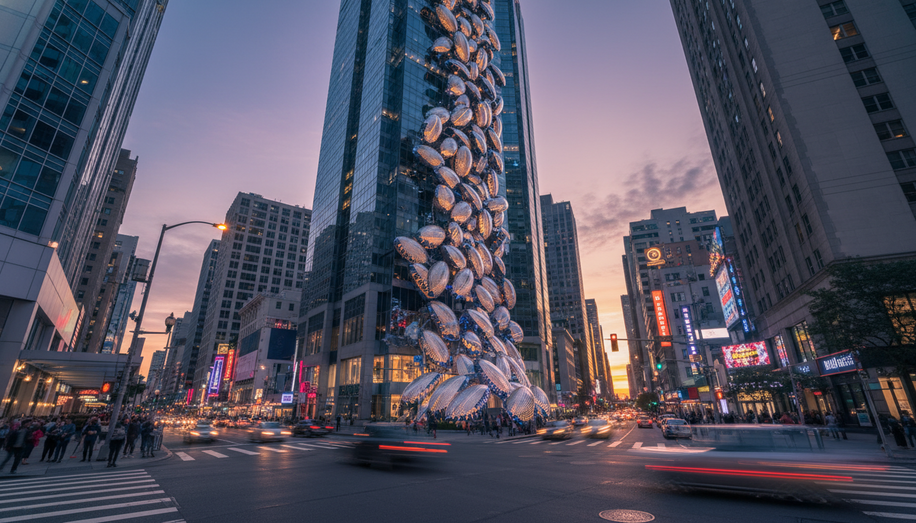

In the heart of Times Square, where the pulse of New York City never slows, a new LED spectacular cascades down the frontage of a gleaming hotel, its 6.6 mm pixel pitch delivering ultra-sharp visuals that command attention from Duffy Square to Seventh Avenue. These mega-spectaculars—towering, custom-built out-of-home (OOH) installations—have evolved far beyond static billboards into urban landmarks that redefine cityscapes. They capture the “wow” factor, blending artistry, technology, and engineering to create immersive experiences that linger in public memory long after the campaign ends.
The creative process begins with a bold vision: transforming advertising into architecture. Agencies and brands collaborate to conceive structures that exploit prime locations, turning high-traffic zones into theatrical stages. Take the Circa Digital Spectacular in downtown Los Angeles, overhauled by SNA Displays and BIG Outdoor into a 20,000-square-foot continuous DOOH platform—the largest on the West Coast. Designers start with site analysis, mapping pedestrian flows, sightlines, and light conditions to ensure maximum impact. Concepts often draw from 3D illusions or dynamic animations, like the Shinjuku naked-eye 3D billboard in Japan, where holographic effects make products leap from the screen, mesmerizing commuters. Creative directors iterate through digital renders and scale models, fusing brand storytelling with spectacle. “We love it when OOH becomes an immersive experience,” notes one industry observer, as seen in a 2025 installation that morphed a space into a massive 3D billboard with trail-running footage, drawing crowds between sessions.
Engineering these behemoths presents formidable challenges. Structures must withstand extreme weather, seismic activity, and constant vibrations from urban life. The Ultimate Display at American Dream mall in East Rutherford, New Jersey—a curved LED mega-spectacular nearly two football fields long—demands precision rigging to hug the façade without compromising integrity. Engineers employ lightweight aluminum frames and high-refresh-rate LEDs to handle 3.6 million pixels across vast surfaces, as in SNA’s Nexus video wall in South Bay, a 2,450-square-foot vertical behemoth processing immense data loads. Power consumption is another hurdle; these displays guzzle energy equivalent to small buildings, requiring custom cooling systems and redundant power feeds to prevent blackouts. In Times Square’s E Walk DOOH platform, facing 42nd Street amid a cluster of rival spectaculars, installers navigate dense cabling and zoning restrictions while achieving seamless pixel integration. Wind loads, thermal expansion, and maintenance access further complicate builds, often pushing timelines to years and budgets into the millions.
Yet the impact justifies the effort. These installations don’t just sell products; they become cultural fixtures. Times Square’s iconic billboards, from kinetic Coca-Cola pours to sprawling digital canvases, have etched themselves into global lore, drawing tourists and boosting foot traffic. The 20,000-square-foot Circa revival in LA amplifies brand visibility across a reimagined downtown corridor, while American Dream’s facade-dominating curve turns a shopping mall into a destination. Metrics bear this out: spectaculars generate billions in earned media value through social shares and news coverage. A 2025 trail-running activation, for instance, turned passersby into unwitting participants, amplifying reach exponentially. Psychologically, they exploit the “wow” effect—novelty triggers dopamine hits, making messages stick. In Tokyo’s Shinjuku or LA’s high-rises, these fixtures foster emotional connections, evolving from ads to landmarks that shape city identities.
Challenges persist, however. Rising costs and regulatory hurdles temper proliferation. Environmental concerns loom large; LEDs’ energy draw clashes with sustainability mandates, prompting shifts to solar integration and recyclable materials. Still, innovation surges: finer pixel pitches enable photorealistic 3D without glasses, and AI-driven content adapts in real-time to weather or crowds. Looking ahead, hybrid installations merging AR overlays with physical structures promise even greater immersion.
Ultimately, mega-spectaculars prove OOH’s enduring power. By transcending commerce to sculpt skylines, they remind us that the most effective advertising doesn’t interrupt life—it becomes part of the landscape. In an era of fleeting digital scrolls, these enduring icons demand attention, forging landmarks that define eras.