
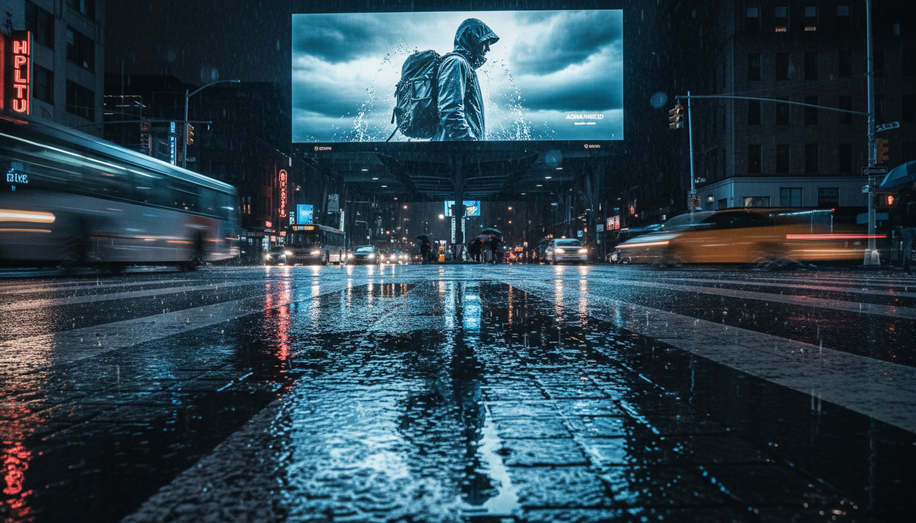

In out-of-home advertising, context has always mattered. A billboard does not exist in a vacuum; it sits in traffic, on a street corner, above a retail park, beside a train platform, or across from a landmark that already shapes how people feel, move, and make decisions. The best OOH creative understands this basic truth and uses it to its advantage. Rather than treating the environment as background noise, standout campaigns now increasingly treat it as part of the message itself.
That shift is especially important as brands compete for attention in increasingly crowded public spaces. The old model of simply scaling up a polished visual and dropping it into a large-format frame is no longer enough to guarantee memorability. People encounter OOH in motion, often for only a few seconds, and the creative has to work harder to earn a glance, a second look, and ideally a response. When designers reflect the surrounding landscape, architecture, or urban rhythm in the execution, they give viewers something instantly legible and emotionally resonant. The ad feels like it belongs where it is.
Environmental cues can operate in subtle ways. A campaign near a station might borrow the geometry of railway lines, departure boards, or platform signage to create a visual language that feels native to the setting. A gym brand placed along a commuting route could use the language of motion, repetition, and endurance in a way that mirrors the daily movement of its audience. In retail districts, creative that acknowledges storefronts, queues, pavements, and shopper behavior can feel more immediate than a generic brand image. The key is not to decorate the ad with local references for their own sake, but to translate the environment into a design idea that strengthens the brand’s message.
Architecture offers some of the richest opportunities. Cities are full of distinct forms, surfaces, and sightlines, and smart OOH creative can respond to them with precision. A clean, minimalist campaign can look powerful against a dense urban backdrop, while a more playful execution can use building lines, windows, or shadows to create optical effects that stop passersby in their tracks. Murals and large-scale installations have long demonstrated how effective it can be when an advertisement appears to interact with its physical surroundings, whether by extending a street scene, echoing a facade, or framing a landmark in a clever visual twist. These kinds of treatments can make the medium feel less like an interruption and more like a curated part of the cityscape.
Urban context also provides clues about audience mindset. People waiting in a bus shelter are not in the same frame of mind as people leaving a concert, driving past a roadside panel, or navigating a shopping center. Designing for these micro-moments means thinking beyond demographics and into lived experience. What is the viewer doing? What are they likely noticing? What is the mood of the space at that hour, in that weather, or during that event? Contextual creativity is strongest when it meets people where they already are, both physically and mentally. That is why the most effective OOH work often feels timely without shouting about it.
Data has made this approach more sophisticated. Location intelligence, footfall patterns, weather triggers, local event calendars, and time-of-day activation all help brands align creative with the real world. But data alone does not create relevance. It simply gives designers better raw material. The creative challenge is to turn those inputs into ideas that feel human, not mechanical. A rainy day message should not just mention rain; it should capture how that weather changes behavior, mood, and need. A stadium-adjacent campaign should not merely cite the match; it should tap into the anticipation, ritual, and communal energy that surround the event.
For designers, this means balancing brand consistency with environmental responsiveness. The most memorable contextual OOH does not abandon brand codes; it amplifies them through the lens of place. Color palettes, typography, illustration styles, and tone of voice can all remain recognizably on-brand while still adapting to local cues. In fact, context often makes brand identity clearer, not weaker, because it gives the audience a reason to notice it. Relevance is not a departure from branding. It is a route to stronger branding.
As public spaces become more media-rich, the bar for creativity keeps rising. Consumers are increasingly responsive to advertising that feels useful, intelligent, and situated in the world they are actually moving through. For OOH, that is a major advantage. No channel is better placed to connect message and environment in real time. The creative that succeeds will be the creative that listens to its surroundings, borrows from them thoughtfully, and turns place into part of the story. In out-of-home, context is not just king. It is often what makes the work impossible to ignore.