
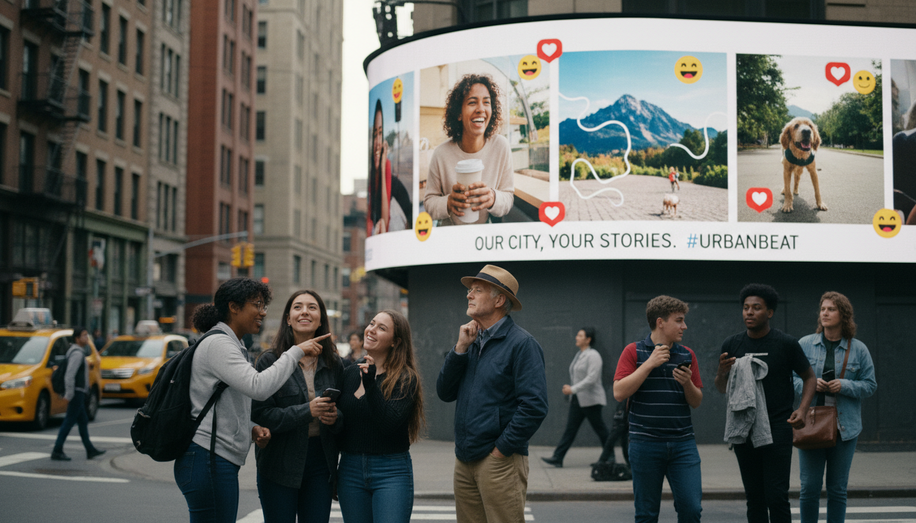

In the bustling heart of Times Square, a digital billboard flickers to life, not with polished ads from a creative agency, but with a cascade of selfies from everyday people posing alongside images of endangered animals. This was National Geographic’s #SaveTogether campaign, where passersby snapped photos at street-level displays, posted them to social media with a hashtag, and saw their contributions projected onto massive DOOH screens moments later. Such real-time integration of user-generated content (UGC)—social media posts, fan art, testimonials, and more—marks a seismic shift in out-of-home (OOH) advertising, transforming static billboards into dynamic hubs of authentic engagement.
UGC, defined as any photos, videos, reviews, or posts created by real users rather than brands, injects genuineness into marketing that consumers crave. In an era where 86% of consumers trust peer recommendations over traditional ads, digital out-of-home (DOOH) displays offer a perfect canvas for this content. Unlike printed billboards, DOOH’s programmability allows brands to pull live feeds from Instagram, TikTok, or Twitter, curating and displaying user submissions in real time. This creates a feedback loop: viewers become participants, fostering community and virality that extends far beyond the physical space.
Coca-Cola’s “Share a Coke” campaign exemplifies the power of this approach. By personalizing bottles with popular names and urging fans to share photos under #ShareaCoke, the brand generated floods of UGC. Extending this to DOOH, Coca-Cola displayed selected user posts on digital billboards, turning public spaces into personalized shoutouts that amplified social sharing. Similarly, Starbucks’ “White Cup Contest” invited customers to decorate plain cups and post creations with #WhiteCupContest. Winning designs appeared not just online but on DOOH screens in high-traffic areas, blending fan creativity with massive visibility and sparking organic buzz.
Fashion and lifestyle brands have leaned heavily into fan art and testimonials for DOOH authenticity. Glossier, known for reposting customer selfies over professional shoots, could rotate real-user stories on billboards outside its stores, emphasizing relatability. Parachute’s #MyParachuteHome campaign swapped staged photos for authentic home snaps shared by buyers; imagine these projected on urban DOOH networks during peak hours, inviting locals to submit their own for a chance to feature. This not only builds trust but drives foot traffic, as seen in Aerie’s body-positive campaigns where unretouched user images fostered loyalty through emotional resonance.
Interactive elements supercharge UGC on DOOH, turning passive viewers into active contributors. Reebok’s speed-test billboard in Stockholm used motion-tracking cameras to clock pedestrians’ sprints, displaying top times and leaderboards—prime for overlaying user-submitted videos of their runs via social hashtags. Netflix took it further with a virtual battle setup: viewers tweeted support for movie characters, and the DOOH screen updated live with animated fights based on vote tallies, incentivizing repeated shares. Gymshark’s playful “shoplifting” stunt pinned real clothes to billboards, revealing discount codes as items were taken; pairing this with UGC from participants’ photos could create a chain reaction of community-driven promotion.
Events like the Super Bowl have long harnessed this for spectacle. Organizers used QR codes and stadium screens to feature fan videos and posts in real time, making attendees feel like co-creators. Doritos’ #CrashtheSuperBowl contest let fans craft ads for national airtime, with winning entries dominating DOOH rotations pre-game, generating buzz through sheer creativity. KitKat’s touch-activated massage billboards evoked its “Have a Break” slogan; imagine users tweeting their relaxation moments for instant DOOH replays, blending touch with social proof.
For brands eyeing implementation, the tech is accessible via platforms that integrate social APIs with DOOH networks. Curate submissions with moderation tools to ensure brand safety, then schedule displays triggered by location, weather, or time—e.g., eBay’s weather-tied ads could layer user testimonials for rainy-day relevance. GMC’s facial-recognition billboards tailored content by demographics, easily enhanced with UGC from smiling families sharing their experiences.
Challenges persist: content volume can overwhelm, and privacy concerns demand clear opt-ins. Yet successes abound. GoPro thrives by showcasing user-captured action footage, perfect for adrenaline-pumping DOOH loops that inspire submissions. Duolingo’s TikTok challenges with influencers drove app downloads; scaling to DOOH could feature live user streaks in city centers.
Ultimately, leveraging UGC on digital billboards redefines OOH as a living conversation. It humanizes brands, boosts engagement metrics—studies show interactive DOOH yields 47% higher recall—and cultivates advocates who amplify reach exponentially. As screens evolve with AR and AI, expect more campaigns where the crowd’s voice drowns out the script, proving authenticity isn’t just buzzworthy—it’s billboard gold.