
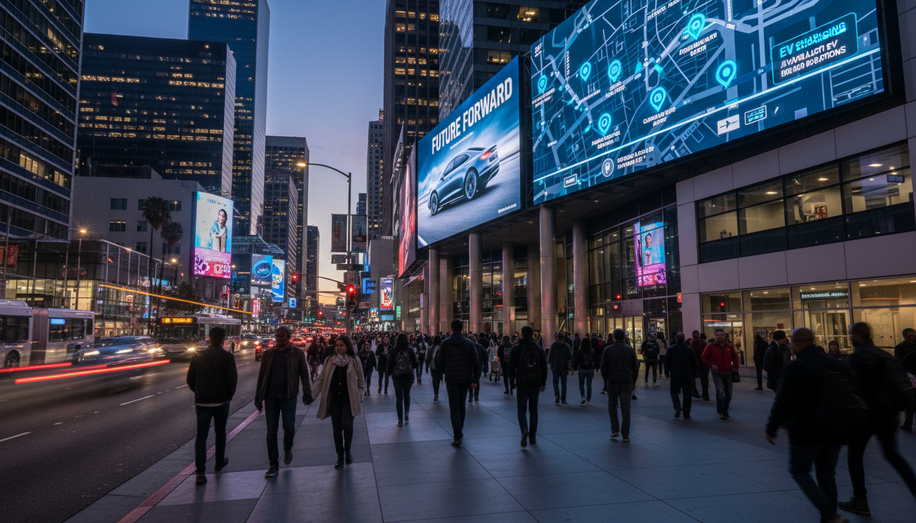

OOH Advertising Charges Ahead: Seizing Electric Vehicle Opportunities
EV growth is supercharging out-of-home (OOH) advertising, from digital screens on charging stations to eco-friendly mobile billboards, offering brands targeted reach and sustainable messaging. (148 chars)
The electric vehicle (EV) revolution is reshaping roadways and redefining out-of-home advertising. With EVs projected to claim 9.1% of U.S. vehicle sales in 2025—rising to 26% by 2030—advertisers are adapting swiftly to capture this expanding, eco-conscious audience. No longer confined to static billboards, OOH is going mobile, digital, and green, leveraging EV infrastructure and fleets for unprecedented visibility and relevance.
At the forefront are EV charging stations, emerging as prime real estate for digital OOH. As EV adoption surges, charging networks are proliferating, particularly along highways and in urban hubs, creating captive audiences during downtime. These stations now integrate high-resolution LED screens that display dynamic ads while vehicles recharge, blending convenience with compelling messaging. This setup turns wait times into engagement opportunities, with screens capable of real-time content updates via AI and geofencing for location-specific targeting. Brands can deliver hyper-personalized promotions—think offers for nearby sustainable products or services tailored to environmentally aware drivers—boosting recall and conversions. In markets like India, government incentives for charging infrastructure have already spurred OOH integrations, positioning these spots as “the next big out-of-home advertising medium.”
Partnerships with charging operators amplify this potential. Advertisers collaborate directly with networks, securing premium placements that align with sustainability narratives. For eco-focused brands, this is a natural fit: ads on charging stations reinforce green credentials without hypocrisy, as the medium itself supports low-emission mobility. Studies highlight how such placements resonate, with mobile digital formats achieving up to 70% higher recall than static billboards, thanks to motion, brightness, and relevance. Imagine a coffee chain promoting its plant-based menu to charging EV owners, or a tech firm showcasing solar gadgets—messaging that feels authentic and timely.
Beyond stations, OOH is electrifying its own fleets. Mobile billboards are transitioning to hybrid and electric-powered trucks equipped with energy-efficient LED displays, slashing carbon emissions while cutting operational costs. These “digital LED trucks” dominate 2025 trends, offering nationwide reach and AI-driven personalization. Screens brighten with sharper imagery, integrate IoT for performance tracking, and even incorporate solar panels for off-grid power, making them among the greenest OOH options available. In 2024 campaigns, such trucks toured 15 cities for a tech brand, driving measurable brand awareness and action through mobility that static formats can’t match.
Targeted messaging is key to capitalizing on the EV wave. Urban EV fleets—electric buses, cabs, and rickshaws—navigate high-density areas frequented by socially conscious consumers, ideal for brands pushing sustainability. Silent and tech-savvy, these vehicles double as moving billboards with dynamic digital wraps, enabling real-time tweaks like weather-responsive or event-tied content. Location-based geofencing triggers ads precisely when vehicles hit prime zones, such as business districts or residential areas, ensuring messages land with impact. This data-driven precision, paired with EV’s eco-appeal, helps brands stand out: digital vehicle screens boast 5x higher recall than traditional wraps, eliminating wasteful materials like vinyl in favor of sustainable tech.
Government policies are accelerating this synergy. Subsidies and tax benefits in the U.S., Europe, China, and India bolster EV infrastructure and adoption, indirectly fueling OOH innovation. Cities like Delhi and Mumbai are mandating electric public transport, handing advertisers future-proof placements on e-buses and cabs amid smart city rollouts. Public-private partnerships further open doors, with brands co-funding green campaigns that promote mobility while amplifying their reach.
Challenges persist, including regulatory pressures and a partial resurgence of traditional methods in 2025, as some innovative trends stabilize amid tech fluctuations. Yet, the momentum favors adaptation. OOH’s evolution mirrors EV growth: mobile, intelligent, and sustainable. Digital trucks project a $2.07 billion market, underscoring the scale.
For advertisers, the playbook is clear: partner with EV charging networks for stationary impact, deploy electric mobile billboards for roaming coverage, and craft messaging that celebrates progress—sustainability, innovation, modernity. This isn’t just adaptation; it’s leadership in a charged future. Brands ignoring it risk fading into the background, while pioneers will electrify their presence on every plugged-in journey.
(Word count: 712)