
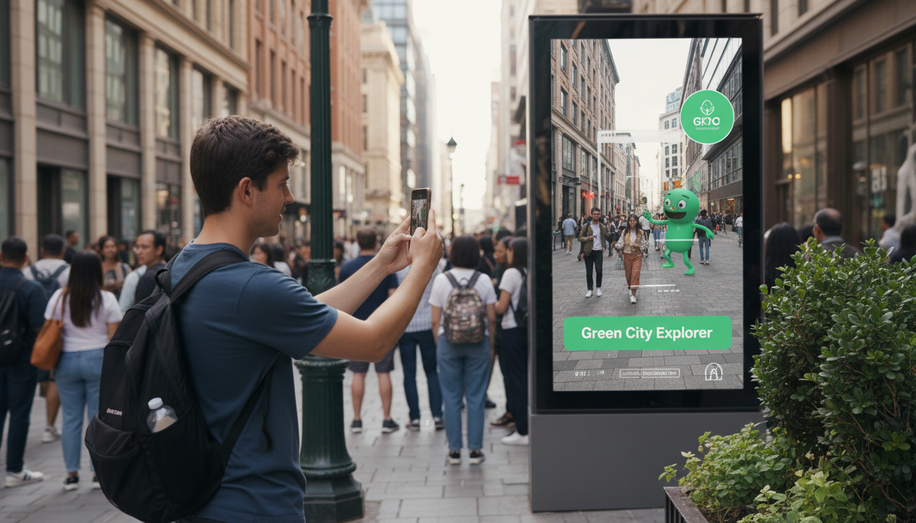

In the bustling streets of modern cities, where commuters rush past towering billboards and vibrant murals, augmented reality is reshaping out-of-home advertising into a dynamic bridge between the tangible world and digital wonder. No longer confined to static images, OOH campaigns now invite passersby to unlock immersive experiences with a simple smartphone scan, turning everyday urban landscapes into interactive playgrounds that captivate and convert.
Consider Verizon’s ambitious 2024 rollout during Art Basel in Miami, a collaboration with BrandXR that brought three AR-enhanced murals to life in Midtown, Coconut Grove, and Hialeah. Pointing a phone at the Midtown mural—a canvas of towering skyscrapers and abstract shapes—unleashed animated lights, moving vehicles, and futuristic cityscapes, vividly illustrating Verizon’s connective prowess. In Coconut Grove, lush greenery merged with neon circuit boards as digital vines crept across the surface, symbolizing harmony between nature and innovation. Hialeah’s culturally rich design transformed portraits of locals into 3D visions of community powered by Verizon’s network. Powered by Snapchat’s WebAR, these murals generated a flood of user-generated content on social media, amplifying the brand’s presence amid Art Basel’s global spotlight.
This fusion of art and technology echoes in Electrifly Detroit, where 15 murals across metro Detroit streets became portals to multidimensional storytelling. Festival-goers downloaded the Electrifly app to reveal animations, audio narratives, and explorable 3D elements layered atop the artwork, courtesy of BrandXR’s platform. What began as a static painting sprang into motion, narrating tales tied to each artist’s vision and drawing thousands into active participation. Such accessibility—requiring no specialized hardware—democratized AR, proving that OOH can evolve from passive observation to personal engagement.
Brands like Vodafone have taken this further with AR billboards that surprise urban dwellers, overlaying 3D graphics, interactive text, and mini-games onto seemingly ordinary displays. A quick camera scan reveals portals promoting the latest tech, sparking conversations and viral shares. Real-time analytics track interactions, dwell times, and resonant elements, allowing advertisers to refine campaigns on the fly. Embedded calls-to-action, such as unlockable coupons, funnel users to nearby stores, directly boosting foot traffic and sales.
Earlier pioneers set the stage for this surge. Pepsi Max’s 2014-2015 “Unbelievable” bus shelter in London used hidden cameras and AR to conjure surreal spectacles: asteroids crashing, UFOs hovering, tigers prowling, and tentacles rising from sidewalks. Captured live and projected onto shelter screens, these illusions went viral, amassing over six million YouTube views and cementing Pepsi as a master of street-level surprise. Similarly, Cadbury commandeered London’s Waterloo Station in 2014 with a massive 120m² digital screen turned AR game, inviting passengers to interact and compete, blending motion with brand playfulness.
Guerrilla tactics shine in Burger King’s Brazil “Burn that Ad” campaign, where the app let users “set fire” to rival burger billboards, replacing them with Whopper coupons redeemable nearby. This cheeky interactivity not only hijacked competitors’ space but forged emotional bonds through playful rebellion. Ally Bank’s Monopoly-themed treasure hunt across six U.S. cities installed 36 physical game-board squares, each scan unlocking WebAR animations of Mr. Monopoly dispensing points and prizes to demystify financial literacy in a fun, gamified hunt.
Even nonprofits harness AR’s pull. The NHS campaign simulated blood donations on interactive posters, showing virtual life-saving impacts in real time, fostering empathy and action. National Geographic’s 2013 Rotterdam train station activation let commuters “step into” dinosaur eras or spacewalks via screen interactions, immersing them in the brand’s exploratory ethos.
These examples underscore AR’s transformative edge in OOH: heightened engagement through participation, where users co-create the narrative rather than merely view it. Static ads fade into the background; AR demands attention, with studies showing dwell times tripling and share rates soaring. Platforms like BrandXR and WebAR lower barriers, enabling scalable deployments without apps, from murals to billboards.
Yet challenges persist. Technical glitches or poor lighting can frustrate users, and equitable access hinges on smartphone penetration. Still, as 5G proliferates and spatial computing advances, any urban surface—from bus shelters to retail displays—becomes a billboard ripe for AR magic. BON V! V Spiked Seltzer’s Los Angeles WebAR portals, for instance, turned in-store ads into safari adventures with animated animals and facts, proving the format’s versatility beyond streets.
Looking ahead, AR OOH promises longevity: campaigns refresh digitally without repainting, sustaining buzz. Toyota’s Crown AR billboards and Coca-Cola’s taste-evoking displays hint at sensory expansions, while Maybelline’s London Underground faux-OOH layered beauty tutorials onto transit ads. By blurring physical and digital realms, AR doesn’t just advertise—it transports consumers, forging memorable connections that linger long after the scan ends. In an era of fleeting attention, this is advertising reimagined: always on, profoundly interactive, and unforgettably alive.