
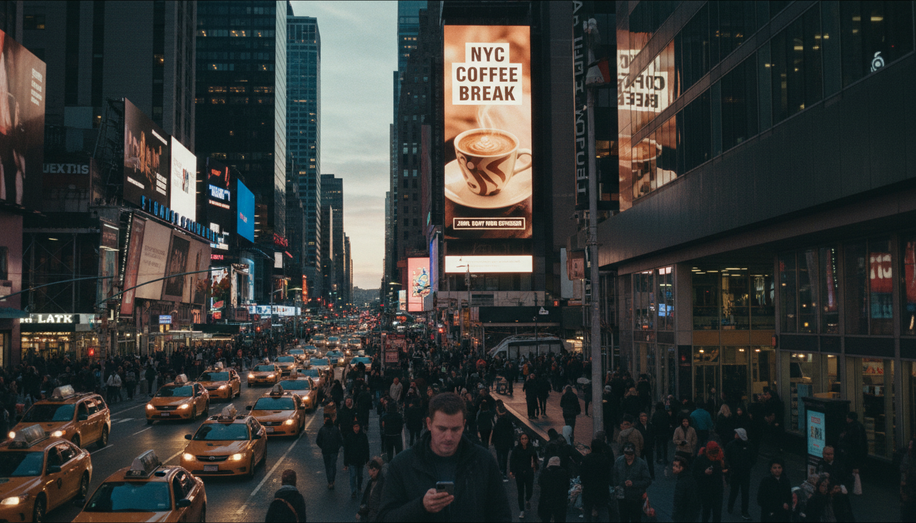

Harnessing AI for Location-Based Marketing: Programmatic DOOH Rewrites the Rules of Reach
Meta description: How AI-powered location-based marketing and programmatic DOOH are reshaping digital billboards, targeting, and real-time audience engagement.
Artificial intelligence is pushing location-based marketing into a new phase of precision and accountability. As programmatic digital out-of-home moves mainstream, agencies and brands are rethinking what a “media impression” looks like in physical space.
Digital billboards, street furniture, and place-based screens are no longer static canvases. They are data-driven endpoints plugged into AI models that interpret movement patterns, context, and intent at city scale, then trigger creative in milliseconds.
An industry at an inflection point
Location-based marketing has matured from simple geofencing to AI-led decisioning that fuses GPS, mobility, weather, and purchase data. By 2025, AI is already reshaping location strategies with hyper-local personalization, real-time geo experiences, and predictive analytics that forecast demand by block and hour.
This sophistication is driving budget shifts. Research on location-based AI marketing shows 84% of marketers now use location data and 94% plan to increase usage, reflecting its strategic role in personalization and performance media. Programmatic DOOH is the natural beneficiary as buyers look for channels that can operationalize this data in near real time.
Marketers are also responding to consumer behavior. Opt‑in rates for location-based campaigns remain relatively strong, with more than half of users willing to receive push notifications when they see a clear value exchange. That gives brands room to lean into contextual, utility-focused messaging instead of pure brand broadcast.
From geo-fencing to geo-intelligence
The core shift is from basic proximity targeting to what many platforms now describe as geo-intelligence. AI models ingest signals from GPS, Wi‑Fi, mobile apps, traffic flows, and IoT sensors to predict where high-value audiences will be and when.
Rather than buying a single billboard for a week, advertisers can activate thousands of screens programmatically, only when a defined audience threshold is likely present. For example, a mobility dataset might show that “commuter cyclists, weekday mornings, dry weather” cluster at certain intersections. AI then automates bidding and creative rotation across those screens when conditions match the pattern.
This level of micro‑segmentation is becoming standard. Instead of broad demographics such as “women 25–44,” AI location tools can target “office workers who visit coffee shops on weekday mornings and gyms after 6pm,” then align DOOH placements along those journeys. Brands use that insight to coordinate mobile, CTV, and OOH for sequential storytelling along a daily route.
Real‑time triggers and responsive storytelling
Real-time decisioning is where AI and programmatic DOOH most visibly intersect. Location-based AI systems scan for triggers such as weather changes, traffic congestion, event schedules, or store footfall spikes. When a trigger fires, the system automatically pushes new creative to nearby digital screens.
Weather-based DOOH is now common: coffee brands serve steaming drinks when temperatures drop; ice cream brands tilt spend toward hot afternoons. But AI is broadening the palette of triggers to include inventory levels, last-mile delivery capacity, and even local air quality, using sensor data to make messaging feel timely and relevant.
The result is a more dynamic public media environment. A single screen may cycle through dozens of creative strategies in a day, depending on audience mix and contextual signals. For media planners, the task is shifting from choosing locations to designing trigger frameworks and guardrails the AI executes against.
Economic momentum behind AI-driven location media
Market forecasts point to sustained growth in location-based marketing spend, with some analyses projecting compound annual growth rates above 15% for the broader market and more than 17% for geofencing specifically through 2030. While those figures span multiple channels, DOOH is increasingly central as the only truly public, high-reach location format.
Case studies from retailers and quick-service brands show why. Starbucks, for example, has used geolocation and AI to push localized offers when customers are near stores, reporting significant lifts in footfall and as much as 25% sales increases in targeted zones. When that same logic is applied to roadside and place-based screens, DOOH becomes an upper-funnel amplifier for proven mobile tactics.
Programmatic buying models make that shift easier. Buyers can test AI-driven location strategies in DOOH with modest budgets, measure against store visits or app activity, then scale spend to the top-performing routes, venues, and time windows. The economics start to look closer to digital performance channels than traditional OOH.
Privacy, regulation, and trust
The expansion of AI in location-based marketing is not without friction. Privacy regulation and platform-level changes are forcing the industry to reconsider how location data is collected, processed, and shared. Marketers now face tighter controls on precise geo data and must justify its use with clear utility and transparency.
This is pushing vendors toward more aggregated, model-based approaches. Instead of tracking individuals, AI systems increasingly work with anonymized cohorts and probabilistic movement patterns. That allows advertisers to preserve targeting accuracy at the screen level while reducing reliance on personally identifiable information.
Consumer sentiment is another constraint. Even with relatively high opt‑in rates to location-based communications, people are wary of feeling surveilled. The most successful AI-enabled DOOH campaigns tend to be those that offer contextual value—such as live travel updates, local offers, or service information—rather than hyper-personalized messaging that risks crossing the “creepy” line in public space.
Where AI and location-based DOOH go next
Looking ahead, marketers expect AI-led automation to grow, not shrink, in DOOH and wider location-based marketing. Consulting and industry reports point to AI-driven personalization and optimization as the most impactful trends in marketing as a whole by mid‑decade. In OOH, that means more screens plugged into unified demand-side platforms, more data partnerships, and more experimentation with predictive models.
At the same time, the definition of “screen” is expanding. As 5G, AR, and connected vehicles roll out at scale, the boundary between personal and public media will blur further. An AI system that today decides what runs on a roadside billboard could soon orchestrate content across that billboard, a driver’s dashboard, and a commuter’s phone, all based on shared location context.
For agencies and brands, the strategic question is no longer whether to use AI in location-based marketing, but how deeply to embed it into planning, creative, and measurement. Programmatic DOOH sits at the center of that shift. Treated as a data-native channel rather than a digital veneer on traditional OOH, it offers a path to more accountable reach in the physical world—one decisioned impression at a time.