
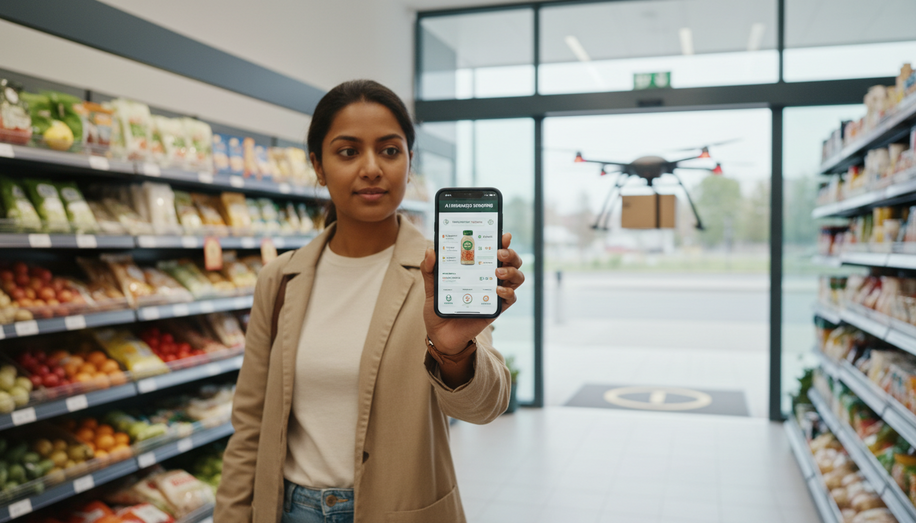

In the bustling halls of the National Retail Federation’s Big Show in New York City, Google CEO Sundar Pichai and incoming Walmart CEO John Furner took the stage on Sunday, unveiling a transformative partnership poised to redefine retail by 2026 and beyond. Their joint keynote painted a vivid picture of a shopping future powered by artificial intelligence and drone delivery, where conversational AI chatbots handle everything from product discovery to checkout, and drones whisk orders to doorsteps in minutes.
At the heart of the announcement is the deep integration of Walmart and Sam’s Club products into Google’s Gemini AI chatbot, now boasting over 650 million monthly users. Shoppers will soon query Gemini for recommendations, compare prices in real time, and complete purchases entirely within the chat interface, drawing on Walmart’s live inventory, assortments, and pricing data. Loyalty members can link their accounts, unlocking personalized suggestions based on shopping history—whether from in-store visits or online orders—making every interaction feel tailor-made. “We think the future will be very personalized, it will be very convenient,” Furner declared, positioning AI not as a backend tool but as the primary customer interface.
This seamless commerce experience hinges on Google’s newly introduced Universal Commerce Protocol (UCP), an open industry standard co-developed with Walmart, Shopify, Etsy, and Target. UCP enables AI agents to interact directly with retailers’ systems, personalizing offers, loyalty prompts, and messages while keeping retailers as the merchant of record. Pichai emphasized control for merchants: “The retailer is able to shape the relationship at every step.” Powered by Google’s Shopping Graph—encompassing over 50 billion product listings with real-time pricing, reviews, and inventory—Gemini positions Google to compete fiercely against rivals like OpenAI, Microsoft, and Anthropic in the shift from traditional search to agentic commerce.
Furner, set to assume Walmart’s top role in February, framed the move as “the next great evolution in retail,” with Walmart driving rather than reacting to the platform shift. The rollout begins in the U.S., blending Gemini’s AI prowess with Walmart’s delivery network for under-three-hour fulfillment in many cases, and as fast as 30 minutes for select items. International expansion follows, underscoring Walmart’s multi-platform strategy that already includes ties with OpenAI alongside homegrown tools like the Sparky shopping assistant.
Complementing the AI push, the partnership accelerates Walmart’s drone delivery via Google’s Wing service, expanding from current hubs in Dallas, Orlando, and Atlanta to 150 more locations—including Miami and Los Angeles—for a nationwide total of 270 sites. In Atlanta, half of Wing users return repeatedly, with deliveries often under 20 minutes, though Furner candidly noted persistent regulatory and technical hurdles. This builds on Walmart’s existing drone operations, merging aerial logistics with AI-driven orders to compress the path from conversation to doorstep.
The NRF revelations signal retail’s accelerating embrace of “agentic AI,” where intelligent agents handle complex workflows from inspiration to fulfillment. Google reported surging retailer adoption of its AI tools year-over-year, with Pichai promising a “full stack approach” to shape retail’s next chapter. For Walmart, succeeding Doug McMillon’s tenure, Furner inherits a mandate for AI transformation, rewriting the playbook amid competition from Amazon and others.
Broader implications ripple through out-of-home advertising and retail media. As AI chatbots supplant web searches, OOH campaigns must evolve to drive traffic into conversational ecosystems, where dynamic, location-based ads feed real-time data to Gemini or rivals. Retailers retain customer relationships via UCP, but platforms like Google gain leverage through commerce infrastructure, potentially reshaping ad targeting around predictive shopping behaviors. Walmart’s drone footprint opens new possibilities for hyper-local OOH integrations, like geofenced promotions triggering instant drone orders.
Pichai and Furner’s vision isn’t without challenges—data privacy concerns, AI accuracy in recommendations, and drone scalability loom large—but their partnership positions Google and Walmart as frontrunners in a $30 trillion global retail market increasingly defined by speed, seamlessness, and smarts. “AI can improve every step of the consumer journey, from discovery to delivery,” Pichai said, a mantra that could echo across showrooms and screens alike. As 2026 unfolds, this alliance may not just shape shopping; it could redefine how retailers connect with customers in an agent-led world.