
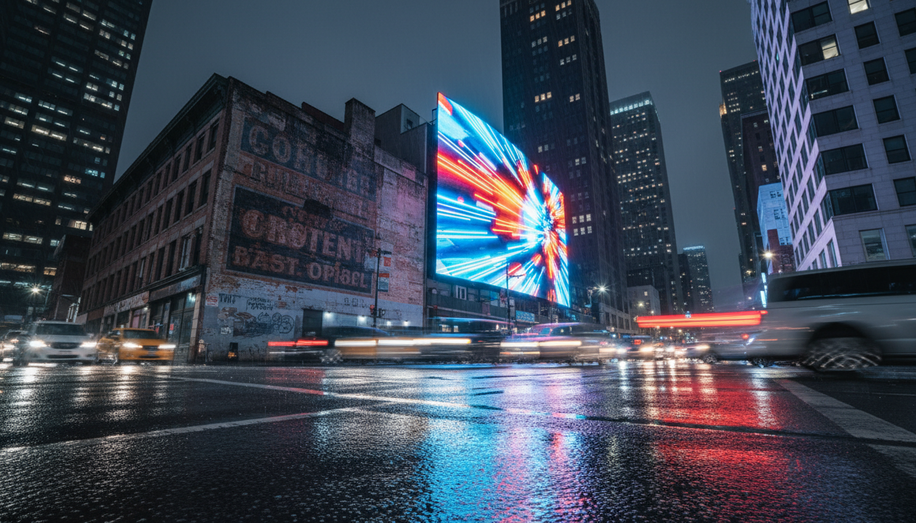

In the shadowed alleys of ancient Egypt, towering stone obelisks carved with proclamations stood as the first sentinels of public messaging, etching laws and decrees into the collective gaze of passersby. This primordial form of out-of-home (OOH) communication evolved into the hand-painted murals of medieval Europe, where artisans labored under open skies to adorn walls with vivid scenes promoting markets, saints, and sovereigns. These early masterpieces, born of painstaking craftsmanship, mirrored a culture tethered to oral traditions and visual spectacle, where every brushstroke conveyed authority and immediacy in an illiterate world.
The dawn of the modern era accelerated this artistry. In 1450, Johannes Gutenberg’s movable type birthed the handbill, but it was the perfection of lithography in 1796 that unleashed the illustrated poster, transforming OOH from bespoke murals into reproducible spectacles. By the late 19th century, American bill posters had organized into state associations, culminating in 1900 with a standardized billboard structure that spanned the continent. Brands like Palmolive, Kellogg, and Coca-Cola seized this uniformity, flooding highways with mass-produced panels that demanded attention through bold colors and slogans. Hand-painted signs, often executed by skilled “wall dogs” who scaled precarious scaffolds with buckets of paint, became icons of the urban skyline. These murals and billboards weren’t mere advertisements; they were cultural barometers, reflecting a burgeoning consumer society hungry for instant gratification amid industrialization’s roar.
This era’s aesthetic prized simplicity and scale—massive, unmissable imagery that cut through the haze of horse-drawn carriages and early automobiles. Yet, limitations loomed: static designs couldn’t pivot with fleeting trends, and weathering eroded their vibrancy. Cultural shifts toward speed and mobility in the early 20th century nudged OOH toward resilience. The 1942 introduction of the OBIE Awards by the Outdoor Advertising Association of America (OAAA) celebrated ingenuity, honoring designs that blended artistry with endurance. Billboards evolved into storytelling canvases, their handcrafted allure capturing America’s post-war optimism, from Route 66 diners to Hollywood premieres.
The digital revolution shattered these constraints, ushering OOH into a kinetic age. High-definition screens supplanted paintbrushes, birthing dynamic displays that rotated messages and pulsed with light. By the 21st century, digital out-of-home (DOOH) billboards introduced animations, interactivity, and real-time adaptability, turning passive viewers into engaged participants. Noticeability remained a constant marvel—surveys from 2019 to 2025 consistently report around 90 percent of adults spotting OOH ads monthly, with digital formats boosting recall to 80 percent or higher, outpacing other media. In bustling metropolises, 3D billboards emerged from static roots, leveraging LED technology to hurl virtual products into the street—think a tumbling soda can or a soaring smartphone that defies gravity.
These innovations reveal profound cultural undercurrents. Early hand-painted murals embodied communal craftsmanship, a slow-burn dialogue with the public in eras of scarcity and shared spaces. As lithography democratized visuals, OOH mirrored rising consumerism, broadcasting abundance to the masses. Digital artistry, however, speaks to our fragmented, on-demand existence. AI-driven updates now tailor content by time, weather, or traffic, personalizing the impersonal hoardings of yesteryear. A billboard might shift from a sunny beach ad to a cozy coffee invite as dusk falls, fostering intimacy amid urban anonymity. This evolution underscores communication’s pivot from broadcast to conversation: where murals commanded obedience, digital OOH invites response—81 percent of roadside viewers note messages, and many act by searching online or visiting stores.
Yet, this progression isn’t linear triumph; it’s a dialogue with society. The 1990 OAAA pact to curb ads for minors-only products reflected ethical maturation, while today’s diverse formats—street furniture, transit wraps, cinema screens—adapt to fragmented lifestyles. DOOH’s growth hasn’t diluted impact; consumer engagement hovers near 80 percent, proving technology amplifies rather than erodes human connection. 3D spectacles, once novelties, now symbolize immersive escapism in a screen-saturated world, echoing ancient obelisks’ awe but with pixels instead of chisels.
Looking ahead to 2025 and beyond, OOH design trends forecast fusion: AI-personalized holograms blending traditional boldness with hyper-local relevance. These shifts illuminate our cultural arc—from static proclamations of power to fluid expressions of desire. In an age of fleeting attention, OOH endures as the ultimate public canvas, evolving not just in form, but in its intimate understanding of how we see, share, and shape the world around us. Hand-painted ghosts linger in digital glows, reminding us that at its core, OOH has always been about capturing the human eye—and heart.