
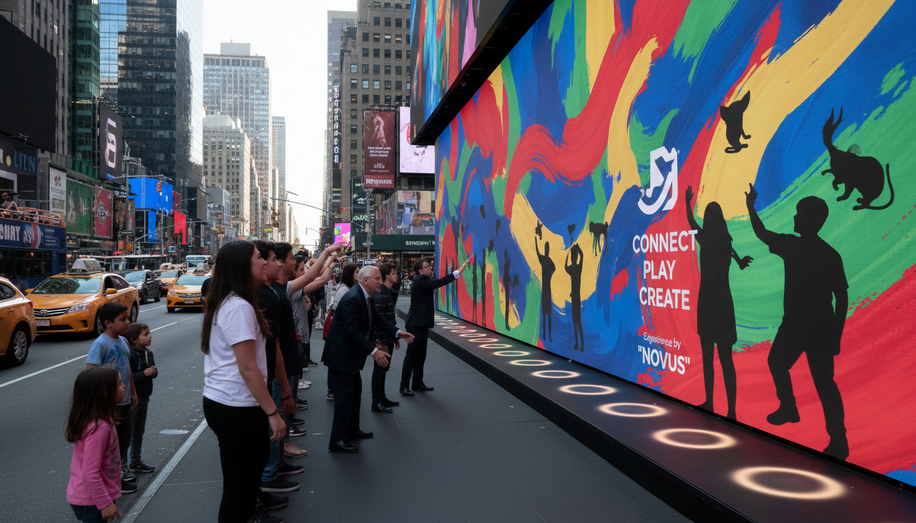

For years, out-of-home advertising was defined by its scale: big boards, big formats, big reach. Now, a different kind of scale is emerging—the depth of the experience. As cities become denser with digital noise, brands are turning outdoor spaces into stages, playgrounds and pop-up worlds where consumers do more than look; they touch, play, share and sometimes even help shape the story.
Experiential advertising in OOH sits at the intersection of media, live events and technology. Instead of a static message, it offers an encounter: a connected bus shelter that dispenses samples, an augmented reality mural that comes alive through a phone, or a takeover of a public square that turns passersby into participants. Interactive elements in outdoor environments are extending dwell time by encouraging active participation rather than passive exposure, with formats like touchscreens, motion sensors and AR filters leading the charge.
The shift is fueled in part by the evolution of digital out-of-home. Networks of LED screens and interactive displays now allow creative to change in real time, respond to weather, time of day or audience profiles, and integrate with mobile devices. A transit shelter can invite commuters to play a quick game tied to a brand story; a digital wall can recognize gestures and respond with personalized content. These experiences do more than entertain. By asking people to interact—to tap, swipe, scan or move—they create micro-commitments that deepen memory and emotional connection.
Live events and pop-up activations are amplifying that effect. Stadiums, festivals and city-center gatherings have become laboratories for high-impact experiential OOH, where audiences are primed to engage and dwell times are naturally longer. At sports arenas, brands are pairing giant LED boards with on-the-ground experiences: AR face filters tied to the jumbotron, live contests triggered via seat-side QR codes, or motion-activated games that play out simultaneously on the concourse and the main screen. The energy of the crowd becomes part of the creative, transforming a media buy into a shared moment that fans are eager to document and share.
Guerrilla-style outdoor installations are pushing the format even further. Brands are experimenting with street art takeovers, unexpected projections and pop-up “worlds” that appear overnight in high-traffic zones. These stunts often lean into surprise and spectacle—an oversized object dropped into a plaza, a façade that appears to crack open with 3D or AR effects—but their success hinges on human-scale interaction. When passersby are invited to step inside, scan a code, trigger an animation or co-create content, they are more likely to share the experience on social platforms, effectively multiplying the OOH investment through earned media.
Behind the spectacle is a strategic shift in what brands want outdoor media to do. Rather than serving solely as a reach vehicle at the top of the funnel, experiential OOH is being used to drive mid-funnel engagement and even direct action. QR codes and NFC taps link installations to microsites, loyalty programs, retail offers or social challenges. Real-time data from sensors and mobile integrations helps planners understand how many people interacted, for how long, and what they did next. Industry data suggests that interactive outdoor formats can increase dwell time by 20 to 40 percent, a critical metric when advertisers are vying for attention in busy urban corridors.
Technology is also blurring the line between physical and virtual experience. Augmented reality overlays turn murals, bus shelters and building façades into portals for deeper storytelling, while mixed-reality events allow a few hundred people on the street to share a moment simultaneously with thousands watching or participating remotely. A product launch might unfold in a single city square, yet be mirrored in VR for global audiences, extending the reach of an inherently location-based activation. For OOH, this hybridization means the impact of a physical installation is no longer capped by foot traffic alone.
The creative challenge is to balance novelty with authenticity. Consumers, especially younger demographics, are increasingly sensitive to experiences that feel gimmicky or invasive. Experiential outdoor campaigns that resonate tend to offer something of clear value: utility (wayfinding, charging, shelter), entertainment, self-expression, or community connection. They also increasingly reflect broader cultural priorities, from inclusivity and accessibility to sustainability in materials and production. As experiential design matures, questions about how long structures remain in place, where they go when dismantled and how they impact public space are moving from the margins to the briefing stage.
For OOH specialists, the rise of experiential advertising is reshaping how campaigns are planned and sold. Media owners are partnering more closely with event agencies, experiential shops and technologists to deliver integrated solutions rather than just locations. High-traffic sites are evaluated not only for impressions, but for their potential as “experience canvases”: is there room for a build-out, what are the sightlines, how does the crowd move, what digital infrastructure is available? Programmatic DOOH buying is starting to intersect with this world as well, allowing brands to trigger interactive creative only when certain audience or contextual thresholds are met.
What is emerging is a view of the city itself as a responsive interface—a global operating system where streets, stations and venues can be programmed with live, interactive brand stories. In this environment, experiential OOH becomes less about one-off stunts and more about an evolving layer of public content that people encounter, touch and shape as they move through their day. For brands vying for relevance in an attention-fragmented world, turning outdoor media into a place where experiences happen—not just messages appear—may be the clearest path to being remembered.
For brands navigating this new landscape, platforms like Blindspot become indispensable for transforming the city into a truly responsive interface. By leveraging advanced location intelligence, programmatic DOOH capabilities, and real-time audience analytics, Blindspot empowers advertisers to identify optimal ‘experience canvases,’ trigger contextually relevant interactive content, and precisely measure the deeper engagement and ROI that define successful experiential OOH campaigns today. Visit https://seeblindspot.com/ to learn more.