
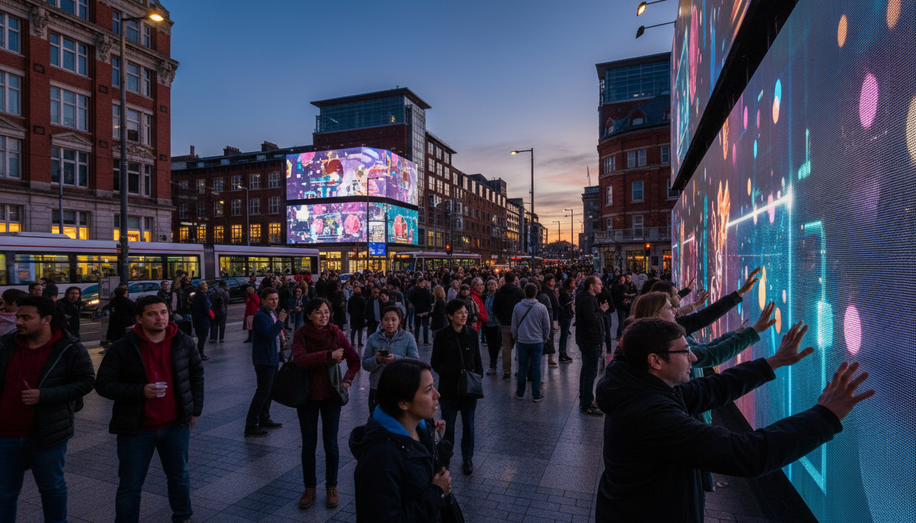

Engaging Consumers with Interactive Digital Billboards
Meta description: Interactive digital billboards are transforming OOH, using real-time data and two‑way engagement to capture attention and drive measurable action.
Interactive digital billboards are rapidly becoming the most compelling canvas in out-of-home, turning passive glances into active participation and trackable results. Brands are discovering that when a screen responds to people, people respond to brands.
The timing is ideal. Digital billboards already outperform static inventory on attention and impressions, with formats capturing significantly more views and up to 60% more impressions than traditional boards in comparable locations. Digital signage also delivers standout recall, with studies showing recall rates exceeding 80% for dynamic digital content. Layering interactivity on top of that attention advantage is giving marketers a powerful formula: high reach, deep engagement and robust data in a single medium.
At the heart of this shift is a move from one-way messages to two-way experiences. Interactive DOOH campaigns invite audiences to touch, speak, scan, vote, play or connect via mobile, often in real time. That participation is not just a gimmick; research on interactive content more broadly shows that more than 80% of marketers say it holds attention better than static formats and nearly as many say it enhances message retention. In a channel where dwell time is measured in seconds, anything that earns a few more of those seconds is strategic.
Mobile is the glue that makes much of this possible. QR codes, short URLs, NFC tags and social triggers are now common creative devices on digital billboards, bridging the gap between the street and the screen in consumers’ hands. Industry data indicates that around three-quarters of mobile users take some form of action—searching, calling or visiting a store—after seeing a digital billboard ad. By designing creative that explicitly invites that action, interactive campaigns convert fleeting attention into measurable behavior.
A typical example is the “play to unlock” format that has appeared in major city centers. Pedestrians are prompted to scan a QR code to take control of a game displayed on the billboard—anything from steering a car to painting a mural—with their phone acting as the controller. As they play, their name or avatar appears on the big screen, while the brand message frames the entire experience. Every interaction generates first-party engagement data, from time of play to dwell duration, and often opt-in contact details through prize mechanics.
Real-time data integration is another powerful dimension of interactive DOOH. Digital billboards can already adapt to time of day, weather or live events, optimizing relevance on the fly. Adding user input—such as live voting, crowdsourced content or social media feeds—turns these adaptive screens into dynamic public stages. Campaigns inviting passersby to vote via hashtag or microsite on a new product flavor, or to submit photos that are moderated and displayed within minutes, create a shared experience that feels both local and live.
The effectiveness of these approaches is visible in downstream metrics. DOOH as a category is strongly action-oriented, with studies indicating that more than three-quarters of viewers take some form of action after exposure, from visiting restaurants and stores to engaging with mobile content. Digital billboards in particular are associated with sharp spikes in branded search, website visits and app activity following campaign launches, as advertisers connect exposure to subsequent online behavior through location and traffic analytics. When creative includes a clear, trackable call to action, attribution becomes even more precise.
Measurement has become a central selling point for interactive DOOH. Beyond traditional impression counts, networks now offer impression analytics, foot-traffic evaluation, sales lift analysis and cross-channel retargeting tied to exposure. Interactive billboards add engagement metrics—participation rates, completion rates, scans, sign-ups, shares—that align OOH more closely with digital performance benchmarks. For OOH specialists, this data is a powerful tool in conversations with performance-focused clients who may once have viewed outdoor as a “brand-only” medium.
Campaigns leveraging personalization and contextual relevance also showcase the unique strengths of interactive digital billboards. Location-aware creative can change not just by time or weather but by audience density or behavior patterns, serving different messages when a nearby event ends or when commuting patterns peak. When that context is combined with user interaction—for instance, serving personalized offers to people who have just scanned or tapped—a physical screen becomes the front door to a digital journey tailored in real time.
For advertisers, the creative challenge is to design interactions that are simple enough to understand in an instant but rewarding enough to motivate participation. Successful campaigns typically feature a single, bold prompt—“Scan to play,” “Vote to see the result live,” “Share to appear on this screen”—paired with strong visual cues and minimal copy. Emotional resonance also matters: digital OOH that uses humor, surprise or urgency has been shown to significantly increase engagement and conversion intent over purely informational messaging.
As out-of-home continues its digital evolution, interactive billboards are redefining what a roadside, transit or city-center screen can do. With attention at a premium and digital fatigue driving many consumers away from cluttered online environments, a large-format, high-impact, responsive screen in the real world offers a rare combination: unavoidable presence, genuine participation and quantifiable outcomes. For brands and agencies, the question is less whether interactive digital billboards work, and more how quickly they can be integrated into the core media mix.