
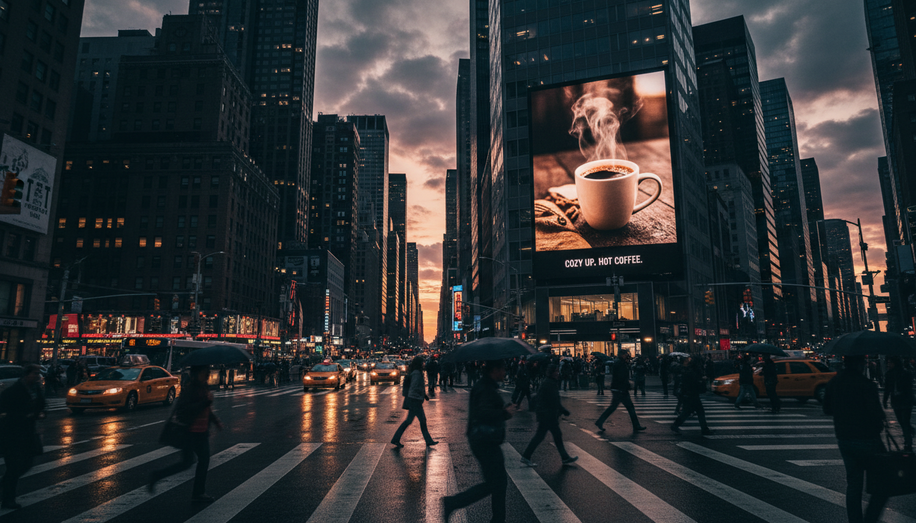

Digital out-of-home (DOOH) advertising has evolved from static billboards into a vibrant ecosystem of screens that pulse with real-time data, transforming passersby into captivated audiences. By integrating live feeds from weather stations, traffic sensors, sports APIs, and news wires, these displays deliver hyper-relevant messages that feel eerily personal, boosting engagement and proving that context is the ultimate currency in outdoor media.
Imagine driving through a sweltering city street on a scorching afternoon. A nearby DOOH screen flickers to life, not with a generic soda ad, but one featuring icy droplets cascading down a Coke bottle, tailored precisely to the mercury’s climb. Coca-Cola’s iconic campaign exemplified this precision: on hot days, billboards shifted to evoke refreshment, spiking sales during peak heatwaves by aligning visuals with the viewer’s immediate sensory reality. This isn’t coincidence; it’s dynamic creative optimization (DCO), where algorithms pull live temperature data to swap creatives in seconds, ensuring ads resonate when thirst—and attention—is at its height.
Weather triggers extend far beyond beverages. Sunsilk’s campaign across Manila and Mumbai harnessed rain sensors to activate ads touting frizz-fighting products the moment downpours began, achieving a 203% surge in potential views and 289% increase in unique reach over 57 days compared to static alternatives. Similarly, a Caribbean tourism board blanketed snowy Northeast U.S. screens with balmy destination forecasts during winter storms, stoking wanderlust by contrasting local chill with tropical promise. These examples underscore how real-time meteorology turns DOOH from interruption into invitation, with systems automating swaps based on predefined rules—no human intervention required.
Traffic data unlocks even sharper relevance, especially for mobility-focused brands. A major automotive campaign adjusted messaging on congested highways: jammed roads prompted ads highlighting plush interiors and infotainment, while free-flowing traffic emphasized speed and safety features. Retailers amplify this with location-based personalization, displaying nearest-store promotions complete with distances, directions, and ETA—pulled from GPS feeds—to convert impulse into action. Grocery chains tap regional inventory lists for hyper-local deals, ensuring screens in one neighborhood hawk avocados in season while another pushes seasonal berries, all updated dynamically.
Sports and news feeds inject urgency and shared excitement. During the 2022 ICC Men’s T20 World Cup, a global DOOH network across 2,211 screens in 662 locations blasted near real-time scores and highlights, generating 2.6 million plays via 149 unique creatives that refreshed relentlessly. Super Bowl or World Cup viewers encounter brand tie-ins with live tallies, transforming neutral spectators into engaged fans—and potential customers. News integration adds timeliness: countdown timers for lotteries flash current jackpots, building frenzy, while event-based promotions sync with local happenings, like an airline’s route-launch countdowns in high-traffic hubs that drove bookings within the first hour.
This data symphony doesn’t stop at triggers; it enables sophisticated personalization and measurement. Programmatic DOOH platforms fuse first-party data—like CRM loyalty records—with audience movement patterns, sequencing messages across a city’s screens to “follow” high-value segments on their daily paths. AHA targeted South Indian expatriates in U.S. cities using geo-fencing and footfall analytics, delivering 552,853 impressions in retail hotspots for outsized visibility. Dynamic content optimization layers in A/B testing, pitting variations against engagement metrics mid-campaign to refine what works.
The payoff is measurable: relevance breeds recall. Triggered campaigns outperform static ones by amplifying reach and utility, turning DOOH into a precision tool rather than broad awareness spray. Challenges persist—data privacy demands careful handling, and seamless integration requires robust APIs—but advancements in programmatic bidding and modular creatives are smoothing the path.
As urban screens proliferate, powered by weather, traffic, scores, and headlines, DOOH elevates advertising from spectacle to conversation. Brands that master these live feeds don’t just capture eyes; they anticipate needs, fostering loyalty in the fleeting moments of real-world encounters. In an era craving authenticity, this real-time alchemy positions DOOH not as the future of out-of-home, but its intelligent present.