
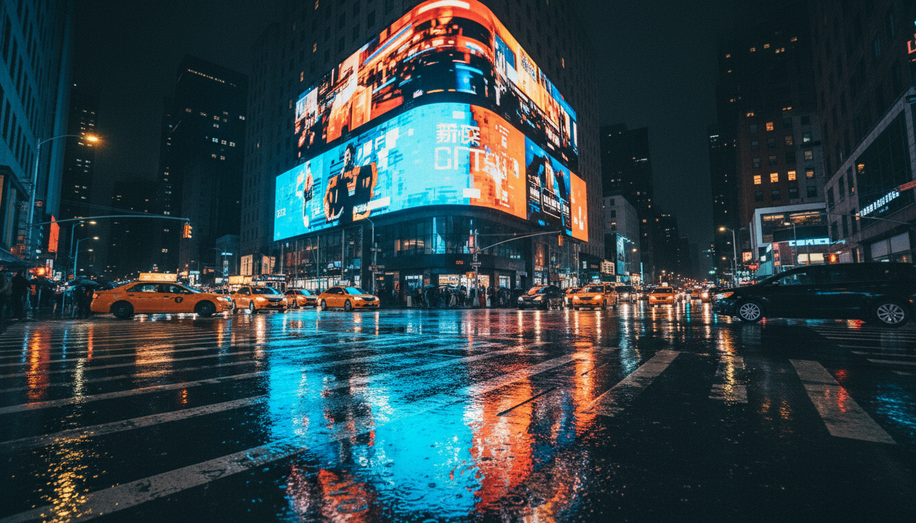

In the split-second world of out-of-home (OOH) advertising, where drivers glance at a billboard from a moving car or pedestrians steal a fleeting look at a transit wrap, design must seize attention and etch the message into memory. Success hinges on fundamental principles—color psychology, typography, visual hierarchy, and message brevity—that transform passive exposure into lasting recall, often in under eight seconds.
Color psychology forms the emotional backbone of OOH visuals, leveraging innate human responses to evoke feelings and guide perception instantly. Red commands urgency and excitement, ideal for clearance sales or fast-food calls to action, while blue instills trust and calm, suiting banks or healthcare brands. High-contrast pairings amplify this effect: a vibrant yellow CTA against a deep navy background ensures the message pops amid urban clutter, reducing cognitive load and boosting readability from afar. Designers must consider context too—daylight washes out pastels, so saturated hues dominate daytime billboards, while neon accents thrive at night. This strategic use not only grabs the eye but embeds brand associations subconsciously, as studies show color alone can influence 85% of purchasing decisions.
Typography serves as the verbal anchor, demanding legibility at speed and distance. Bold, sans-serif fonts like Helvetica or Futura reign supreme in OOH, their clean lines cutting through motion blur where ornate serifs falter. Scale is paramount: headlines dwarf supporting text, often spanning 20-30% of the canvas to dominate the visual field, while body copy shrinks to essentials—never more than seven words per line. Kerning and leading create rhythm, preventing letters from merging into an indecipherable smear. In practice, a campaign for a ride-sharing app might blast “RIDE NOW” in 10-foot-tall letters, paired with a modest logo and tagline below, ensuring the core imperative registers before the viewer passes by.
Visual hierarchy orchestrates this chaos into a deliberate flow, dictating what the eye hits first, second, and last. By manipulating size, contrast, whitespace, and placement, designers create a natural pathway that funnels attention from hook to finisher. The largest element—say, a heroic product image or explosive headline—claims focal primacy, drawing gaze like a magnet. Contrast then spotlights the next layer: a pulsing CTA button amid muted tones screams “act now.” Whitespace acts as a conductor, grouping related items through proximity and providing breathing room that eases the brain’s processing in high-speed scenarios. Proximity binds logo to tagline, alignment creates seamless progression from top-left to bottom-right, mirroring natural reading paths. In DOOH, where screens rotate content, this hierarchy resets every cycle, reinforcing recall through repetition without fatigue.
Message brevity ties these elements together, distilling complex ideas into haiku-like precision. OOH thrives on the “7×3 rule”—no more than seven words across three lines—because the average dwell time hovers at 3-5 seconds. Extraneous details dilute impact; instead, pair a single, vivid benefit with a brand hook. Consider Nike’s iconic “Just Do It”: three words, infinite resonance, amplified by stark black-and-white hierarchy and motivational red accents. Brevity demands ruthless editing—cut adjectives, fuse concepts, test at speed. When brevity meets hierarchy, the message doesn’t just land; it lingers, converting glimpses into mental sticky notes that influence later decisions.
These principles intersect in real-world triumphs. Coca-Cola’s billboards master color psychology with silver fizz against red, hierarchy via oversized bottle imagery leading to “Taste the Feeling,” and brevity in a five-word mantra. Transit ads for Spotify layer playlist visuals in a three-tier hierarchy—bold artist name, thumbnail art, tiny “Play Now”—all in high-contrast neons that pierce subway haze. Failures underscore the stakes: cluttered designs with tiny fonts or clashing colors vanish into irrelevance, as eye-tracking data reveals 70% of viewers ignore low-hierarchy ads.
Yet challenges persist in OOH’s unpredictability—varying light, angles, and viewer moods demand iterative testing. Tools like Figma enable rapid prototyping of scale and contrast, while AR previews simulate motion blur. Emerging DOOH tech adds dynamism: sequential frames build hierarchy over time, with color shifts heightening emotion. Still, timeless rules endure: prioritize the glance, honor the brain’s wiring.
Ultimately, OOH design isn’t about beauty alone; it’s engineered persuasion for the peripheral vision. By wielding color to emote, typography to clarify, hierarchy to direct, and brevity to imprint, creators craft ads that don’t just interrupt the commute—they hijack the memory.