
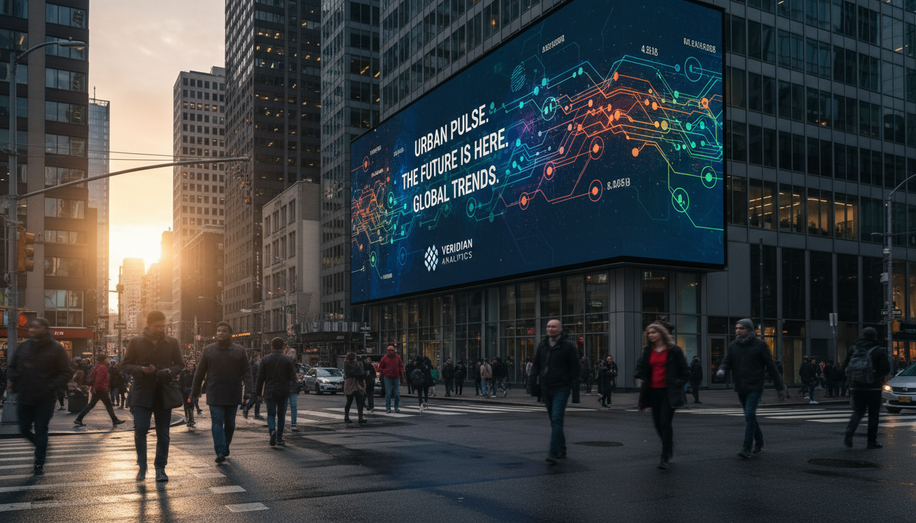

In the bustling streets of urban centers, where commuters rush past towering billboards and digital screens flicker with fleeting messages, out-of-home (OOH) advertising has long relied on bold visuals to capture attention. Yet as consumer data proliferates, a new frontier is emerging: data visualization techniques that transform raw analytics into compelling, memorable narratives right on the billboard itself. By distilling complex datasets—such as foot traffic patterns, demographic profiles, and real-time engagement metrics—into intuitive graphics, advertisers are elevating OOH from mere visibility to profound impact.
This shift is powered by location intelligence and mobility analytics, which provide the foundational data for these visualizations. Marketers now analyze geospatial information to map audience saturation, purchasing power, and brand affinity at specific sites, revealing not just who passes by but what drives their behavior. Imagine a digital billboard near a high-traffic mall visualizing peak-hour commuter flows as flowing rivers of color-coded dots, peaking in red during rush hour to signal optimal engagement windows. Such representations, drawn from mobile signal density and footfall data, allow brands to craft ads that resonate precisely when and where audiences are most receptive.
The magic lies in simplicity. Complex messages, like climate change statistics or health trends, often overwhelm in traditional formats, but data visualization simplifies them into striking icons and charts. For instance, a campaign for a sustainable energy provider could display swirling heatmaps of local carbon emissions, shrinking dramatically under the influence of their product—turning abstract numbers into a visceral call to action. Eye-tracking studies confirm that such elements—color gradients, dynamic animations, and minimalist typography—hold gazes longer, boosting recall by up to 40% in tested OOH efforts. These visuals exploit the brain’s preference for patterns, making intricate ideas stick in seconds, far outpacing static text.
Real-world applications underscore the potency. City Vision, an OOH specialist, integrated geofencing with social listening to visualize post-exposure interactions on a campaign for an FMCG brand, resulting in a 40% lift in brand recall. Heatmaps overlaid on billboards showed consumer movements funneling toward stores, attributing visits directly to ad exposure. Similarly, predictive analytics forecast optimal placements by rendering historical foot traffic as layered timelines, helping advertisers pinpoint high-engagement zones like event-adjacent streets or commuter hubs. In one retail case, heatmap analytics visualized a 30% surge in store visits post-campaign, guiding budget reallocations to proven locations.
Technology amplifies this further. AI-powered cameras and anonymous device tracking feed live data into DOOH screens, enabling real-time visualizations that adapt content dynamically. A billboard might pulse with impression counts—vehicles and pedestrians tallied as rising bars—while QR codes link to personalized microsites for deeper dives. Attribution modeling ties these visuals to outcomes, such as sales spikes or app downloads, by sequencing exposure logs with behavioral data. For beer brands, evening in-train visuals sync with nearby OOH displays showing recency-effect peaks, visualized as tightening proximity rings around convenience stores.
Predictive tools take it further, segmenting audiences via psychographic overlays on maps. Advertisers forecast responses by depicting consumer segments as clustered nodes—affluent millennials in blue near upscale districts, families in green at suburban routes—tailoring creatives accordingly. This not only maximizes ROI but proves it: real-time dashboards track conversions against impressions, with CPM metrics visualized as efficient gears turning revenue.
Critics might argue OOH’s ephemerality limits depth, but data visualization counters this by embedding memorability. Studies on visual elements emphasize how color and imagery in these graphics enhance engagement, far surpassing text-heavy ads. As digital out-of-home (DOOH) evolves, integrations with big data and machine learning promise even smarter visuals, like weather-responsive skincare ads blooming on sunny days.
Ultimately, harnessing data visualization redefines OOH as a data-driven powerhouse. Brands that master this—blending analytics with artistry—don’t just advertise; they illuminate insights, forging emotional connections amid the daily grind. With tools now measuring everything from dwell time to downstream sales, the era of guesswork is over, replaced by precision storytelling that lingers long after the light changes. Leading this transformation, platforms like Blindspot empower advertisers to leverage advanced location intelligence and audience analytics for precise targeting and dynamic content delivery on DOOH screens. Their programmatic management and real-time ROI attribution capabilities ensure campaigns are not only impactful but also measurably successful, driving true business outcomes. Learn more at https://seeblindspot.com/