
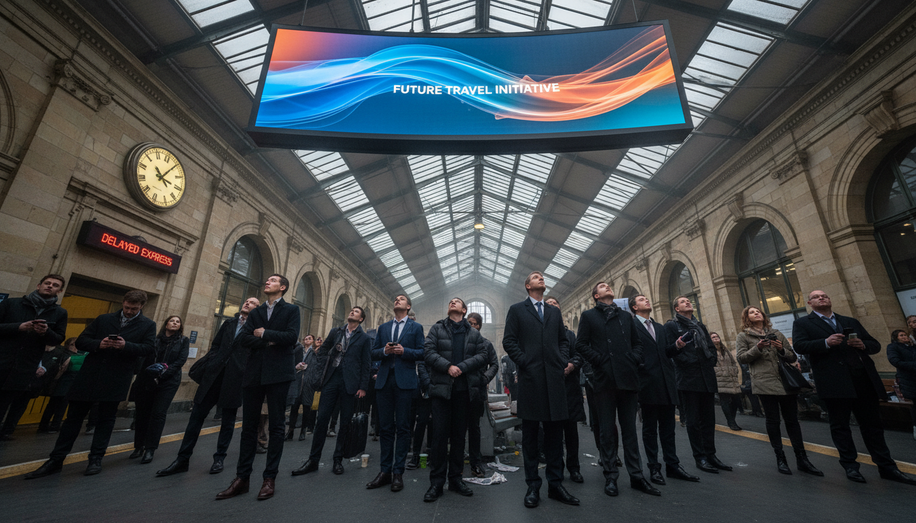

In the bustling departure lounges of airports or the echoing platforms of train stations, out-of-home (OOH) advertising finds its sweet spot. Here, captive audiences linger—trapped by delays, queues, or commutes—offering advertisers rare windows of undivided attention that digital screens rarely match. Dwell time, the duration consumers spend within viewing range of an ad, transforms these enforced pauses into goldmines for brand impact, far surpassing the fleeting scrolls of mobile feeds.
Consider the London Underground, where passengers await trains for minutes on end, their eyes drawn repeatedly to cross-track billboards opposite platforms. These 48-sheet displays command average dwell times of three minutes or more, ideal for unfolding narratives that build familiarity through repetition. Inside carriages, panel ads hold gaze for entire 15- to 30-minute journeys, turning routine rides into immersive brand experiences. Dubai’s Metro mirrors this potency: platform screens at eye level snag two to three minutes of wait-time focus, while carriage panels endure 20- to 30-minute trips, layering messages amid high commuter traffic. Airports amplify the effect further, with travelers parked in gates for stretches that yield minutes-long exposures to digital screens and billboards, unhurried by the rush of urban streets.
These environments—airports, train stations, subway platforms, and even specialized waiting zones like bus shelters or retail queues—excel because they align with human behavior. Pedestrians at shelters dwell five to 15 minutes, factoring in bus spacing and payment routines, while gym treadmills or restaurant tables extend visibility across multiple ad loops. Place-based venues like shopping malls or stadiums prime mindsets: UK data shows 83% of shoppers recall OOH ads seen within 30 minutes of purchase, with 72% swayed toward buying. In retail queues or pedestrian zones, dwell times stretch to support richer content, from storytelling to QR code calls-to-action.
Yet dwell time alone doesn’t guarantee success; savvy campaigns tailor creative to the pause’s length and context. Short-exposure spots, like roadside billboards, demand bold visuals that seize attention in three to five seconds. Longer hauls in transit or waiting areas invite complexity: looping videos, dynamic DOOH triggered by weather or time of day, or interactive elements that encourage scans and shares. Adidas’s DOOH test in Canadian restaurants proved the point—diners with hour-long exposures doubled brand recall over static OOH, deeming ads more relevant amid natural repetition of 30-plus plays per visit. Indoor DOOH shines in retail, outpacing mobile by catching shoppers at decision points, free from phone distractions.
Measurement sharpens the edge. Dwell time, calculated via visibility distance, approach speed, or sensors tracking passersby, informs everything from geo-targeting to content pacing. The formula is straightforward: average dwell time multiplied by daily impressions yields total exposure, guiding ROI-maximizing placements. Agencies blend formats—cross-track static with carriage digital—for frequency and depth, weaving OOH into broader digital ecosystems.
Interactivity elevates dwell further. QR codes in subway panels or AR on airport screens prompt engagement without rush, turning passive viewers into participants. Context matters too: mall ads tap shopping intent, while station campaigns sync with travel frustrations, offering diversions like promotions or entertainment. Even front-door tactics, though niche, extend OOH logic by prompting seconds-long pauses as residents remove hangers, potentially carrying them indoors for prolonged review.
Challenges persist—crowded visuals risk dilution, and variables like passenger loads skew predictions—but data-driven planning mitigates them. OOH’s less-distracted dwell outshines web/mobile brevity, fostering deeper recall in public pauses. As attention fragments online, these captive arenas reclaim it, proving that in dwell-time havens, captivating ads don’t just interrupt; they inhabit the wait.
Brands maximizing this embrace evolution: DOOH’s measurability—impressions, demographics, even store attributions—pairs with analytics for attribution. Forward-thinking campaigns test variations, prioritizing repetition and relevance to convert minutes into loyalty. In an era of shrinking spans, OOH in dwell-rich spots like airports and stations doesn’t chase eyes—it holds them, crafting impressions that endure long after the gate call or train departs.