
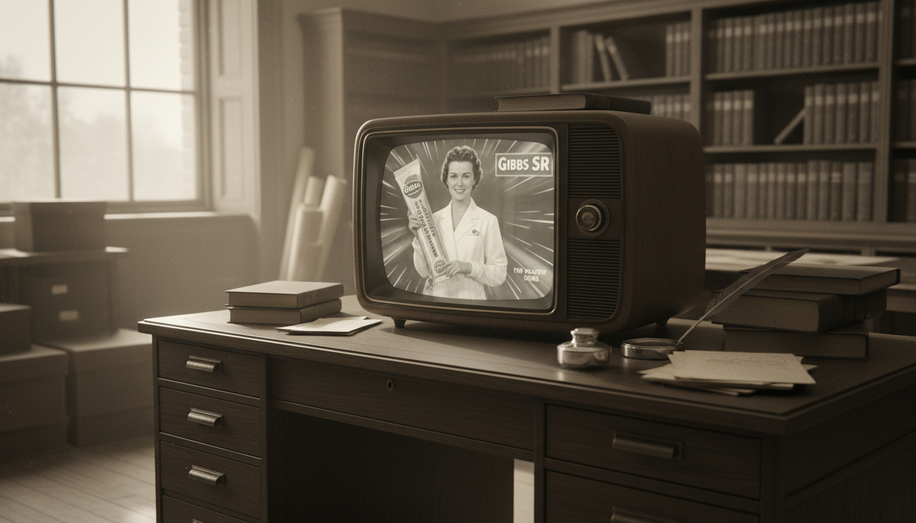

Brian Palmer, who has died aged 96, was a pioneering copywriter and agency founder whose work on Gibbs SR toothpaste announced not only the arrival of commercial television in Britain but a new visual language for modern advertising. When ITV went on air on 22 September 1955, it was Palmer’s 60-second spot – a tube of toothpaste encased in a block of ice, “tingling fresh… fresh as ice” – that opened the era, setting the benchmark for what television could do for brands.
Palmer made his name as a young writer at Young & Rubicam in London, one of the few agencies at the time willing to back the untested medium of commercial TV. While many in British advertising dismissed television as a passing fad, Palmer insisted it would become central to the business and angled his career towards it. His Gibbs SR film, made for Unilever, was drawn “out of a hat” to take the historic first slot on opening night, but nothing about the execution was left to chance: art director Dennis Auton devised the ice-block visual, Palmer wrote the copy, and the pair created a cool, modern aesthetic that contrasted sharply with the staid print and cinema styles of the day.
The spot ran in a break during a Jack Jackson variety show and is still lodged in the industry’s collective memory: the toothpaste frozen in ice, the “plug girl” Meg Smith brushing “up and down and round the gums,” and announcer Alex Macintosh promising that Gibbs SR “does your gums good, too.” It was a distillation of Palmer’s lifelong belief in a “strong, visual click” – a single, simple mnemonic image that locked the brand into viewers’ minds. He would later point to Gibbs’s ice block, the gun-toting girl for Regent and the ubiquitous horse in his whisky work as proof that big ideas begin with a clear picture.
Born Brian Dudley Buller Palmer in 1929, he showed early promise as a poet and painter and even won a British Travel Association poster competition while still at school. After National Service, a chance bus conversation led him to meet the novelist and advertising writer Nigel Balchin, who suggested a career in the agencies. Palmer joined CF Higham as a trainee on £4 a week, moved to Young & Rubicam in 1952, and rose quickly as television’s importance grew; he became head of television at the agency as the medium shifted from experiment to engine room.
If Gibbs SR made Palmer’s name, his greatest institutional legacy came a decade later with the formation of Kingsley, Manton & Palmer (KMP), founded with Tony Kingsley and Brian Manton. In an era when British shops were still dominated by clubby, hierarchical agencies, KMP positioned itself as a creative, client-facing challenger. Palmer argued that clients should meet the people doing the work, not be buffered by layers of account men, and he helped design one of the country’s first open-plan agency environments to break down internal barriers.
KMP quickly established itself as one of the most innovative shops of the 1960s and early 1970s. In 1965 it became the first British agency to open in New York, a bold move for a London independent. The following year Palmer spearheaded a campaign that would become a classic of long-running brand storytelling: White Horse whisky’s “You can take a White Horse anywhere.” The combination of a flexible line and a simple, surreal visual device – a white horse turning up in improbable places – gave the brand years of distinctive, exportable work and reinforced Palmer’s conviction that visual mnemonics trumped elaborate copy.
Under his influence, KMP also anticipated the coming wave of filmic British commercials by championing directors and insisting that 30 seconds could carry a fully formed narrative. The generation of Ridley Scott, Alan Parker, Adrian Lyne and Hugh Hudson, who cut their teeth in commercials, worked within the visual discipline Palmer had argued for since Gibbs SR. He was never a household name, but inside the business he became a quietly influential figure – the kind of senior creative who changed the trajectory of younger talent with a single conversation.
By the early 1970s Palmer began easing away from day‑to‑day agency life. From 1973 he scaled back his involvement with KMP and joined Young’s Brewery as a director of the new wines and spirits division, taking his brand instincts client-side. In 1979 he was headhunted to run the London office of Doyle Dane Bernbach, then one of the world’s most admired creative agencies, which he quickly returned to profitability. Four years later he founded New Solutions, a strategic marketing and research consultancy that extended his influence beyond advertising executions into commercial planning and insight.
For an industry that trades on its own history yet often forgets its architects, Palmer’s death in December 2025 passed with surprisingly little fanfare in some quarters. That omission sits oddly with the scale of his contribution: the first British TV commercial, a breakthrough independent agency, a global whisky platform and a set of principles – visual clarity, creative accountability, respect for audiences – that still feel current in an age of fragmented screens and data dashboards.
In conversations late in life, Palmer returned frequently to that block of ice, not out of nostalgia but as a lesson in how to approach any new medium. When the industry did not yet “understand television,” he and a small group of believers at Young & Rubicam treated it not as an awkward bolt‑on to old habits but as a canvas for new kinds of storytelling. In today’s out-of-home and connected environments, where screens proliferate and attention is fleeting, his insistence on a single, sharp, memorable image may be the most enduring tribute: a reminder that whatever the technology, the job is still to make one moment that sticks.