
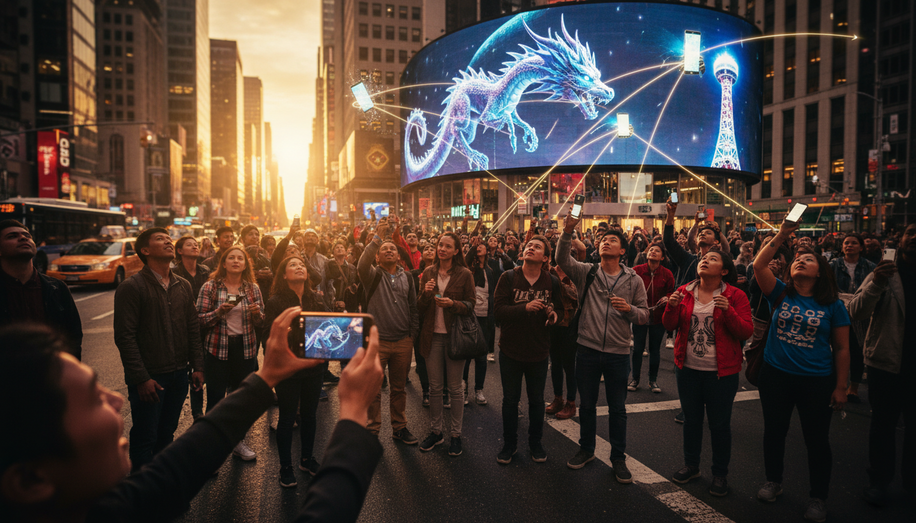

In the bustling heart of a city, a static billboard springs to life as a pedestrian scans a QR code with their smartphone. Suddenly, a virtual desert landscape unfurls across the Manhattan sidewalk, complete with shifting sands and a treadmill that syncs with the runner’s pace, transforming an urban ad into a pulse-pounding brand adventure. This is the new frontier of out-of-home (OOH) advertising, where augmented reality (AR) is shattering the barriers between physical spaces and digital immersion, turning passive glances into unforgettable interactions.
AR’s integration into OOH has evolved rapidly, fueled by affordable digital signage and web-based platforms that require no app downloads. Billboards, bus shelters, and kiosks now serve as portals to layered realities, overlaying 3D animations, gamified challenges, and personalized content onto the real world. In 2026, as smart city infrastructure proliferates, these experiences leverage IoT-connected screens and real-time data for hyper-local relevance—ads that adapt to weather, crowds, or events, ensuring messages hit with precision. The result? Campaigns that don’t just capture eyes but command engagement, fostering emotional bonds through interactivity that static media could never achieve.
Consider Burger King’s audacious “Burn that Ad” stunt in Brazil, where rivals’ billboards became virtual infernos. Users pointed their phone cameras at competitors’ posters, igniting them in AR flames via the BK app, revealing a Whopper coupon in the ashes. This subversive tactic not only hijacked enemy territory but drove app downloads and redemptions, proving AR’s power to turn competition into consumer delight. Similarly, Pepsi Max’s 2015 “Unbelievable” bus shelter in New York became a viral sensation, with hidden cameras feeding live street feeds into screens showing meteors crashing, robots rampaging, and tentacles emerging from the pavement—pure spectacle that blurred reality and illusion, racking up millions of views online.
Gamification takes this further, embedding play into public spaces. Ally Bank’s Monopoly-themed treasure hunt scattered 36 AR-enabled board squares across six U.S. cities. Scanning unlocked web AR experiences with Mr. Monopoly doling out points and cash prizes, blending financial literacy with fun and boosting brand affinity through shared excitement. In the Netherlands, PLUS supermarkets turned an entire town into a live Monopoly game, where residents bid on real streets via interactive OOH elements, sparking community buzz and foot traffic. These campaigns illustrate AR’s knack for participatory storytelling, where consumers aren’t viewers but players, extending the ad’s life through social shares.
Immersive stunts amplify the drama. HOKA’s Mafate X sneaker launch blanketed a Manhattan block in simulated desert conditions—sand, wind, rocks—capped by an Unreal Engine-powered treadmill that morphed landscapes in real-time to match runners’ rhythms. At AT&T Stadium, Dallas Cowboys fans posed with AR overlays of star players on interactive kiosks, snapping shareable photos that amplified reach exponentially. Red Bull brought cliff-diving thrills to bus stops worldwide; a QR scan plunged users into a 70-foot virtual dive, capturing the adrenaline of live events for those who couldn’t attend.
Even retail and lifestyle brands are cashing in. BON V!V Spiked Seltzer’s Los Angeles murals summoned tappable 3D vending machines via web AR, letting passersby “shop” virtual cans right on the street. Kinder’s African safari portals at in-store OOH spots unleashed animated animals with fun facts, delighting families and spiking engagement without apps. And for horror fans, promotions like The Walking Dead’s zombie-infested tram stops in Vienna used live video compositing to make the undead lurch from screens, creating viral terror that award judges couldn’t ignore.
By 2026, AR-OOH isn’t niche—it’s standard, with touch kiosks, motion-sensing displays, and 3D anamorphics paving the way for deeper integration. GMC’s early face-analysis billboards, which tailored 30 video variants by age and gender using AI, hinted at this future; today, it’s scaled with ethical data practices. Challenges remain, from tech accessibility to privacy concerns, but the metrics speak volumes: Pizza Hut’s AR Pac-Man pizza boxes generated 741 million impressions and 10.6 million sales.
Ultimately, AR redefines OOH as a bridge-builder, merging the tangible cityscape with boundless digital possibility. It turns fleeting encounters into lasting memories, urging brands to think beyond screens—not replacing the physical world, but enriching it. As urban spaces digitize, the most compelling campaigns will be those that invite us to play, explore, and connect in ways once confined to imagination.