
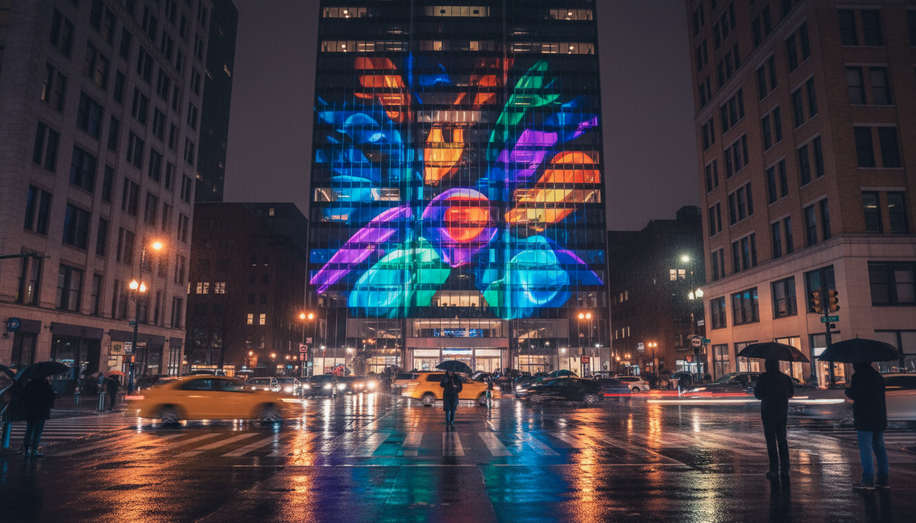

The advertising landscape has undergone a seismic shift. While billboards once dominated the out-of-home space as the default medium for mass exposure, brands are increasingly discovering that the most memorable campaigns transcend traditional formats entirely. In an era saturated with static signage, the most innovative marketers are embracing unconventional approaches that transform ordinary environments into extraordinary brand experiences.
Projection mapping stands at the forefront of this revolution. Rather than confining creative to flat surfaces, this spatial augmented reality technology allows brands to turn architectural elements, sculptures, and objects of any shape into dynamic digital canvases. By using specialized software to spatially map projections onto three-dimensional surfaces, advertisers can create immersive narratives that seem to defy reality. A building’s façade becomes an animated storytelling device. A landmark transforms into a glowing work of art. The technology combines edge blending and warping techniques to ensure seamless image alignment, whether content is projected onto a skyscraper or an unconventional structure. The result is a campaign that stops pedestrians in their tracks, generates organic social media engagement, and creates genuine moments of wonder in urban environments.
Building wraps represent another compelling evolution of ambient media. Unlike their billboard cousins, these expansive installations can cover entire façades, creating an inescapable visual presence that permeates the streetscape. When executed thoughtfully, a building wrap doesn’t feel like advertising forced onto a structure—it becomes part of the architectural identity itself, seamlessly blending brand messaging into the urban fabric.
Pop-up installations and experiential activations offer yet another pathway to cutting through the clutter. These temporary, location-specific environments invite audiences into immersive brand worlds rather than simply exposing them to messages. Whether a gamified retail experience, an interactive art installation, or a multisensory environment that evolves in real time, pop-ups create the kind of memorable moments that traditional advertising rarely achieves. They generate conversation, encourage social sharing, and foster genuine emotional connections between consumers and brands.
Laser projections expand the possibilities even further. These systems enable brands to reach high-traffic areas and hard-to-access locations throughout a market, transforming walls and building surfaces with precision-engineered light. Unlike traditional projections, laser technology can reach greater distances with enhanced clarity, making it particularly effective for activations in dense urban environments where conventional projectors might lack sufficient throw distance.
Anamorphic and forced perspective billboards represent a hybrid approach, creating optical illusions that make flat images appear to extend into three-dimensional space. These techniques blur the line between traditional and innovative formats, capturing attention through visual trickery that engages the viewer’s perception in unexpected ways.
The common thread connecting these unconventional formats is intentionality. The most successful ambient media campaigns go beyond novelty. They’re grounded in precise engineering, thoughtful content design, and strategic placement that aligns with audience flow and environmental context. A projection mapping activation tailored to a music festival differs fundamentally from one designed for corporate environments—both in execution and in the creative sensibilities that drive them.
What makes these formats particularly powerful is their capacity to tell stories dynamically. Traditional billboards deliver static messages to passive observers. Projection mapping, experiential installations, and ambient media can respond to their audiences, evolve in real time, and integrate audio-visual narratives that create multisensory brand experiences. In retail environments, museums, sporting events, and city centers worldwide, brands are discovering that people don’t just consume these experiences—they participate in them, remember them, and share them.
As the experience economy continues to accelerate, the brands that will dominate the out-of-home space won’t be those with the biggest budgets for traditional media buys. They’ll be the ones willing to reimagine what public space advertising can be—transforming everyday environments into unexpected moments of connection and leaving lasting impressions that standard billboards simply cannot achieve.