
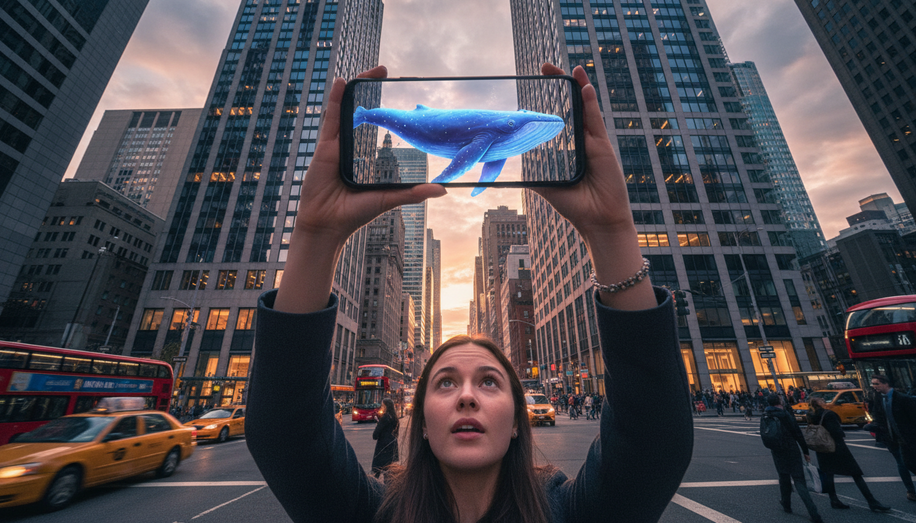

In the bustling streets of Miami’s Midtown, where skyscrapers pierce the skyline, a vibrant mural caught the eye of Art Basel attendees in 2024. Passersby who scanned it with their smartphones watched as the static artwork burst into life: lights flickered across towering buildings, vehicles zipped through digital streets, and Verizon’s messaging about connectivity materialized in three-dimensional splendor. This was no ordinary street art; it was augmented reality (AR) transforming out-of-home (OOH) advertising into an immersive portal that blurred the line between physical space and digital wonder.
Verizon’s collaboration with BrandXR exemplified AR’s power to elevate OOH from passive observation to active engagement. Three murals—strategically placed in Midtown, Coconut Grove, and Hialeah—each tailored to local vibes. In lush Coconut Grove, digital vines crept over neon circuit boards, symbolizing nature’s harmony with technology. Hialeah’s culturally rich design featured portraits of residents morphing into futuristic 3D scenes, emphasizing human connections powered by robust networks. Powered by Snapchat’s WebAR, these experiences required no app download, just a phone camera, making them instantly accessible. The result? Social media exploded with user-generated videos, amplifying Verizon’s reach amid the global art event’s crowds.
Such campaigns highlight AR’s core strength: turning static billboards, murals, and bus shelters into dynamic storytelling devices. Traditional OOH relies on bold visuals to grab fleeting attention, but AR invites participation. A pedestrian views a billboard through their smartphone and suddenly tries on virtual clothes, plays an interactive game, or steps into a brand’s universe. This interactivity fosters deeper consumer experiences, as seen in Electrifly Detroit’s 2024 festival, where 15 murals across metro Detroit sprang alive via the Electrifly app. Paintings animated with stories, audio narratives, and explorable 3D elements, all enabled by BrandXR’s platform. Thousands engaged without technical hurdles, proving AR’s scalability for public art and advertising alike.
Pepsi Max’s 2015 “Unbelievable” bus shelter in London remains a benchmark for AR’s viral potential. Hidden cameras captured live street feeds, overlaying illusions of asteroids crashing, UFOs hovering, and tentacles emerging from sidewalks. Onlookers’ stunned reactions fueled a YouTube video that amassed over six million views, cementing the campaign’s status as a social media sensation. Similarly, Vodafone has deployed AR murals and billboards that surprise with 3D graphics, mini-games, and tech promotions emerging from seemingly flat surfaces. These “unexpected discoveries” spark conversations and shares, extending OOH’s lifespan beyond initial exposure.
Red Bull harnessed AR for its 2023 World Series Cliff Diving promotion, using 8th Wall’s WebAR to let users scan a QR code and witness a 70-foot dive’s scale from their phones. This brought extreme sports’ thrill to urban dwellers unable to attend live events, forging emotional bonds through breathtaking immersion. Cadbury’s 2014 takeover of London’s Waterloo Station featured a massive 120-square-meter digital screen where passengers played AR games, interacting directly with motion-tracked elements. National Geographic’s 2013 Rotterdam campaign let commuters “step into” dinosaur eras or spacewalks via train station screens, celebrating the brand’s exploratory spirit.
These examples underscore AR’s versatility across OOH formats—from murals and billboards to digital screens and bus stops. Platforms like BrandXR and Rock Paper Reality democratize creation, allowing artists and brands to layer animations, analytics, and calls-to-action without heavy infrastructure. Real-time data tracks scans, dwell time, and interactions, enabling optimizations mid-campaign. Embedded promotions, like unlockable coupons, drive foot traffic to stores, blending engagement with conversions.
Beyond metrics, AR builds emotional connections. The UK’s NHS campaign let users virtually donate blood via OOH posters, visualizing its life-saving impact for instant feedback and positive associations. BON V!V Spiked Seltzer’s WebAR retail experiences across Los Angeles turned everyday posters into interactive brand worlds, enhancing memorability. By personalizing content with geolocation—tailoring messages to local interests—AR makes ads feel bespoke, not intrusive.
Social amplification turbocharges these efforts. AR’s shareable nature floods Instagram and TikTok with street-level spectacles, contests, and rewards, multiplying visibility exponentially. Pepsi’s bus shelter prank went viral organically, while Verizon’s murals rode Art Basel’s influencer wave. This fusion of OOH and social media creates a feedback loop: physical encounters generate digital buzz, drawing more eyes to real-world ads.
Yet AR’s true revolution lies in longevity and adaptability. Unlike fading posters, AR content updates seamlessly—adding seasonal twists or new narratives to sustain interest. As digital out-of-home (DOOH) screens proliferate, spatial computing turns any urban surface into an AR canvas. Challenges remain, like ensuring broad accessibility amid varying smartphone capabilities, but WebAR’s no-download model mitigates this.
In 2026, with AR platforms maturing, OOH advertisers wield unprecedented tools to captivate. Verizon’s murals, Pepsi’s pranks, and Red Bull’s dives prove AR doesn’t just enhance visibility; it crafts unforgettable encounters that linger in consumers’ minds and feeds. Urban landscapes, once mere backdrops for brands, now pulse with interactive potential, redefining engagement one scan at a time. As technology evolves, expect AR to anchor OOH’s next era, where every billboard beckons not just to look, but to leap in.
As AR redefines OOH engagement, the need for precise measurement and strategic optimization becomes more critical than ever to capitalize on its dynamic potential. Blindspot equips advertisers with real-time campaign performance tracking and robust ROI measurement, offering unparalleled insights into AR interactions like scans and dwell time, directly linking engagement to conversions. Furthermore, its location intelligence and audience analytics ensure these interactive experiences are strategically placed and tailored for maximum impact across urban canvases. Learn more at https://seeblindspot.com/