
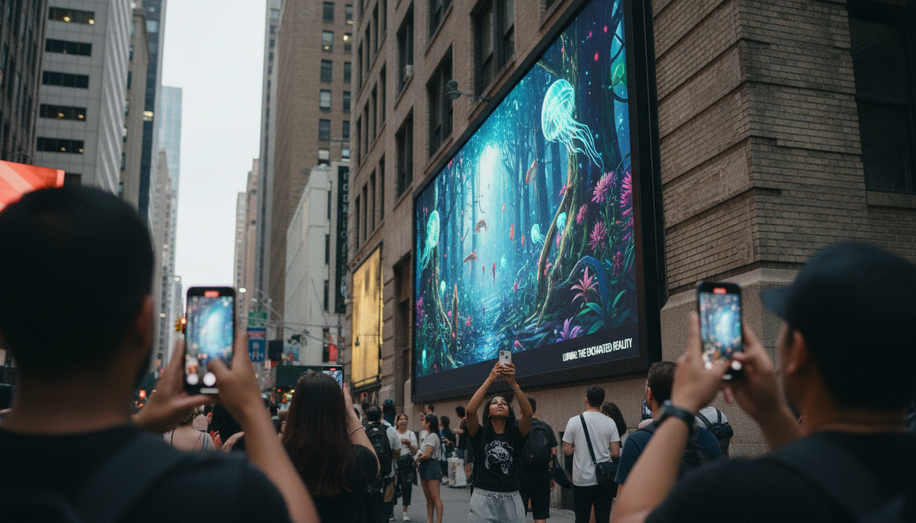

In the bustling streets of modern cities, where static billboards once competed for fleeting glances, augmented reality is rewriting the rules of out-of-home advertising. By overlaying digital layers onto physical spaces via smartphones, AR transforms ordinary posters, bus shelters, and digital screens into portals of immersive interaction, blurring the line between the tangible world and virtual possibilities. This fusion not only captures attention in an era of sensory overload but also fosters deeper emotional connections, turning passive viewers into active participants.
Traditional OOH has long relied on bold visuals and clever copy to stand out amid urban noise, but AR elevates it by inviting direct engagement. A simple QR code scan launches experiences right in a user’s mobile browser, often without app downloads, making accessibility seamless. Digital signs, increasingly replacing static billboards, amplify this potential through spatial computing, where any urban surface becomes a dynamic canvas. The result? Extended dwell times, higher brand recall, and measurable analytics on user interactions, all while bridging the physical ad with digital virality on social media.
Consider Burger King’s audacious “Burn That Ad” campaign in Brazil, which weaponized AR against competitors. Passersby pointed their phones at rival fast-food billboards—like those of McDonald’s—and watched them erupt in flames via the Burger King app, revealing a Whopper coupon in their place. The stunt drove one million app downloads in a month and boosted in-app sales by 56.4 percent, proving AR’s power to hijack attention and convert it into action. Similarly, Vodafone has pioneered AR billboards and murals that surprise audiences with immersive visuals, setting new benchmarks for real-time engagement in public spaces.
Healthcare and social causes demonstrate AR’s versatility beyond commerce. The UK’s NHS Blood and Transplant deployed billboards in Birmingham and London, where scanners overlaid a virtual needle on users’ arms, simulating blood donation to an ailing patient on the ad. As the virtual bag filled, the patient visibly improved, creating an emotional bond that spurred real donations. This instant feedback loop exemplifies how AR crafts memorable, positive associations, far surpassing traditional messaging.
Alcohol brands have leaned into AR for retail seduction. Jackson Family Wines’ Siduri campaign brought founder Adam Lee to life as a photorealistic hologram via WebAR on in-store billboards and bottles. Scanning a QR code unleashed playful storytelling about the Pinot Noir’s origins, drawing eyes to shelves and enticing distributors. BON V!V Spiked Seltzer took a similar tack in Los Angeles and San Diego, where mural scans summoned a virtual vending machine. Users tapped to dispense 3D-animated flavors, then navigated to stores or bought online, blending discovery with seamless commerce.
Even gaming icons like Monopoly have entered the fray through Ally Bank’s treasure hunt across six U.S. cities. Thirty-six physical board squares triggered WebAR experiences of Mr. Monopoly doling out points and prizes, yielding 100,000 plays and 86 percent completion rates while subtly promoting financial literacy. Coca-Cola Zero’s 2023 “TakeATasteNow” pushed interactivity further: billboards let users rotate virtual bottles and tweak backgrounds in real time, merging novelty with brand intimacy.
Beauty giant Maybelline pushed boundaries with the world’s largest AR mirror at Kyiv’s Gulliver Mall, spanning 4,000 square meters. Shoppers virtually tried mascara on live video feeds from ad screens, personalizing the pitch in ways static imagery never could. Kinder’s in-store safari portals animated 3D animals with fun facts, captivating families app-free and spiking product engagement.
These campaigns underscore AR’s economic momentum; by 2023, the industry had ballooned to a projected $160 billion market, fueled by brands chasing immersive edges. Yet success hinges on execution: WebAR minimizes friction, emotional resonance builds loyalty, and calls-to-action drive foot traffic or e-commerce. Challenges remain, like ensuring broad smartphone compatibility and measuring true ROI amid viral hype, but the trajectory is clear.
As cities digitize, AR OOH isn’t just enhancing traditional formats—it’s redefining them. Billboards evolve from monologues to dialogues, physical divides dissolve into shared digital realms, and brands that master this bridge will dominate the next wave of public persuasion. The era of glance-and-go advertising is fading; in its place rises a landscape where every scan sparks a story.